Security: Threats & Defense · Study deck
Advanced Security Concepts
Picture a field device that claims to prove its software state before sending readings.
Shield Shelly is your guide for this deck.

After studying this chapter
Learning objectives
You will be able to:
- identify when a standard control is insufficient and an advanced mitigation is needed
- Explain: The label sounds strong, but the service still needs to know what was measured, who checked it, how old the proof is, and what happens when the proof fails.
- Explain: The service should refuse or restrict the unsafe case, keep a clear reason, and preserve a recovery path that does not silently widen trust.
- Explain: If a concept cannot fill in those three, it is decoration, not security.
Major section
In 60 Seconds
The label sounds strong, but the service still needs to know what was measured, who checked it, how old the proof is, and what happens when the proof fails.
- Telemetry means readings and status sent by that device.
- This single claim does not prove the whole device is secure.
- For everyday IoT work, that habit keeps advanced controls honest.
Major section
In 60 Seconds (continued)
The service should refuse or restrict the unsafe case, keep a clear reason, and preserve a recovery path that does not silently widen trust.
- The deeper sections show how measured state, isolated execution, key change, automated detection, response plans, limits, and expiry make advanced controls reviewable.
- Advanced security is not about adding impressive labels to an IoT design.
- If any part is missing, the concept is still useful, but the claim is not complete yet.
Major section
Stronger Claims Need Stronger Evidence
If a concept cannot fill in those three, it is decoration, not security.
- Advanced security is not a collection of impressive words.
- If you only need the intuition, this layer is enough: "the device uses attestation" is not a claim.
- That statement gives a reviewer something concrete to test.
Major section
Stronger Claims Need Stronger Evidence (continued)
For example, a smart-building gateway may combine secure boot, TPM-backed attestation, signed updates, and network isolation.
- The unifying habit for this whole chapter is a small loop: every advanced concept must produce a claim (what should be true), evidence (why it should be accepted), and limits (what the evidence does not prove).
- Naming the limit is part of the claim.
- Beginner ExamplesTaken together, these checks make the section reviewable.
Major section
Stronger Claims Need Stronger Evidence (continued)
If you can turn a concept into a claim with evidence and a limit, you have the core idea.
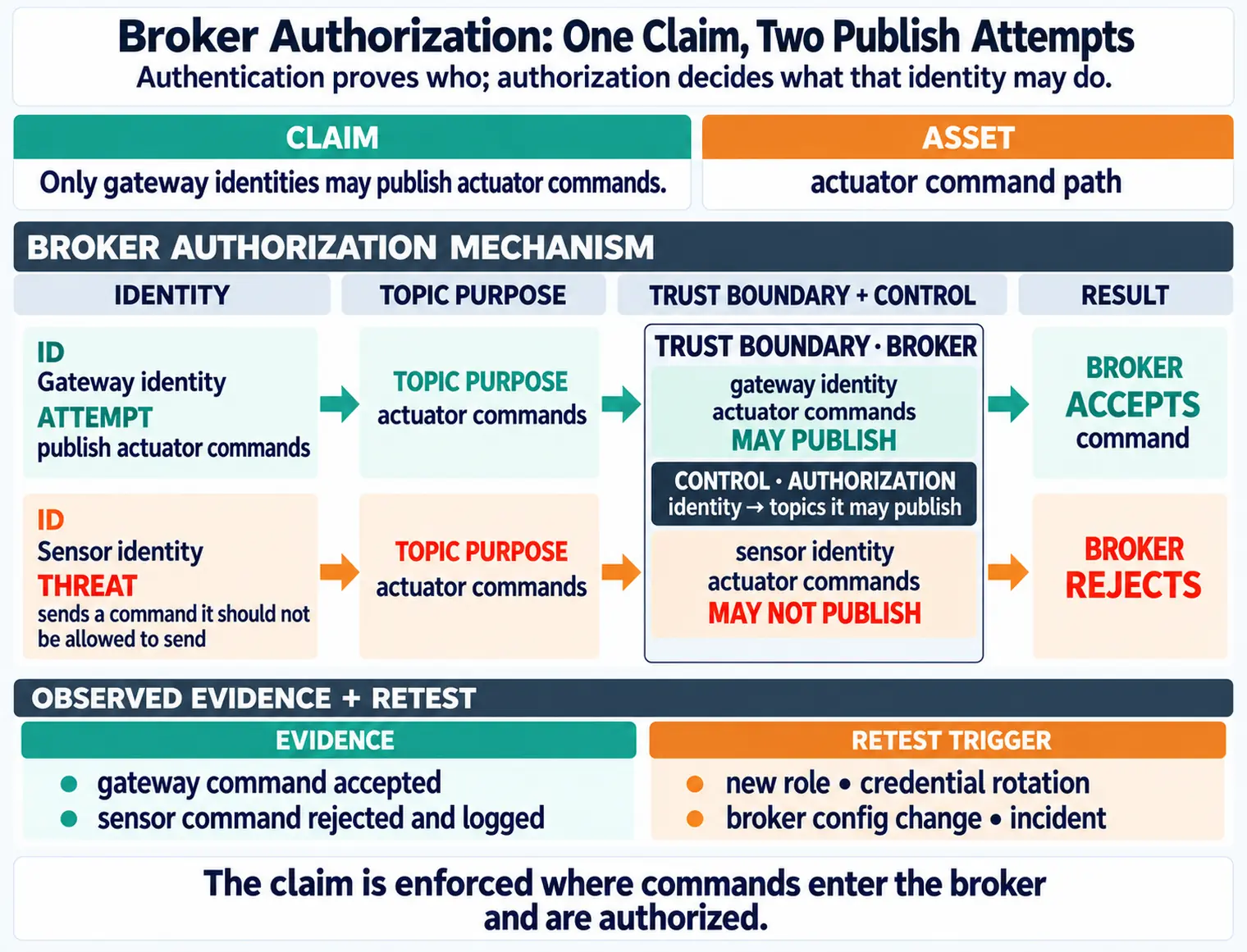
- A claim says what state is measured, who verifies it, what result is accepted, what happens on failure, and when the evidence expires.
- Think of a car advertised as "5-star safety rated." The badge is reassuring, but an engineer wants the crash-test data: which impacts were tested, at what speeds, and what the test did not cover.
- That order prevents a control name from being treated as proof and connects the visual to the chapter's evidence-led review sequence.
Major section
Practitioner: Review Advanced Controls as Claims
Worked Review RecordA gateway uses secure boot, attestation, isolated key storage, and automatic isolation when attestation fails.
- The aim is a modest, defensible record, not an impressive label.
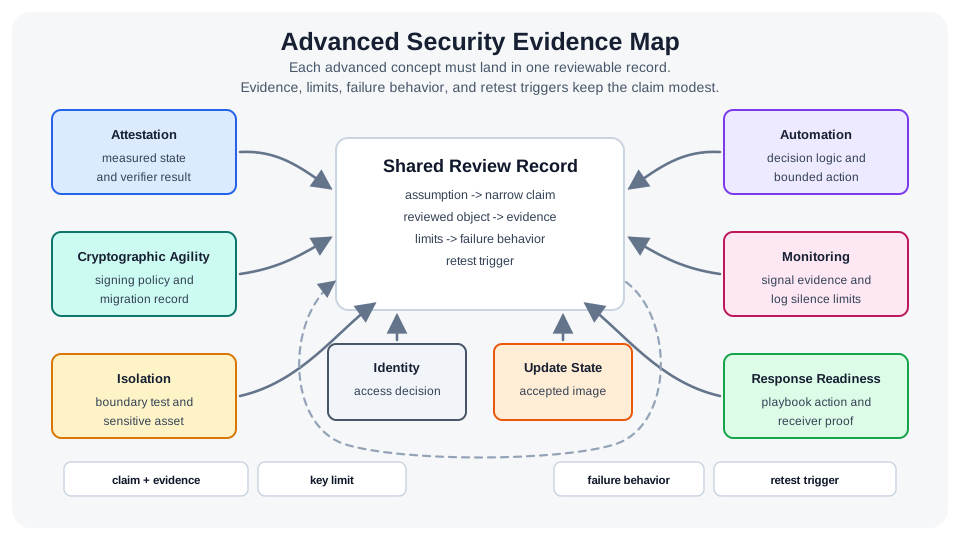
- Per-Concept Evidence and Its Key LimitConcept.
- Proves state matched, not that code is defect-free.
- Agility is not strength of any one algorithm.
Major section
Practitioner: Review Advanced Controls as Claims (continued)
Evidence gapsNo record shows how algorithm or signing-policy changes are tested; the key-use isolation boundary is described but not tested; the response record does not say when automatic denial requires human review.
- Protected asset, allowed callers, boundary tests.
- A privileged bypass can defeat the boundary.
- Behavior when the boundary check fails.
Major section
Practitioner: Review Advanced Controls as Claims (continued)
A detector can be wrong in both directions.
- Automation must stay accountable and reversible.
- When to require review before or after action.
- ConclusionAccept the scoped claim about telemetry access after accepted attestation.
- If you can review each control as a claim with evidence, limits, and failure behavior, you can use advanced concepts responsibly.
Major section
Under the Hood: Mechanisms and Their Dependencies
Choices can be rotated and retired ones refused.
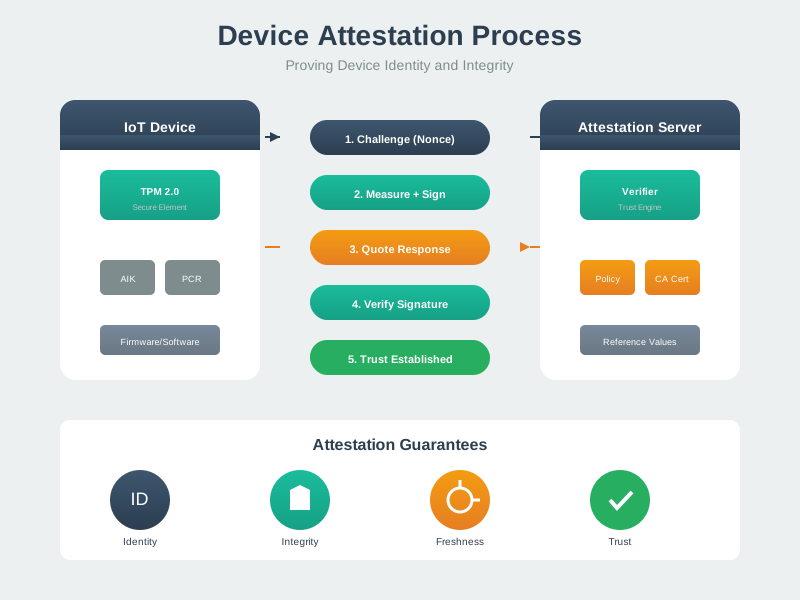
- Second, the difference from secure boot: secure boot enforces by refusing to run unverified code, while attestation reports a measurement for a verifier to judge.
- A measurement without a verifier that acts on it is just a number.
- App faults cannot reach the protected asset.
Major section
Under the Hood: Mechanisms and Their Dependencies (continued)
And even a passing attestation proves only that the observed state matched an accepted reference at measurement time; it does not prove the running code is free of defects.
- Agility is the property that lets a system change algorithms, key sizes, certificate profiles, or signing policies without a redesign.
- A trusted execution environment is one way to provide that separation.
- The Dependency TrapThe advanced risk that beginners miss is interdependence.
Major section
Under the Hood: Mechanisms and Their Dependencies (continued)
Mechanically it needs version or policy negotiation, an overlap window where old and new choices both validate during migration, and explicit refusal of retired choices afterward.
- Agility is not the same as strength: a system can be agile and still run a weak algorithm, or strong today but unable to migrate tomorrow.
- Isolation and Trusted Execution: Mind the BypassIsolation separates security-sensitive work, such as key use, measurement, and command authorization, from general application code, so that an ordinary software fault cannot reach the protected asset.
- An automated action that denies, isolates, revokes, or rolls back can itself cause an outage.
Major section
Under the Hood: Mechanisms and Their Dependencies (continued)
If these controls share one anchor, one key, or one assumption, then defeating that single thing defeats the whole advanced stack at once.
- The review must describe the boundary by its allowed interactions: which callers may enter, what data crosses, and what is refused.
- Shared memory and message calls are expected, but they are the reviewed doorway, not a free bridge.
- Common PitfallsTaken together, these checks make the section reviewable.
Deck summary
Key takeaways
The label sounds strong, but the service still needs to know what was measured, who checked it, how old the proof is, and what happens when the proof fails.
- The service should refuse or restrict the unsafe case, keep a clear reason, and preserve a recovery path that does not silently widen trust.
- If a concept cannot fill in those three, it is decoration, not security.
- For example, a smart-building gateway may combine secure boot, TPM-backed attestation, signed updates, and network isolation.
- If you can turn a concept into a claim with evidence and a limit, you have the core idea.
Retrieval practice
Recall check 1 of 3
Shield Shelly says: answer from memory, then check your reasoning.
Q1A design document says a gateway uses attestation, but it does not state what is measured or what happens when attestation fails. What is the most evidence-bound conclusion?
Show answer
Answer: D Attestation is reviewable only when the record shows what is measured, who verifies it, what result is accepted, and what happens when the result fails.
Retrieval practice
Recall check 2 of 3
Shield Shelly says: answer from memory, then check your reasoning.
Q2A team proposes automatically isolating any device whose attestation fails, with no human checkpoint. What is the strongest review concern to raise?
Show answer
Answer: B Automated response should be accountable and reversible.
Retrieval practice
Recall check 3 of 3
Shield Shelly says: answer from memory, then check your reasoning.
Q3Why can an attestation result be trustworthy only if the controls beneath it are sound?
Show answer
Answer: A Attestation reports a measurement signed by a hardware-backed key anchored in the root of trust.
Print reference
Answers
Answer key.
- D · Attestation is reviewable only when the record shows what is measured, who verifies it, what result is accepted, and what happens when the result fails.
- B · Automated response should be accountable and reversible.
- A · Attestation reports a measurement signed by a hardware-backed key anchored in the root of trust.