Security: Threats & Defense · Study deck
Secure Data in IoT Protocols
A smart lock can send encrypted messages while still accepting a replayed old secure command or exposing a secure key to the wrong service.
Shield Shelly is your guide for this deck.

After studying this chapter
Learning objectives
You will be able to:
- review one data flow at a time instead of trusting a protocol name as a security claim
- compare what MQTT (broker model) and CoAP (request-response over UDP) each require for security
- distinguish authentication from authorization precisely at a gateway boundary
- check replay protection, freshness, and gateway trust rather than encryption alone
Major section
Follow Protection From Sensor Record to Consumer
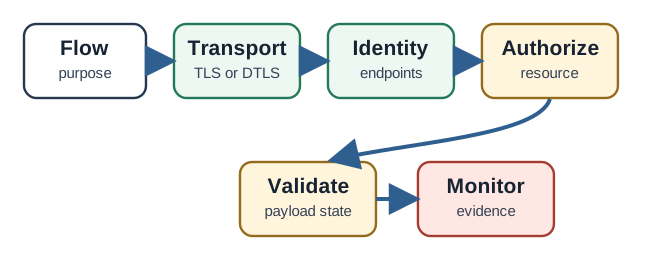
A TLS session to a gateway may protect radio or IP transit while the gateway can still read and transform the payload.
- A secure-data record is incomplete if it only proves that an allowed secure protocol message arrived.
- Telemetry needs related but different treatment.
- The system should preserve observation time and reject altered units.
Major section
Follow Protection From Sensor Record to Consumer (continued)
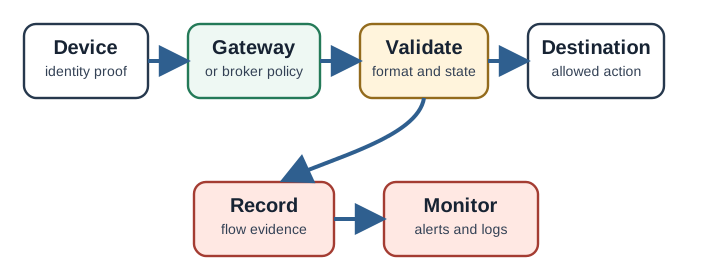
If cmd-884 is captured and replayed after acceptance, the stable identifier or nonce state should reject a second unlock.
- At rest, encrypt sensitive stores, limit retention, and keep keys separate from exported secure data where possible.
- Secure key lifecycle is part of the protocol design.
- Failure must be secure and observable.
Major section
Follow Protection From Sensor Record to Consumer (continued)
An expired certificate should not make the device accept any certificate, switch to plaintext, or ignore time without a bounded recovery rule.
- A fleet-wide shared secret makes one extracted secure key a fleet boundary failure.
- Logs should identify credential versions without printing secret material.
- Include clock behavior in secure-message tests.
Major section
Follow Protection From Sensor Record to Consumer (continued)
A chain of individually encrypted links can still have one highly trusted middle system.
- A locked-out fleet is also harmful, so test credential renewal before expiry, clock loss, partial rollout, and rollback.
- Retain identifiers, decisions, versions, and error categories needed for investigation, but do not copy keys, authorization headers, or complete sensitive payloads.
- Freshness based on time can fail when a device reboots without a trusted clock.
Major section
Start With the Story: The Lock Was Real, but the Rule Was Missing
The lock symbol appears, but the same identity can also send a shutdown command.
- Protected travel did not prove that the sender had the right permission.
- Telemetry means readings and status sent by a remote device.
- A protocol is an agreed set of message and timing rules.
Major section
Start With the Story: The Lock Was Real, but the Rule Was Missing (continued)
A payload is the useful data inside a message.
- Message Queuing Telemetry Transport (MQTT) carries named messages through a service.
- Transport layer security is protection for data moving across a network.
- Transport Layer Security (TLS) protects a connected path.
- Datagram Transport Layer Security (DTLS) protects message-based paths.
Major section
Start With the Story: The Lock Was Real, but the Rule Was Missing (continued)
None of these names alone states who may read, send, or change a resource.
- This exercise cannot prove every product rule or secret-handling step.
- A temperature sensor publishes through an encrypted MQTT connection.
- The dashboard shows the padlock, so the team assumes the flow is safe.
Major section
Start With the Story: The Lock Was Real, but the Rule Was Missing (continued)
During review, the same credential can publish to a command topic and subscribe to other devices' readings.
- The channel was protected, but the rule that limits what that identity may do was missing.
- This chapter uses that small mistake as the starting point.
- TLS or DTLS protects the path, but identity, authorization, validation, and monitoring turn the protocol into a defensible IoT control.
Deck summary
Key takeaways
A TLS session to a gateway may protect radio or IP transit while the gateway can still read and transform the payload.
- If cmd-884 is captured and replayed after acceptance, the stable identifier or nonce state should reject a second unlock.
- An expired certificate should not make the device accept any certificate, switch to plaintext, or ignore time without a bounded recovery rule.
- A chain of individually encrypted links can still have one highly trusted middle system.
- The lock symbol appears, but the same identity can also send a shutdown command.
Retrieval practice
Recall check 1 of 3

Shield Shelly says: answer from memory, then check your reasoning.
Q1An MQTT broker requires encrypted connections, yet every connected device can subscribe to every topic. Which layer is missing?
Show answer
Answer: A Encryption protects the channel and authentication identifies the client, but authorization decides what each identity may access.
Retrieval practice
Recall check 2 of 3

Shield Shelly says: answer from memory, then check your reasoning.
Q2An MQTT broker requires TLS client certificates, so every device is strongly authenticated, but there is no per-identity topic policy. What is the most accurate review conclusion?
Show answer
Answer: A Client certificates prove identity over a protected channel; they do not constrain which topics each identity may use.
Retrieval practice
Recall check 3 of 3

Shield Shelly says: answer from memory, then check your reasoning.
Q3A constrained device opens a DTLS connection to a gateway but does not validate the gateway's certificate or key. What is the most accurate description of the protection?
Show answer
Answer: B Encryption without verifying the peer leaves a middle-person attack open.
Print reference
Answers
Answer key.
- A · Encryption protects the channel and authentication identifies the client, but authorization decides what each identity may access.
- A · Client certificates prove identity over a protected channel; they do not constrain which topics each identity may use.
- B · Encryption without verifying the peer leaves a middle-person attack open.