Cloud, SDN & Production Architectures · Study deck

SDN Controllers: Rule Strategies

Known sensor paths need rules before traffic starts.

Cloud Clara is your guide for this deck.

Cloud Clara, the module guide, in a scene from this chapter.
iotclass.org

After studying this chapter

Learning objectives

You will be able to:

  • Test rule installation strategy with a concrete scenario and pass criteria.
  • Validate state freshness breaks automation with a concrete scenario and pass criteria.
  • test rule installation strategy with a concrete scenario and pass criteria
  • validate state freshness breaks automation with a concrete scenario and pass criteria
iotclass.org

Major section

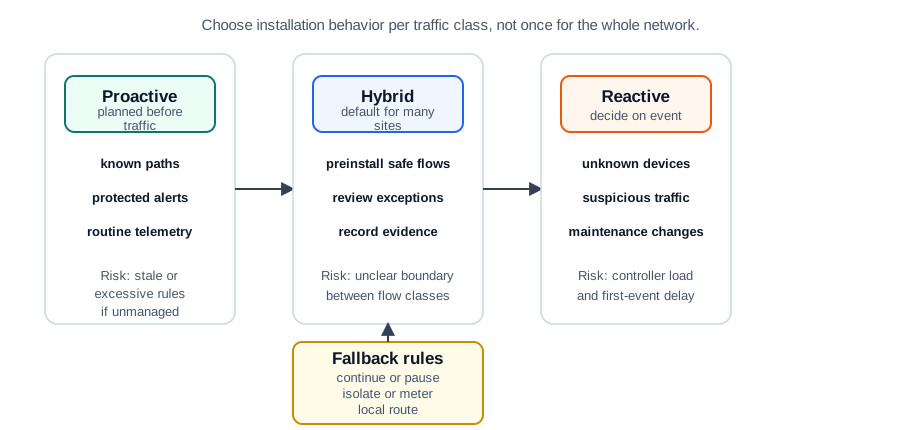
Rule Installation Strategy

They reduce controller dependency but consume table space and must be kept current.

  • The decision is rarely "reactive or proactive for everything." Most production designs use a hybrid strategy.
SDN controller rule installation strategy
iotclass.org

Major section

IoT Controller Placement Fit

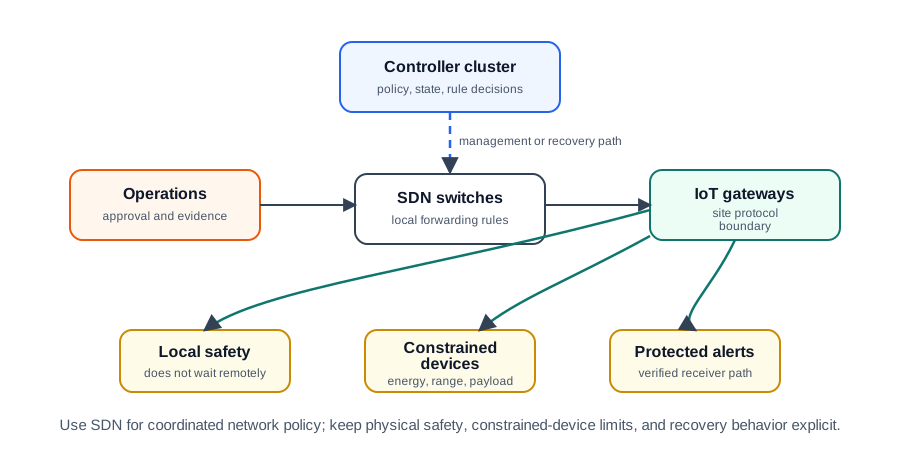
IoT deployments add physical, gateway, and local-control constraints that a controller design must respect.

  • The resulting visual statement is: SDN controller placement fit for IoT networks.
  • For IoT, preserve a management or recovery path, keep local safety behavior local, and use the controller for coordination that benefits from global context and traceable proof.
SDN controller placement fit for IoT networks
iotclass.org

Major section

Build Gateway Policy Changes

Scenario: A building network carries door-access alerts, environmental telemetry, maintenance traffic, camera feeds, and background updates through shared gateways.

  • A security workflow asks the SDN controller to restrict one gateway after suspicious maintenance traffic is observed.
  • Door-access alerts must continue.
  • Receiver still sees door-access alerts.
  • Restricted traffic counter increases.
iotclass.org

Major section

Common Pitfalls

A controller needs a management or recovery path that is not broken by the rules it installs.

  • Security, QoS, routing, and maintenance applications can request contradictory behavior unless conflict rules are explicit.
  • Topology, device capability, and active-rule records can be stale.
  • The controller should know when freshness matters.
iotclass.org

Major section

Controller as Decision System

In a course project, that means the controller diagram should name one real decision path, not just boxes for applications, control logic, and switches.

  • An SDN controller is not just a central brain.
  • This record also separates authority from convenience.
  • The rule manager then computes match fields, priority, timeout, counter attachment, and affected devices.
iotclass.org

Major section

Controller as Decision System (continued)

The useful question is not "is there a controller?" The useful question is whether the controller record connects intent, state freshness, policy ownership, rule result, switch acknowledgement, receiver proof, rollback, and review condition.

  • A controller may expose a single northbound API, but the request still needs a named owner, an approved service boundary, and a versioned view of the network before it can change forwarding behavior.
  • For example, a controller handling a smart-building gateway should not simply accept "restrict gateway G-17" and emit a broad flow rule.
  • Topology, device capability, policy, active rules, controller role, telemetry, and freshness limits.
iotclass.org

Major section

Controller as Decision System (continued)

A trustworthy controller decision is narrow enough to reason about and complete enough to audit after the network changes.

  • The useful proof is not the controller log alone; it is switch acceptance, counters for the restricted class, receiver confirmation for door-access alerts, and an operations record that names the rollback owner.
  • Application request, packet event, topology change, device session, telemetry threshold, or operator action.
  • Scoped match fields, actions, priorities, timeouts, counters, affected devices, and fallback behavior.
iotclass.org

Major section

Controller Decision Record

It should show what service intent was requested, which state was trusted, which rule changed, what proof closed the loop, and what would force the decision to be reviewed.

  • A practical record is short but specific.
  • It should also state which service owns conflicts.
  • Topology change, failover, rejected rule, missing telemetry, or owner change.

Key terms

Device acceptance
Device acceptance is paired with receiver proof that the intended service still works.
iotclass.org

Major section

Controller Decision Record (continued)

If two controller paths can change the same gateway, "last writer wins" is not an architecture; it is an outage waiting for a busy maintenance window.

  • For a hospital facilities network, one controller application may prioritize nurse-call traffic while another meters software-update traffic from the same gateway stack.
  • The rule change is limited to the approved service intent and does not hide protected traffic.
  • The installed rule is scoped, conflict-checked, acknowledged, and reversible.
iotclass.org

Major section

Controller Decision Record (continued)

The record should name the requester, affected VLAN or IP prefix, protected receivers, active controller owner, topology and policy versions, switch capability assumptions, rule timeout, rollback rule, and evidence source.

  • The controller knows which state must be current and which state may be sampled or stale.
  • Device acceptance is paired with receiver proof that the intended service still works.
  • Receiver proof missing, counter mismatch, alert, rollback, or service-level change.
iotclass.org

Major section

State Freshness Breaks Automation

Controller automation fails when it treats all state as equally trustworthy.

  • Policy ownership and active rules may need strong coordination.
  • Topology and device capability need freshness checks.
  • Telemetry may be delayed.
  • Switch local state and receiver behavior must be verified outside the controller's own record.

Why it matters

For IoT, this matters because gateways often sit at site boundaries where one mistaken rule can cut telemetry, firmware updates, alarms, and rollback access at the same time.

iotclass.org

Major section

State Freshness Breaks Automation (continued)

Under the hood, each service has a different failure mode.

  • A topology service can keep a stale view after a link flap or gateway move.
  • A device manager can overestimate switch capability if firmware changes table size, meter support, or OpenFlow version behavior.
  • A policy resolver can approve two incompatible writes unless ownership is explicit.
iotclass.org

Major section

State Freshness Breaks Automation (continued)

Sequence numbers, bundle support, role negotiation, and idempotent rule identifiers keep recovery predictable enough to debug.

  • A rule manager can produce a valid-looking rule that is rejected by one switch, shadowed by a higher-priority rule, or installed without the counter needed for evidence.
  • The telemetry collector can arrive seconds late, and a receiver log can prove a service failure even when the switch accepted the update.
  • A southbound acknowledgement is not service proof.
iotclass.org

Major section

State Freshness Breaks Automation (continued)

A sound design names which state can be stale, which state blocks writes, and which external proof closes the loop.

  • A standby controller should not replay old intent against a newer switch table, and a primary controller should not assume every acknowledged OpenFlow message reached every device in the same order.
  • The practical risk in state freshness breaks automation needs a diagram. The linked figure in Part 1 summarizes it: Different controller records need different ownership and freshness rules before automation can be trusted.
  • Two controller paths must not make incompatible decisions for the same scope without a defined owner and conflict rule.
iotclass.org

Major section

State Freshness Breaks Automation (continued)

Topology, device capability, active rules, and controller role need age or version checks before risky rule changes.

  • Switches and gateways must have safe behavior when controller contact is degraded or a rule update is rejected.
  • Receiver logs, protected traffic, application acknowledgements, and operations records close the loop beyond switch acceptance.
  • It says a device accepted an update; it does not prove the intended receiver still works or the protected path stayed protected.
iotclass.org

Deck summary

Key takeaways

They reduce controller dependency but consume table space and must be kept current.

  • IoT deployments add physical, gateway, and local-control constraints that a controller design must respect.
  • Scenario: A building network carries door-access alerts, environmental telemetry, maintenance traffic, camera feeds, and background updates through shared gateways.
  • A controller needs a management or recovery path that is not broken by the rules it installs.
  • In a course project, that means the controller diagram should name one real decision path, not just boxes for applications, control logic, and switches.
iotclass.org

Retrieval practice

Recall check 1 of 3

Cloud Clara says: answer from memory, then check your reasoning.

Q1A controller receives a request to restrict maintenance traffic from one IoT gateway while preserving door-access alerts. Which decision path is strongest?

AInstall a broad block for the gateway because security events should override all maintenance and alert traffic.
BValidate scope, protected paths, scoped rules, receiver proof, and rollback.
CLet the security app write switch rules directly because it already knows which gateway looks suspicious.
DWait for traffic counters to prove the problem, then decide whether topology checks are needed.
Show answer

Answer: B A controller decision is trustworthy when request, state, policy, rule result, switch proof, receiver outcome, and rollback condition are connected.

iotclass.org

Retrieval practice

Recall check 2 of 3

Cloud Clara says: answer from memory, then check your reasoning.

Q2A controller architecture diagram lists topology, policy, rule, telemetry, and device services. What added record best makes the design operationally reviewable?

AA note that the controller has a global view, so individual service records are unnecessary after installation.
BA list of switch models, because controller architecture depends mainly on forwarding hardware.
CRecord intent, state version, owner, computed rule, device ack, proof, and rollback.
DA dashboard screenshot after one rule update appears in the controller UI and looks healthy.
Show answer

Answer: C Controller architecture needs records that connect service intent, state, policy, rule installation, receiver proof, and rollback.

iotclass.org

Retrieval practice

Recall check 3 of 3

Cloud Clara says: answer from memory, then check your reasoning.

Q3Two controller applications can update rules for the same gateway: one isolates suspicious traffic and one preserves maintenance access. Which architecture control prevents conflicting automation?

ALet whichever application sends the rule last win because the controller has the latest observed state.
BDisable telemetry collection so controller state cannot disagree with switch counters or receiver logs.
CForward all packets through the controller until operators decide which application owns the gateway.
DDefine owner, conflict rule, idempotency, freshness gate, rollback, and proof.
Show answer

Answer: D Controller automation needs explicit ownership, conflict handling, freshness gates, rollback, and receiver proof when multiple paths can affect the same forwarding scope.

iotclass.org

Print reference

Answers

Answer key.

  1. B · A controller decision is trustworthy when request, state, policy, rule result, switch proof, receiver outcome, and rollback condition are connected.
  2. C · Controller architecture needs records that connect service intent, state, policy, rule installation, receiver proof, and rollback.
  3. D · Controller automation needs explicit ownership, conflict handling, freshness gates, rollback, and receiver proof when multiple paths can affect the same forwarding scope.
iotclass.org