Cloud, SDN & Production Architectures · Study deck
SDN Production Case Studies
Picture a factory network carrying safety alarms, camera files, and maintenance checks over the same narrow path.
Cloud Clara is your guide for this deck.

After studying this chapter
Learning objectives
You will be able to:
- Compare production SDN case studies by problem pattern instead of copied deployment results.
- Identify when traffic-engineering, service-slicing, or scheduled-forwarding patterns fit an IoT network.
- Check baseline proof and post-change proof before accepting a case-study lesson.
- Separate transferable architecture lessons from environment-specific implementation details.
Major section
Start With the Case Proof
A published case says central rule changes improved service, but the factory owner needs proof that local switches and staff can handle the same change and its failure modes.
- A valid alarm must keep its protected route.
- An unapproved path must stay closed.
- Software-defined networking, or SDN, separates rule control from packet forwarding.
Major section
Start With the Case Proof (continued)
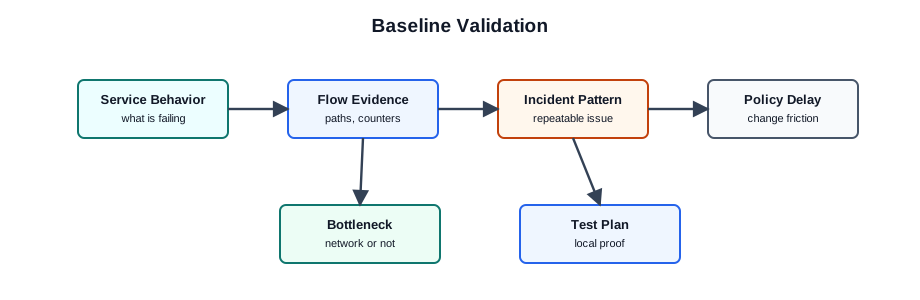
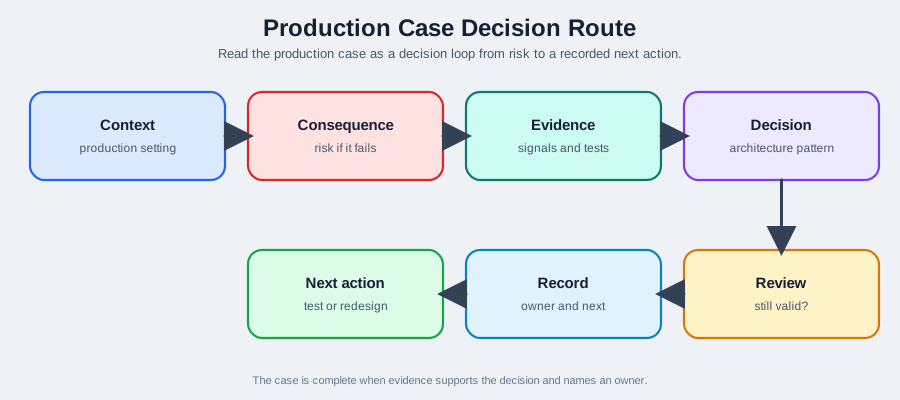
A result from another site is only a clue until local proof matches its conditions.
- Under the Hood explains rule order, table limits, observation gaps, safe local behavior, and the races hidden by a simple before-and-after chart.
- An SDN case study is useful only when it proves how a pattern behaves under local constraints.
- Traffic engineering, slicing, and scheduled forwarding all sound promising until the gateway, controller, and receiver evidence are checked.
Major section
Minimum Viable Understanding · Case-Study Lenses
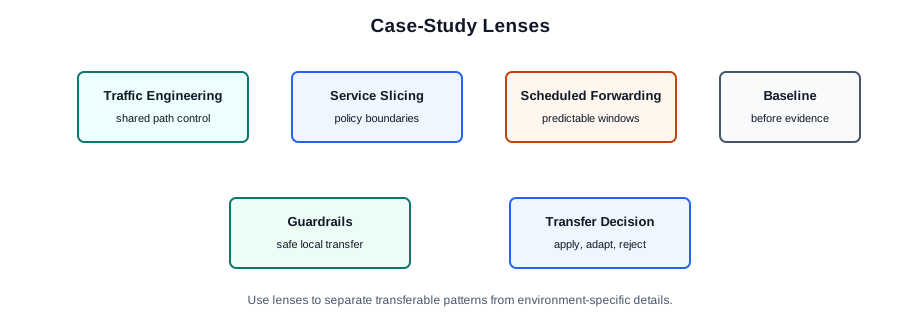
A case study is proof, not a recipe.
- Its value depends on whether the operating conditions match your network.
- Traffic engineering, service slicing, and scheduled forwarding identify the control pattern; baseline proof and operational guardrails test whether it is safe locally; the transfer decision records which assumptions survive the move into the target network.
Major section
Pattern 1: Traffic Engineering · Pattern 2: Service Slicing
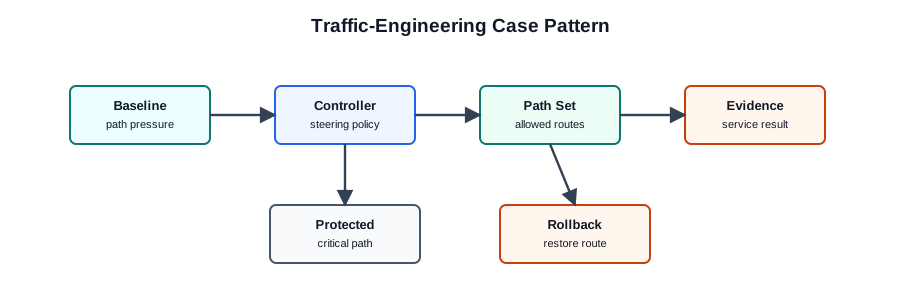
A traffic-engineering case study starts with uneven path use or congestion risk across shared links.
- Congestion counters and receiver outcomes must improve while protected traffic remains inside its boundary; the rollback record identifies the measurement that restores the old path choice.
Major section
Pattern 3: Scheduled Forwarding
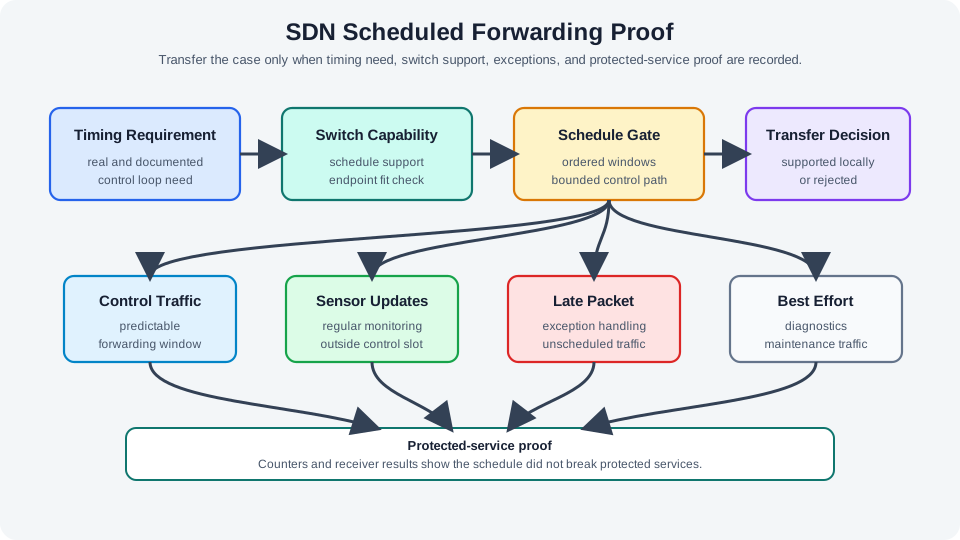
A scheduled-forwarding case study starts with a control loop or industrial workflow that cannot tolerate unpredictable queuing.
- Late packets take an exception path, while protected-service proof and the transfer decision determine whether the schedule is acceptable.
- Transfer the lesson only if the timing requirement is real, documented, and supported by the switching environment.
Major section
Cross-Case Proof Comparison · Baseline Validation
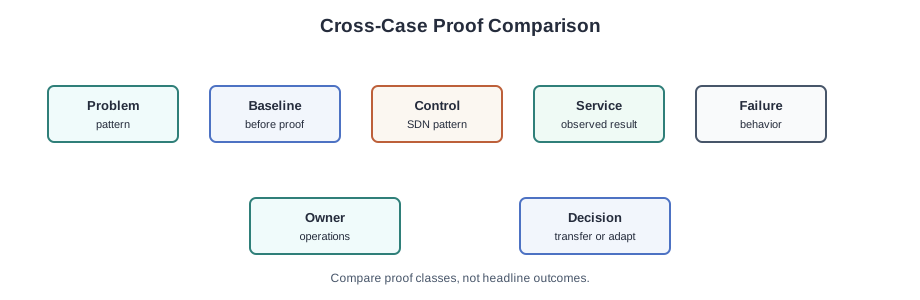
A blank field is visible uncertainty; it cannot be hidden by a larger throughput or latency headline from a different environment.
- Baseline proof: what was measured before SDN was introduced.
- The most common case-study mistake is accepting a pattern before proving the local problem.
- Policy delay is a separate observation.
Major section
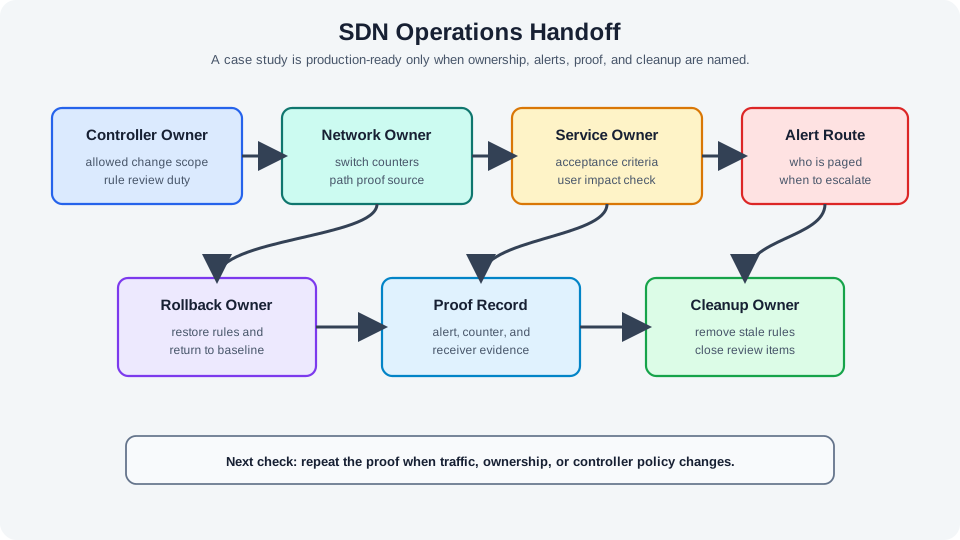
Migration Risk Boundaries · Operations Handoff
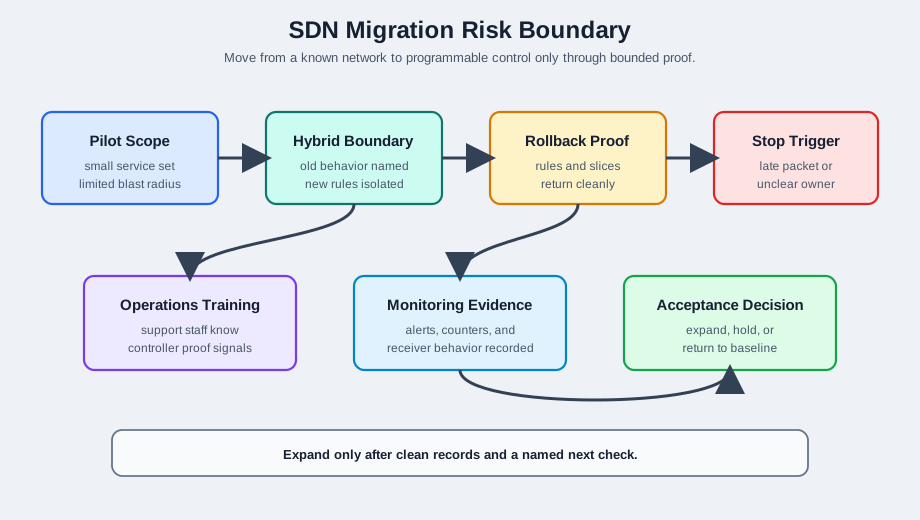
Operations training and monitoring evidence support the acceptance decision; a stop trigger blocks expansion, while a written expansion rule makes broader rollout conditional on the pilot evidence rather than enthusiasm.
- A stop trigger holds or reverses the pilot; only a satisfied expansion rule widens scope.
- The hybrid boundary and rollback proof remain authoritative throughout both outcomes.
Major section
Walkthrough: Choosing a Case Pattern · Case-Study Proof Loop
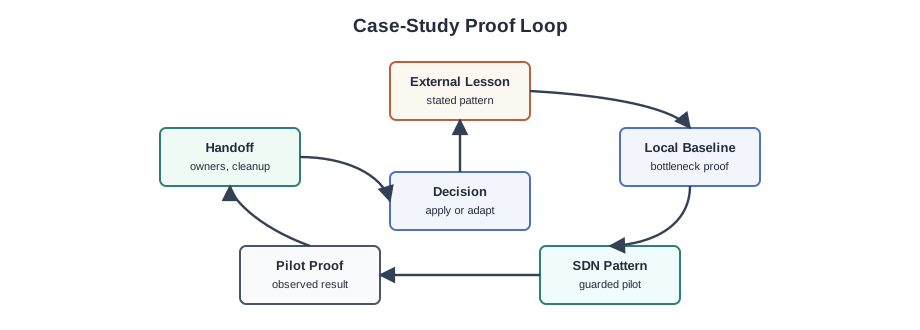
Baseline: gather pre-change proof for each pattern instead of assuming one case study solves every problem.
- The local baseline selects or rejects the SDN pattern; pilot proof and the operations handoff constrain the transfer decision; and the next check feeds new evidence back into the baseline instead of treating acceptance as permanent.
Major section
Common Pitfalls · Campus IoT OpenFlow Case
Skipping baseline measurement: without local proof, teams cannot tell whether SDN solved the actual problem.
- Ignoring migration risk: pilots, hybrid boundaries, rollback, and training are part of the lesson.
- Forgetting operations handoff: a successful pilot still fails if alerts, ownership, cleanup, and next check are unclear.
Major section
Flow-Table TCAM Exhaustion
OpenFlow rules that match on wildcards and priorities live in TCAM — fast but expensive and physically small.
- A typical hardware switch holds only a few thousand TCAM flow entries (often ~2,000–8,000, sometimes fewer).
- That needs 5,000 TCAM entries — more than a 2,000-entry switch can hold.
- That record also needs an owner.
Major section
Flow-Table TCAM Exhaustion (continued)
Worked example.: Suppose the design installs one specific flow rule per device for fine-grained policy, and the campus has 5,000 IoT endpoints.
- When TCAM fills, new rules either fail to install or spill to slow software forwarding, and traffic that should be line-rate now crawls or drops.
- The practitioner lesson for case-study transfer is to record the scale assumption behind every rule.
- A paper may describe per-flow steering, but a production pilot should ask how many rules each switch will hold in normal operation, during a failover, and while temporary diagnostic rules are active.
Major section
Reactive, Proactive, Available
In proactive mode, rules are pre-installed before traffic arrives — no per-flow latency and no packet-in flood, at the cost of less on-the-fly flexibility.
- The second concern is that the controller is now critical infrastructure.
- If forwarding depends on it and it fails, the network can stop; even where switches keep forwarding on installed rules, no new policy can be applied.
- Meanwhile a standby controller takes over when the primary is patched.
Major section
Reactive, Proactive, Available (continued)
So production designs run the controller in a high-availability cluster with failover, and often keep switches able to forward existing flows through a brief controller outage.
- The convenience of central control is paid for with the discipline of central-control resilience.
- Switching that subnet to proactive rules (traffic pre-authorised by class) removes the packet-in path, and rate-limiting packet-ins protects the controller elsewhere.
- A deeper case-study review should ask which fail-open or fail-closed behavior is being claimed.
- Production IoT networks lean proactive precisely because IoT flows are predictable and the packet-in path is a denial-of-service surface.
Deck summary
Key takeaways
A published case says central rule changes improved service, but the factory owner needs proof that local switches and staff can handle the same change and its failure modes.
- A result from another site is only a clue until local proof matches its conditions.
- A case study is proof, not a recipe.
- A traffic-engineering case study starts with uneven path use or congestion risk across shared links.
- A scheduled-forwarding case study starts with a control loop or industrial workflow that cannot tolerate unpredictable queuing.
Retrieval practice
Recall check 1 of 5

Cloud Clara says: answer from memory, then check your reasoning.
Q1A team wants to reuse a published SDN traffic-engineering case study for a mixed IoT network with shared uplinks, safety alarms, diagnostics, and a small control zone. What should the transfer check compare first?
Show answer
Answer: A SDN production case studies transfer as proof patterns: local baseline, matching problem shape, SDN control pattern, guardrails, receiver outcome, rollback, and operations handoff must all be checked before the case becomes a local design argument.
Retrieval practice
Recall check 2 of 5

Cloud Clara says: answer from memory, then check your reasoning.
Q2A team wants to copy a traffic-engineering SDN case study because the published result sounds impressive. What should they verify first?
Show answer
Answer: B A case-study lesson transfers only when the local baseline, assumptions, guardrails, pilot result, and operations handoff support the same pattern.
Retrieval practice
Recall check 3 of 5

Cloud Clara says: answer from memory, then check your reasoning.
Q3What does SDN separate, and how does OpenFlow fit in?
Show answer
Answer: A The controller decides policy; OpenFlow installs the forwarding rules into the switches.
Retrieval practice
Recall check 4 of 5

Cloud Clara says: answer from memory, then check your reasoning.
Q45,000 IoT devices each get a specific OpenFlow rule, but the switch has ~2,000 TCAM entries. What happens, and what fixes it?
Show answer
Answer: A TCAM is small, so match on shared attributes rather than per-device to stay within capacity.
Retrieval practice
Recall check 5 of 5

Cloud Clara says: answer from memory, then check your reasoning.
Q5Why do production IoT SDN deployments favour proactive flow installation over reactive?
Show answer
Answer: A Predictable IoT flows suit proactive rules, sparing the controller the packet-in flood.
Print reference
Answers 1 of 2
Answer key.
- A · SDN production case studies transfer as proof patterns: local baseline, matching problem shape, SDN control pattern, guardrails, receiver outcome, rollback, and operations handoff must all be checked before the case becomes a local design argument.
- B · A case-study lesson transfers only when the local baseline, assumptions, guardrails, pilot result, and operations handoff support the same pattern.
- A · The controller decides policy; OpenFlow installs the forwarding rules into the switches.
Print reference
Answers 2 of 2
Answer key.
- A · TCAM is small, so match on shared attributes rather than per-device to stay within capacity.
- A · Predictable IoT flows suit proactive rules, sparing the controller the packet-in flood.