Cloud, SDN & Production Architectures · Study deck

SDN OpenFlow Challenges

Picture a factory network whose central rule service becomes slow during an alarm.

Cloud Clara is your guide for this deck.

openflowchallenges
Cloud Clara, the module guide, in a scene from this chapter.
iotclass.org

After studying this chapter

Learning objectives

You will be able to:

  • Explain why rule-state pressure, broad matches, and table-miss behavior create operational risk.
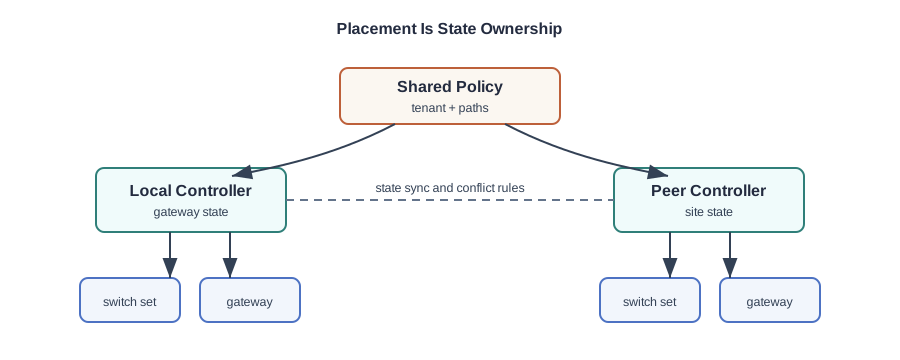
  • Check controller placement as a state-ownership and failure-domain decision.
  • Identify southbound capability drift without assuming every switch supports the same actions.
  • Evaluate controller loss, control-channel security, and constrained IoT boundaries.
iotclass.org

Major section

Start With the Pressure Point

A new flow reaches a switch, but the switch has no matching rule.

  • Waiting too long may delay a safety message; accepting anything may open the wrong path.
  • Software-defined networking separates the system that chooses network paths from the devices that forward messages.
  • OpenFlow is one way those choices become switch rules.
iotclass.org

Major section

Start With the Pressure Point (continued)
The network owner should name what each switch does when the rule service is late, unreachable, or wrong.

  • A safety message may need a small rule that already exists at the switch.
  • A new office connection can wait or fail closed.
  • This simple story does not settle every speed or trust trade-off.
iotclass.org

Major section

In 60 Seconds · Minimum Viable Understanding

OpenFlow-style SDN gives operators precise control over switch behavior, but the control model introduces operational challenges.

  • Operators must check rule-state pressure, table-miss behavior, controller placement, failure domains, southbound capability drift, and control-channel security before treating a design as production-ready.
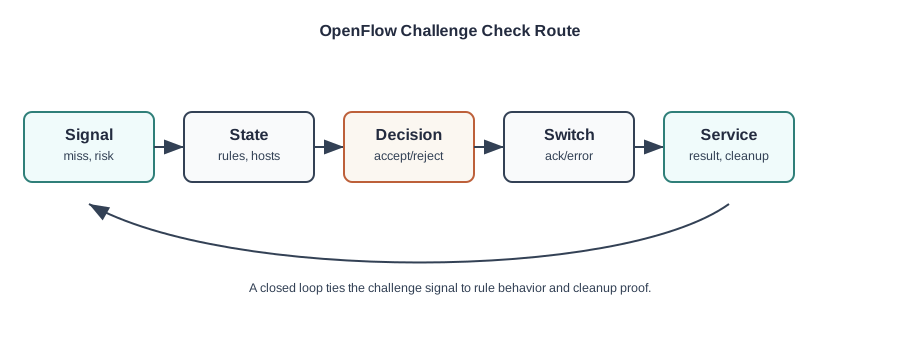
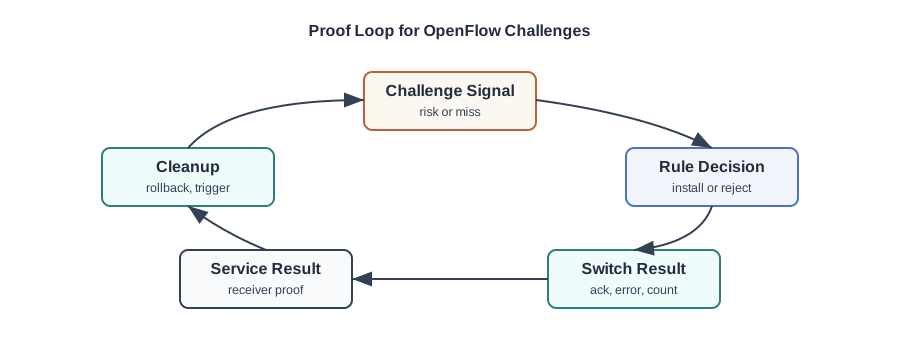
Check route from challenge signal through affected state, control decision, switch proof, receiver result, and cleanup record.
iotclass.org

Major section

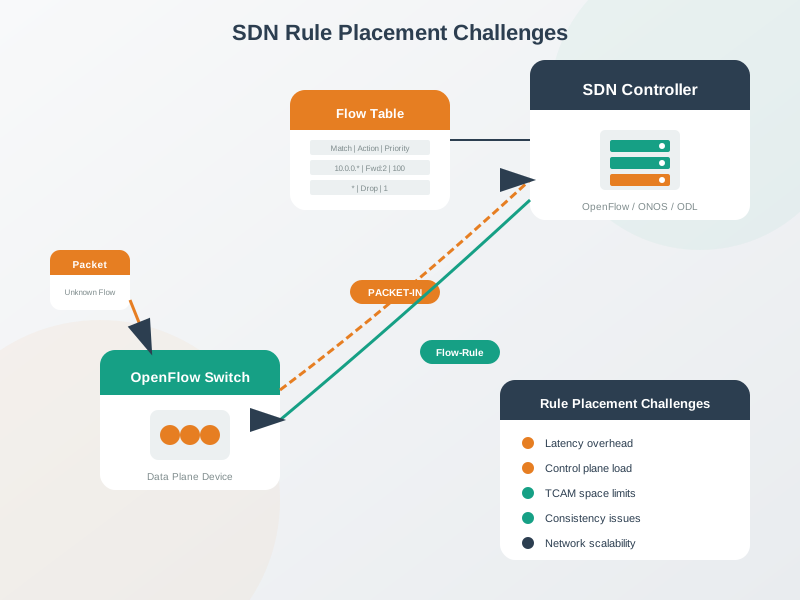
Challenge Map · Variant Fit Addendum

The next challenge map step needs SDN Controller as a visual checkpoint.

  • At,: Unknown Flow supplies the relationship to challenge: OpenFlow rule placement is constrained by latency, control-plane load, limited TCAM space, consistency, and scalability.
  • That structure supports challenge map: OpenFlow rule placement is constrained by latency, control-plane load, limited TCAM space, consistency, and scalability.
OpenFlow rule placement is constrained by latency, control-plane load, limited TCAM space, consistency, and scalability.
iotclass.org

Major section

Rule-State Pressure

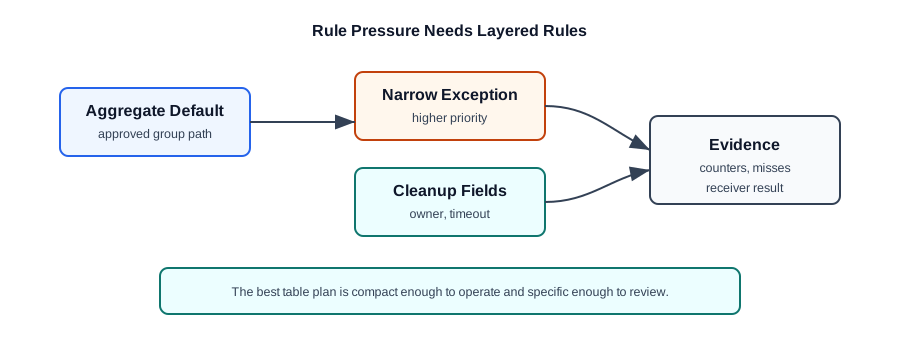
Rule-state pressure appears when the controller wants one rule per condition but the switch needs bounded, auditable behavior.

  • The chapter needs visual evidence for rule-state pressure. Provides it: SDN OpenFlow rule-state pressure.
  • The goal is to keep the forwarding policy precise enough to audit.

Why it matters

The goal is not merely to reduce rule count.

OpenFlow rule-state pressure is controlled with aggregate defaults, narrow exceptions, explicit priority, table budgets, counters, ownership, timeouts, and verified cleanup.
iotclass.org

Major section

Table-Miss Pressure · Controller Placement

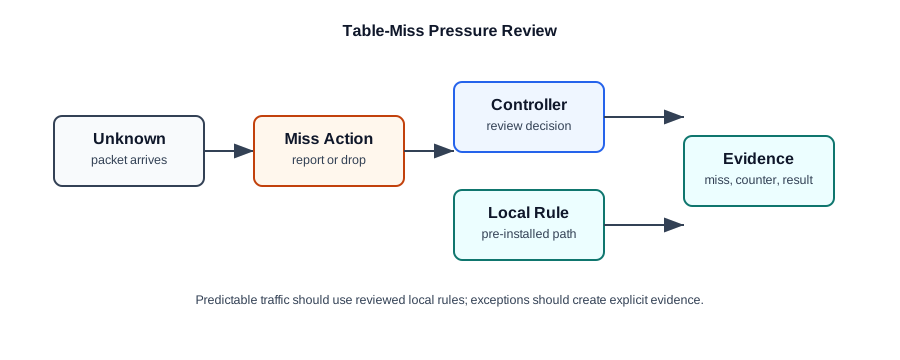
Reactive control is useful for unusual events, but a design that depends on constant table misses is fragile.

  • The next table-miss pressure step needs Table-Miss Pressure Review as a visual checkpoint.
  • The route through is figure-specific: Table-Miss Pressure Review states one concern,: Controller names another, and miss, counter, result closes the scope.

Key terms

Placement
Placement is not only about delay.
SDN OpenFlow table-miss pressure
iotclass.org

Major section

Failure Domain Boundaries · Capability Drift

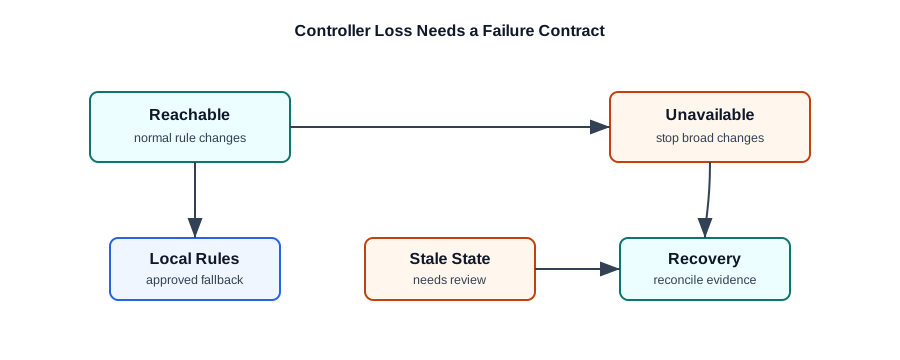
Switches can continue to forward already installed local rules during controller loss, but the design still needs a failure contract.

  • The chapter needs visual evidence for failure domain boundaries. Provides it: SDN OpenFlow failure domain check.
  • Examine Controller Loss Needs a Failure Contract together with: Local Rules.
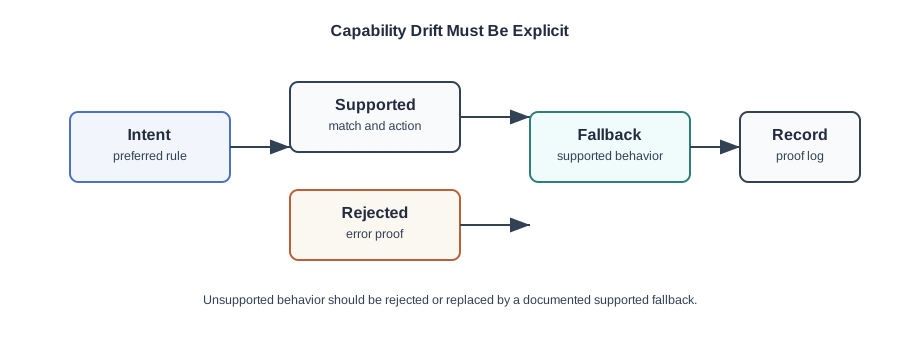
  • For capability drift, inspect at Capability Drift Must Be Explicit.

Key terms

Capability drift
Capability drift is dangerous when it is discovered after a rule is already part of a release plan.
SDN OpenFlow failure domain check
iotclass.org

Major section

Control-Channel Security · Constrained IoT Boundaries
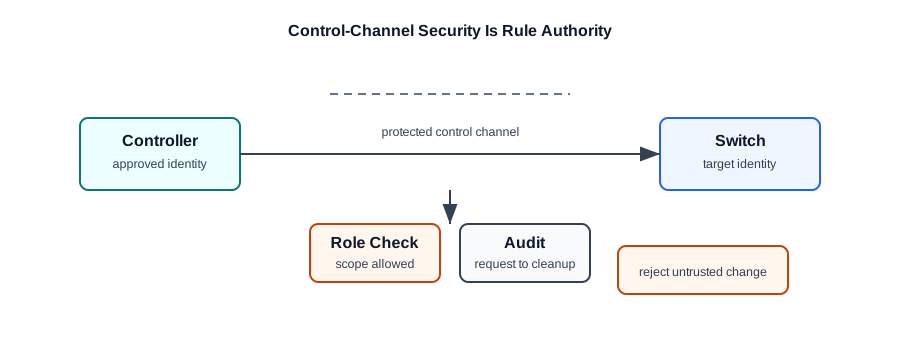
The control channel can change forwarding behavior across the network, so its security proof must be separate from data-plane proof.

  • Together they explain the reject untrusted change figure claim: SDN OpenFlow control-channel security check.
  • Controller identity: switches should accept control messages only from approved controller endpoints.
SDN OpenFlow control-channel security check
iotclass.org

Major section

Proof Loop · Check the Challenge Proof

Every OpenFlow challenge check should end in a proof loop that can be reviewed later.

  • The reason to inspect proof loop is concrete. Depicts: Proof loop showing challenge signal, rule decision, switch result, service result, protected path check, cleanup, and next check trigger.
Proof loop showing challenge signal, rule decision, switch result, service result, protected path check, cleanup, and next check trigger.
iotclass.org

Major section

Common Pitfalls · OpenFlow Challenges as Proof Gaps
An OpenFlow challenge is not just a technical limitation.

  • Treating rule count as the only table risk: broad rules can be dangerous if they hide required exceptions or cleanup.
  • Leaving table-miss behavior implicit: every miss path should say whether it reports, drops, or follows a checked fallback.
  • A good first response is conservative.
iotclass.org

Major section

Write The Challenge Record · Rule State Outlives Intent

If any of those fields are missing, the challenge is still open.

  • The record keeps temporary fixes from becoming invisible production rules.
  • A newer Open vSwitch instance may accept the meter or group action, while an older appliance may reject it or need a simpler queue rule.
  • Controller placement adds another state boundary.

Why it matters

Under the hood, capability drift is especially dangerous because it can look like a policy decision succeeded while one switch executes a fallback path or rejects an action.

iotclass.org

Major section

Summary · Key Takeaway

OpenFlow challenges are check problems, not just performance problems.

  • Rule-state pressure, table misses, controller placement, failure domains, switch capability drift, control-channel security, and constrained IoT boundaries all need explicit proof.
  • A strong design uses aggregate defaults, narrow exceptions, bounded table-miss behavior, local fallback, identity checks, and cleanup records so forwarding behavior remains understandable after the controller intent has been translated into switch rules.
  • OpenFlow challenges are operational constraints: scalability, controller availability, rule conflicts, stale state, security, and troubleshooting need explicit mitigations.
iotclass.org

Deck summary

Key takeaways

A new flow reaches a switch, but the switch has no matching rule.

  • The network owner should name what each switch does when the rule service is late, unreachable, or wrong.
  • OpenFlow-style SDN gives operators precise control over switch behavior, but the control model introduces operational challenges.
  • The next challenge map step needs SDN Controller as a visual checkpoint.
  • Rule-state pressure appears when the controller wants one rule per condition but the switch needs bounded, auditable behavior.
iotclass.org

Retrieval practice

Recall check 1 of 3

Cloud Clara says: answer from memory, then check your reasoning.

Q1A gateway aggregation switch starts sending table-miss packets to the controller after a team adds per-device exceptions for alarms, diagnostics, and firmware traffic. Some switches acknowledge the rule plan, but one model reports action errors and alarm receivers see delayed paths. What should the OpenFlow challenge check compare first?

ACompare challenge signal, match space, table budget, miss rate, placement, capability errors, receiver result, and cleanup owner.
BApprove the SDN design because the controller accepted the policy intent and the reference architecture includes OpenFlow switches.
CUse one successful flow-mod acknowledgement as proof that every switch can run the rule plan at scale.
DLeave table budgets, controller-loss behavior, control-channel security, cleanup, and rollback ownership until after the switch firmware is standardized.
Show answer

Answer: A An OpenFlow challenge check should connect the challenge signal, match space, table budget, controller placement, switch capability proof, error and counter evidence, receiver behavior, cleanup or rollback owner, and review condition before the rule plan becomes production state.

iotclass.org

Retrieval practice

Recall check 2 of 3

Cloud Clara says: answer from memory, then check your reasoning.

Q2A temporary OpenFlow exception is installed for a gateway update window. The switch accepted the rule. What proof is still needed before closing the check?

ANo more proof is needed because a switch acknowledgement proves the service behavior worked.
BCheck update-rule counters, protected-path counters, receiver result, and recorded cleanup.
COnly the controller request log is needed because controller intent is the source of truth.
DThe rule should be left installed so future updates do not need another check.
Show answer

Answer: B OpenFlow challenge checks should tie the controller request to switch acceptance, traffic counters, receiver behavior, protected-path checks, and cleanup.

iotclass.org

Retrieval practice

Recall check 3 of 3

Cloud Clara says: answer from memory, then check your reasoning.

Q3A temporary OpenFlow rule was installed for an IoT gateway update window. The update finished, but the rule still matches traffic and the controller log only shows the original install request. What should the operations record require?

ACheck counters, receiver outcome, protected paths, timeout or removal, cleanup owner, and final table state.
BLeave the rule installed because the controller once approved it.
CTrust the controller request log as complete proof that forwarding behavior is correct.
DIgnore protected-path counters because only update traffic matters during maintenance.
Show answer

Answer: A OpenFlow rule state can outlive the original controller intent, so temporary exceptions need switch counters, receiver proof, protected-path checks, owner sign-off, and cleanup evidence.

iotclass.org

Print reference

Answers 1 of 2

Answer key.

  1. A · An OpenFlow challenge check should connect the challenge signal, match space, table budget, controller placement, switch capability proof, error and counter evidence, receiver behavior, cleanup or rollback owner, and review condition before the rule plan becomes production state.
  2. B · OpenFlow challenge checks should tie the controller request to switch acceptance, traffic counters, receiver behavior, protected-path checks, and cleanup.
iotclass.org

Print reference

Answers 2 of 2

Answer key.

  1. A · OpenFlow rule state can outlive the original controller intent, so temporary exceptions need switch counters, receiver proof, protected-path checks, owner sign-off, and cleanup evidence.
iotclass.org