Cloud, SDN & Production Architectures · Study deck
SDN for IoT: WSN and Mobile Variants
A WSN node and a roaming handset expose different control surfaces.
Cloud Clara is your guide for this deck.

After studying this chapter
Learning objectives
You will be able to:
- Explain: A light virtual access point (LVAP) is a per-client logical AP context—client identity, BSSID/SSID association context, policy and forwarding attachment, plus the security/session material the implementation explicitly supports.
- Explain: If miss rate is $\lambda_m$ and the routed control exchange costs $b_{in}+b_{rule}$ bytes over an average $h$ radio hops each way, offered control traffic is approximately.
- Explain: A rule installed at node A is not necessarily node-specific in effect; “all nodes drop source X” is network-wide policy and needs coordinated versioning.
- Compare SDN-WISE and mobile SDN control pipelines.
Major section
Named WSN and Mobile SDN Variants
Named systems are treated as historical research examples, not current supported products. -->.
- The constrained-fit test is therefore operational.
- A gateway-mediated design may keep tiny nodes simple; an in-network rule engine may react locally but consumes scarce memory and energy.
- The last distinction is easy to miss.
- Unknown packets are not free.
Major section
Named WSN and Mobile SDN Variants (continued)
Central visibility only helps if synchronization traffic, lossy acknowledgements, and controller latency do not cost more than the policy saves.
- A variant is useful only if those records show better service, lower overhead, or safer recovery for the specific IoT traffic class.
- A value-centric rule matches the observation, such as temperature > 40 °C, and forwards an event because of what it means.
- Ubi-Flow adds a regional scaling sequence.
Major section
Named WSN and Mobile SDN Variants (continued)
Those plot values are historical results for one setup, not performance guarantees.
- The first supports in-network event selection; the second preserves source-specific routes, permissions, and diagnostics.
- In either case the rule needs priority, lifetime, units, invalid-value behavior, and a local fallback.
- Prediction does not itself select where rules should be installed.
Major section
Named WSN and Mobile SDN Variants (continued)
ODIN separates an agent at each access point from a master at the controller.
- A rule installed at node A is not necessarily node-specific in effect; “all nodes drop source X” is network-wide policy and needs coordinated versioning.
- Likewise, selecting a sensor can change payload size and downstream queue pressure, so control surfaces cannot be approved independently.
- Keeping it per client lets state move without pretending the physical AP moved.
Major section
Named WSN and Mobile SDN Variants (continued)
The agent handles 802.11 frames and enforces client-specific state; the master coordinates policy and mobility.
- They expose the engineering exchange: controller knowledge can reduce wasteful data replication and improve chosen paths, but only by paying synchronization and miss-handling overhead.
- Re-run the comparison with radio-on time, useful delivered bytes, control bytes, drops, and energy per useful report.
- Both mechanisms fit one page once they are drawn as state movements.
Major section
Named WSN and Mobile SDN Variants (continued)
If miss rate is $\lambda_m$ and the routed control exchange costs $b_{in}+b_{rule}$ bytes over an average $h$ radio hops each way, offered control traffic is approximately.
- In a dense low-power network, a rule miss can consume energy at several nodes even when no application data is delivered.
- Stateful local processing is valuable only when it saves more communication and delay than its memory, computation, and synchronization cost.
- A light virtual access point (LVAP) is a per-client logical AP context—client identity, BSSID/SSID association context, policy and forwarding attachment, plus the security/session material the implementation explicitly supports.
Major section
Named WSN and Mobile SDN Variants (continued)
For an Order-$K$ Markov predictor, the state at time $t$ is the last $K$ locations.
- Known data frames are forwarded under that context; an unassigned frame is not silently bridged.
- The master authenticates/authorizes the request, assigns an LVAP, sends it to the agent, and only then permits normal processing.
- $\alpha>0$ is optional smoothing so an unseen transition is not assigned impossible probability.
Major section
Containment and Recovery
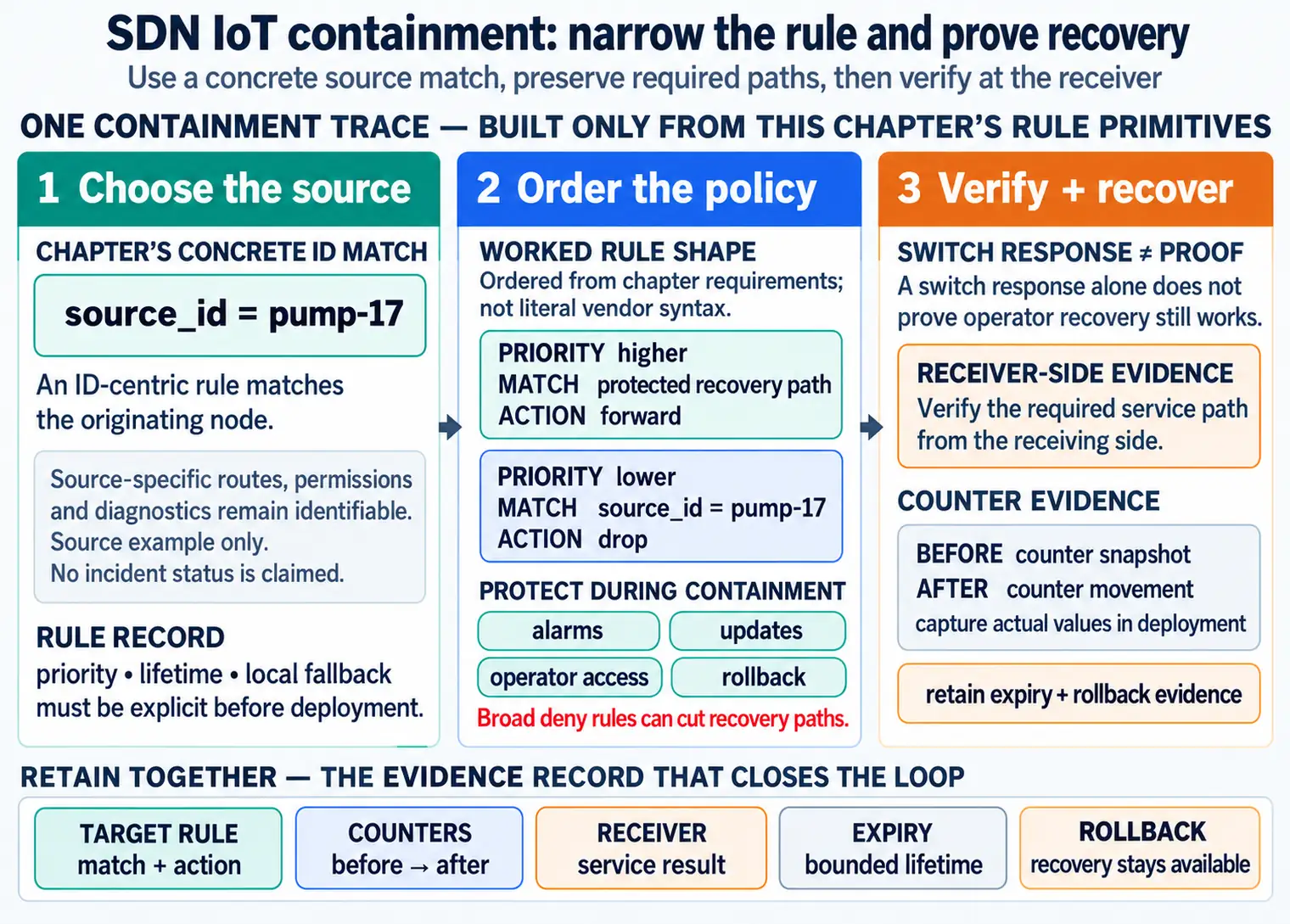
SDN containment should be narrow, reversible, and exception-aware.
- The next containment and recovery step needs Containment that preserves IoT recovery paths as a visual checkpoint.
Deck summary
Key takeaways
Named systems are treated as historical research examples, not current supported products. -->.
- Central visibility only helps if synchronization traffic, lossy acknowledgements, and controller latency do not cost more than the policy saves.
- Those plot values are historical results for one setup, not performance guarantees.
- ODIN separates an agent at each access point from a master at the controller.
- The agent handles 802.11 frames and enforces client-specific state; the master coordinates policy and mobility.
Retrieval practice
Recall check

Cloud Clara says: answer from memory, then check your reasoning.
Q1A proposal names a historical sensor-network SDN design. What should a constrained-fit review measure?
Show answer
Answer: C The chapter treats names as mechanisms to test against operational costs and fallback.
Q2An SDN rule isolates suspicious devices but also blocks operator recovery. What should the team change?
Show answer
Answer: B Containment should be reversible and protect management, alarms, and rollback paths.
Print reference
Answers
Answer key.
- C · The chapter treats names as mechanisms to test against operational costs and fallback.
- B · Containment should be reversible and protect management, alarms, and rollback paths.