Cloud, SDN & Production Architectures · Study deck
SDN for IoT: Assurance and Proof Records
A path rule controls how network traffic is handled.
Cloud Clara is your guide for this deck.

After studying this chapter
Learning objectives
You will be able to:
- Verify SDN service assurance with a cold-room walkthrough.
- Record local limits, containment, and recovery evidence.
- Explain: An SDN IoT application is only useful if the affected service behaves better or remains protected.
- Explain: Every SDN IoT application should leave a proof loop from service problem to result.
Major section
Service Assurance
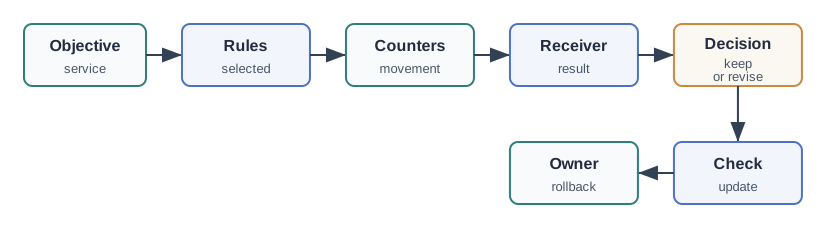
An SDN IoT application is only useful if the affected service behaves better or remains protected.
- The rule record captures its diff, scope, priority, and expiry, while controller state shows the basis for the change.
- The proof loop then assigns an owner and records result, rollback, and the next check trigger.
- Controller acceptance alone cannot close the service claim.
Major section
Proof Loop
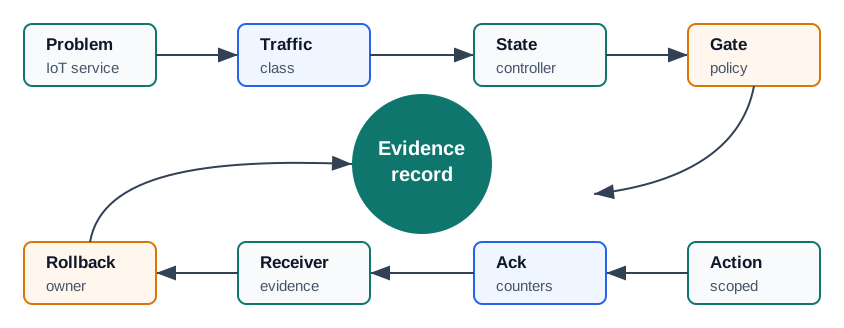
Every SDN IoT application should leave a proof loop from service problem to result.
- A forwarding, queue, meter, mirror, or deny action needs switch acknowledgement and counter movement.
- Receiver evidence must show whether the alarm or service recovered, while rollback has a named owner if it did not.
- The record preserves the old and new state for the next change.
Major section
Common Pitfalls
Starting with an SDN feature instead of a service problem: the check should begin with the affected IoT service and required proof.
- Using broad blocks during containment: narrow actions should preserve alarm, management, update, and recovery exceptions.
- Ignoring controller overhead in constrained networks: small devices and lossy links need local fallback and bounded control traffic.
- Confusing traffic separation with proof: a path or queue rule is not proof that the receiver saw better service.
Major section
Start With the IoT Service
Flow counters, queue counters, or meter counters can show update pressure.
- SDN is useful in IoT when a controller can coordinate different network behavior for different device groups and prove that the service outcome improved or remained protected.
- The starting point is not the SDN feature.
- Receiver proof from the alarm service can show whether alarms recovered.
Major section
Start With the IoT Service (continued)
The starting point is the affected alarm, telemetry, management, update, video, mobility, or containment service.
- A strong use case names the traffic class, gateway group, policy gate, allowed exceptions, scoped network action, receiver proof, rollback path, owner, and review condition.
- Without those details, a controller rule is just a network change, not an IoT application decision.
- If alarm delivery slows during the update, the SDN question is not whether the controller has a queue feature.
Major section
Start With the IoT Service (continued)
The question is whether update traffic can be shaped or moved while alarm, telemetry, management, and rollback paths remain usable.
- The fit check should name the gateway group, receiver, traffic class, expected destination, and protected exceptions before any rule changes.
- Controller state can show attachment points, rule ownership, and conflicting policy.
- If those facts do not line up, the better answer may be a gateway update schedule, protocol retry change, or local fallback rule rather than an SDN action.
Major section
SDN IoT Proof Record
Alarm, management, update, recovery, and rollback exceptions remain visible.
- The proof record should make the controller action reviewable after the event.
- It should show which service problem justified the action, which exceptions were preserved, which switch-side evidence was collected, what the receiver observed, and how the temporary change ends.
- The action is narrow, acknowledged, observable, and reversible.
Major section
SDN IoT Proof Record (continued)
The record states why an SDN action is needed instead of a local or protocol-only fix.
- Exception change, new protected path, missing approval, or stale policy.
- Rejected rule, counter mismatch, rule pressure, mobility event, or topology change.
- The affected service behaved correctly or the degraded state and owner are recorded.
Major section
SDN IoT Proof Record (continued)
That prevents future teams from treating every alarm delay as a controller-policy issue.
- Receiver proof missing, rollback failure, outage, update-window change, or service-level change.
- Acceptance proof would include the controller rule diff, switch acknowledgement, queue or meter counters, alarm receiver latency, telemetry continuity, and an owner who can remove the temporary rule.
- The record should then close with "no SDN action" and point to the local owner, protocol owner, or firmware owner.
Major section
Local Limits Decide Safety
SDN can coordinate gateway and switch behavior, but it cannot remove constrained-device limits, wireless loss, energy budgets, duty-cycle limits, local process timing, or the need for safe fallback.
- The controller is strongest when it coordinates shared network policy while local devices and gateways retain behavior that must not wait for a remote decision.
- Under the hood, the controller sees a partial model of the system.
- Those facts come from gateways, brokers, applications, and operations records.
Major section
Local Limits Decide Safety (continued)
A controller can narrow a path, meter a class, or isolate a device group, but it must preserve alarm paths, management recovery, rollback signals, and receiver-side proof.
- A reliable design therefore keeps local safety and remote policy separate.
- Local gateway behavior should preserve alarm buffering, store-and-forward telemetry, update rollback, and operator recovery even if controller contact is degraded.
- Local fallback: safety and time-critical local behavior should not wait for a remote controller.
Major section
Local Limits Decide Safety (continued)
The SDN policy can shape update traffic, steer a gateway path, or isolate a suspicious group, but the receiver proof and rollback path must work without assuming the controller remains reachable throughout the incident.
- Controller proof is not service proof: A switch acknowledgement must be paired with counters, receiver behavior, exception checks, and rollback evidence before the IoT application claim is closed.
- Constraint boundary: SDN does not remove range, energy, payload, timing, or gateway translation limits.
- Exception boundary: containment and shaping must preserve required alarm, management, update, and recovery paths.
- Proof boundary: controller state, switch acknowledgements, counters, receiver proof, rollback, and owner records must agree.
Deck summary
Key takeaways
An SDN IoT application is only useful if the affected service behaves better or remains protected.
- Every SDN IoT application should leave a proof loop from service problem to result.
- Starting with an SDN feature instead of a service problem: the check should begin with the affected IoT service and required proof.
- Flow counters, queue counters, or meter counters can show update pressure.
- The starting point is the affected alarm, telemetry, management, update, video, mobility, or containment service.
Retrieval practice
Recall check 1 of 3

Cloud Clara says: answer from memory, then check your reasoning.
Q1A gateway update window appears to delay alarm delivery. What is the best SDN fit check before changing switch rules?
Show answer
Answer: A A safe SDN IoT workflow starts with the service problem, classifies traffic, checks policy and state, applies a scoped action only when justified, and records receiver proof.
Retrieval practice
Recall check 2 of 3
Cloud Clara says: answer from memory, then check your reasoning.
Q2A controller rule shaped update traffic and alarms recovered, but the record has no rollback owner or receiver-side proof. What should the practitioner do?
Show answer
Answer: A SDN IoT proof records connect controller action to receiver outcome, rollback ownership, exceptions, and closure.
Retrieval practice
Recall check 3 of 3
Cloud Clara says: answer from memory, then check your reasoning.
Q3Why should an SDN IoT containment rule avoid depending only on remote controller availability?
Show answer
Answer: A SDN IoT designs must respect local safety, constrained-device limits, exceptions, receiver proof, and rollback even when controller policy is available.
Print reference
Answers
Answer key.
- A · A safe SDN IoT workflow starts with the service problem, classifies traffic, checks policy and state, applies a scoped action only when justified, and records receiver proof.
- A · SDN IoT proof records connect controller action to receiver outcome, rollback ownership, exceptions, and closure.
- A · SDN IoT designs must respect local safety, constrained-device limits, exceptions, receiver proof, and rollback even when controller policy is available.