Cloud, SDN & Production Architectures · Study deck
SDN Resilience: Failover Validation
Failover means another controller takes over when the current one fails.
Cloud Clara is your guide for this deck.

After studying this chapter
Learning objectives
You will be able to:
- Test failover sequence checks with a concrete scenario and pass criteria.
- Validate failover needs fresh state with a concrete scenario and pass criteria.
- Explain: Failover design should be checked as a sequence of verifiable events rather than as a single availability promise.
- Explain: This path preserves the chapter’s iot availability fit argument: SDN API and high availability fit for IoT.
Major section
Failover Sequence Checks
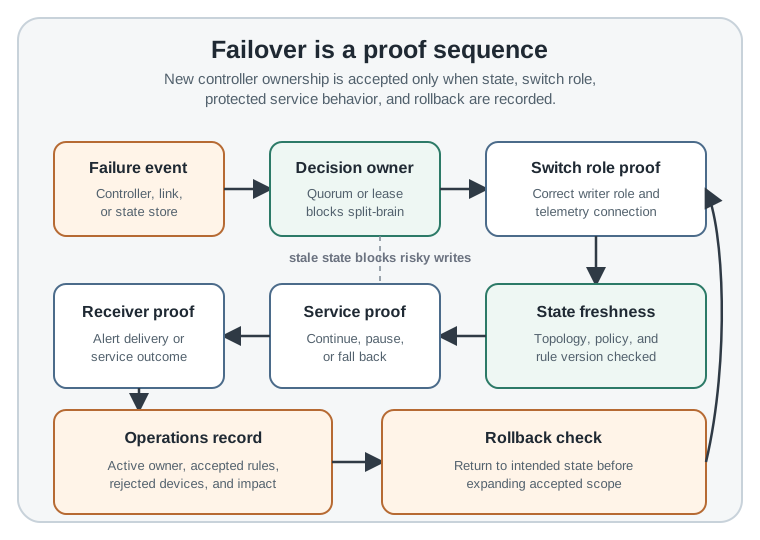
Failover design should be checked as a sequence of verifiable events rather than as a single availability promise.
- Distinguish Failover is a proof sequence from rule version checked.
- The reason to inspect failover sequence checks is concrete. the Failover is a recorded proof sequence: identify the decision owner, verify switch role and state freshness, preserve protected service behavior, confirm the receiver outcome, and retain rollback evidence diagram depicts: SDN controller failover proof sequence.
- The failover route in the Failover is a recorded proof sequence: identify the decision owner, verify switch role and state freshness, preserve protected service behavior, confirm the receiver outcome, and retain rollback evidence diagram checks owner and switch state; keep service, receipt, and rollback proof.
Major section
IoT Availability Fit
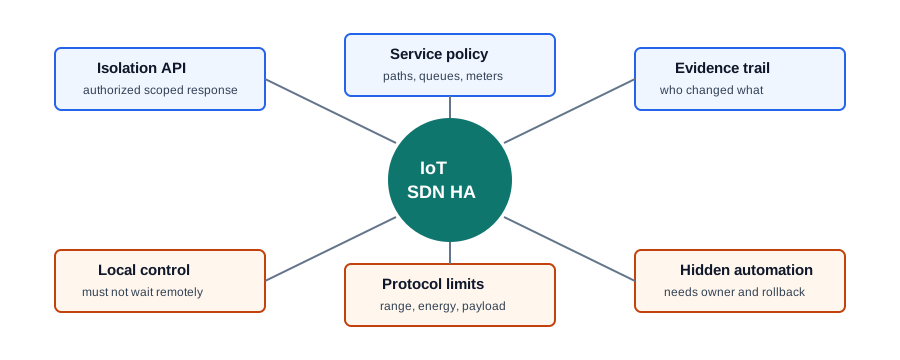
This path preserves the chapter’s iot availability fit argument: SDN API and high availability fit for IoT.
- SDN can coordinate network behavior, but it does not remove wireless range, energy, payload, gateway, or duty-cycle constraints.
- Fast rule changes are risky when ownership, scope, stale-state handling, and rollback proof are not visible.
- SDN API and cluster design is valuable when it reduces operational risk.
- The practical risk in iot availability fit needs a diagram. the SDN API and high availability fit for IoT diagram summarizes it: SDN API and high availability fit for IoT.
Major section
Proof Loop
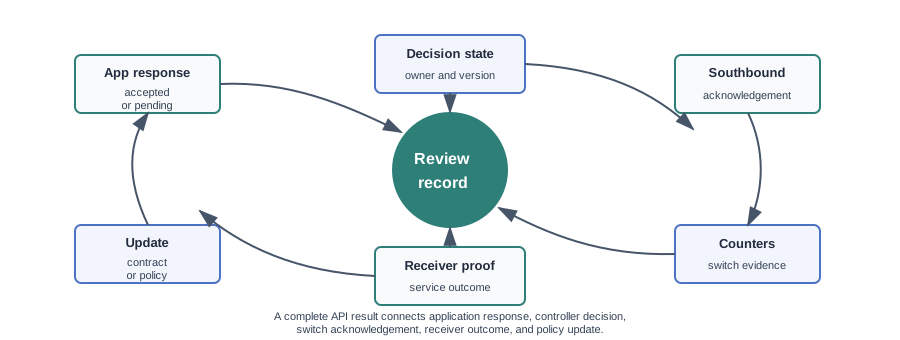
The API result should not be the only proof.
- A successful response can still hide partial rule application, stale state, or broken receiver behavior.
- The controller decision record states the owner, state version, and conflict result.
- Southbound acknowledgement shows what switches accepted; counters show whether traffic followed the intended rule.
Major section
Common Pitfalls
Applications should express intent through a checked contract, not bypass controller validation.
- Retries during timeout or failover can create duplicate, stale, or contradictory rule changes.
- More controller instances do not automatically improve throughput.
- Existing forwarding may continue, expire, pause, or degrade depending on rule and switch behavior.
- Southbound acknowledgement does not prove that the intended service still worked.
Major section
APIs Split Intent and Enforcement
An SDN API is useful when it keeps application intent separate from device enforcement.
- The northbound side should describe who is asking, what service behavior is requested, which scope is affected, and what proof is expected.
- The controller then validates state and policy before translating the request into southbound actions that switches can enforce.
- A cluster is not reliable because it has several instances.
- For example, a smart-building access-control system may ask the network to isolate a suspect maintenance gateway while preserving badge-reader alarms and operator rollback access.
Major section
APIs Split Intent and Enforcement (continued)
The northbound API should carry the requester role, incident id, gateway id, protected traffic class, requested duration, idempotency key, and proof target.
- The southbound action is then a device-facing rule update, not a second copy of the application request.
- The availability claim is proven only when the receiver still sees protected alarm traffic, the controller owner is known, rejected devices are named, and rollback remains possible after a controller role change.
- With switch acknowledgement, receiver outcome, and policy update included, their combined meaning is: The API result is only one part of the evidence loop; receiver proof and operations closure are separate checks.
Major section
Availability Record
It should show what request was made, which controller owner accepted it, which state was trusted, which switch actions happened, what the receiver observed, and what would force the decision to be reviewed.
- In a campus sensor network, an operator might approve a northbound request to meter firmware-update traffic for one building while leaving fire-panel telemetry untouched.
- The record should show the idempotency key used during retries, the controller instance that owned the write lease, the topology and policy version used for conflict checks, and the devices that accepted or rejected each rule.
- New caller, new traffic class, contract change, missing idempotency, or changed proof target.
Major section
Availability Record (continued)
It should also name the protected receiver test, such as MQTT alert delivery to the operations broker, and the rollback owner if the active controller changes mid-window.
- The request is authorized, scoped, retry-safe, and tied to a receiver or service objective.
- Active decision owner, cluster role, state version, conflict owner, and stale-state limit.
- Failover, role change, split-brain event, stale topology, or conflicting automation path.
- Every affected device has acceptance, rejection, timeout, or fallback proof.
Major section
Availability Record (continued)
Device firmware change, rule-table pressure, rejected update, timeout change, or fallback gap.
- The service objective still holds or the record names the degraded state and owner.
- Receiver proof missing, rollback failure, incident repeat, support change, or topology change.
- A gateway-isolation API can be acceptable for one site and still remain unapproved for multi-site failover until the cluster and receiver proof cover that wider scope.
Major section
Failover Needs Fresh State
Failover is a state transition, not a slogan.
- The preset begins with a local gateway loop and a cloud loop; increase only local queueing to test the counterexample in which the apparently nearer controller path becomes slower.
- A shorter physical path is useful only when ownership transfer, queueing, processing, and return traffic still fit the service deadline.
- When a controller or link fails, the system must decide which owner may write, which topology and policy state are fresh enough, which switch role is active, and which traffic should continue, pause, isolate, or fall back locally.
- A high-availability design should record those evidence types separately.
Major section
Failover Needs Fresh State (continued)
The data plane may continue forwarding existing rules, expire stale rules, reconnect to another controller, or enter a degraded state depending on device behavior and rule design.
- That behavior must be tested with representative traffic instead of assumed from the presence of a cluster.
- Under the hood, the hardest part is usually not detecting a dead process.
- External proof: pair switch records with receiver outcome, protected traffic, rollback, and operations closure.
Deck summary
Key takeaways
Failover design should be checked as a sequence of verifiable events rather than as a single availability promise.
- This path preserves the chapter’s iot availability fit argument: SDN API and high availability fit for IoT.
- The API result should not be the only proof.
- Applications should express intent through a checked contract, not bypass controller validation.
- An SDN API is useful when it keeps application intent separate from device enforcement.
Retrieval practice
Recall check 1 of 3

Cloud Clara says: answer from memory, then check your reasoning.
Q1An IoT security workflow asks the controller to isolate one gateway while preserving access-control alerts. Which API boundary design is strongest?
Show answer
Answer: B Strong SDN API design separates authorized intent from controller validation, southbound enforcement, receiver proof, and rollback.
Retrieval practice
Recall check 2 of 3
Cloud Clara says: answer from memory, then check your reasoning.
Q2A controller API returns success after a gateway isolation request, but one switch rejected the rule and receiver proof is missing. What should the availability record show?
Show answer
Answer: C Availability records should distinguish API response, controller ownership, device acceptance, receiver proof, rollback, and unresolved scope.
Retrieval practice
Recall check 3 of 3
Cloud Clara says: answer from memory, then check your reasoning.
Q3During controller failover, why is switch acknowledgement alone not enough proof that an IoT service stayed available?
Show answer
Answer: D Failover proof combines decision ownership, state freshness, switch behavior, receiver outcome, protected traffic, and rollback closure.
Print reference
Answers
Answer key.
- B · Strong SDN API design separates authorized intent from controller validation, southbound enforcement, receiver proof, and rollback.
- C · Availability records should distinguish API response, controller ownership, device acceptance, receiver proof, rollback, and unresolved scope.
- D · Failover proof combines decision ownership, state freshness, switch behavior, receiver outcome, protected traffic, and rollback closure.