Cloud, SDN & Production Architectures · Study deck

SDN Data Centers and Security

Picture a hospital service moving from one host to another during repair.

Cloud Clara is your guide for this deck.

datacenterssecurity
Cloud Clara, the module guide, in a scene from this chapter.
iotclass.org

After studying this chapter

Learning objectives

You will be able to:

  • Treat SDN data-center security as a proof loop: name a workload boundary, then prove both the allowed path and the denied lateral path
  • Build a segmentation record naming workload groups, allowed relationships, denied relationships, and observed proof (rule diff, device ack, counters)
  • Design a bounded response playbook (trigger, scope, action, guardrail, rollback, service-health check) before automation changes live forwarding
  • Protect the controller itself as part of the security boundary (API access, state store, southbound channel, audit trail)
iotclass.org

Major section

Start With the Workload Risk

It must still reach its record store.

  • A guest device on the same site must never reach that store.
  • A bright diagram cannot prove either rule.
  • A quick response is useful only when it is bounded and can be explained.
  • The system should show which view is current and which is old.
iotclass.org

Major section

Start With the Workload Risk (continued)

It should not report a clean state when it cannot see the path.

  • They should be able to answer what was allowed, why, when it changed, and what happened during the break.
  • This small proof loop cannot cover every shared host, rule race, or hostile action.
  • Under the Hood follows control protection, observation gaps, and the deeper limits of fast central change.
  • The design is stronger when the proof loop is visible before an incident.
iotclass.org

Major section

Security Is A Proof Loop
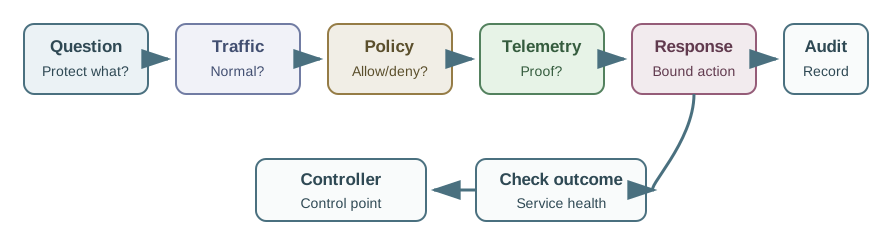
SDN can improve data-center security when it gives operators precise policy, current traffic observations, bounded response actions, and an audit record that survives the incident.

  • For an IoT data-center zone, make that relationship concrete.
  • They should not initiate gateway-to-gateway sessions, reach the time-series database directly, or call the controller API.

Why it matters

The controller is useful because it can express policy and program forwarding behavior quickly.

Start with the workload question, then connect policy, telemetry, response, controller protection, and audit proof.
iotclass.org

Major section

Security Is A Proof Loop (continued)

The controller is useful because it can express policy and program forwarding behavior quickly.

  • Approved traffic reaches the intended broker, service, storage layer, or management endpoint through a named path and protocol family.
  • East-west, management, or lateral movement that should not happen is blocked or logged with enough context to prove the policy.
  • Showing that approved telemetry arrived is incomplete unless the denied lateral or management path was also checked.
iotclass.org

Major section

Segmentation Record

Micro-segmentation is stronger than a subnet label only when it records allowed relationships, denied relationships, rule ownership, and observations from the data plane.

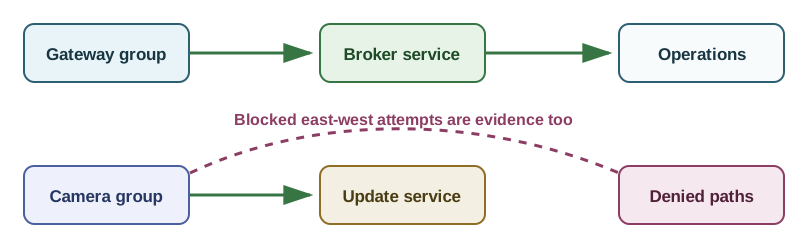
  • For IoT workloads, useful records usually name gateways, brokers, analytics services, storage, update services, operations hosts, and any local fallback path that must continue when the data-center path is degraded.
  • This supports segmentation record.

Key terms

Gateway group
Gateway group is read alongside Update service.
Blocked east-west attempts
Blocked east-west attempts are evidence too adds the remaining acceptance cue.
Segmentation proof names groups, allowed relationships, denied relationships, rule ownership, and observed traffic behavior.
iotclass.org

Major section

Segmentation Record (continued)

The controller rule diff shows intent.

  • Switch or gateway acknowledgement shows the rule was accepted.
  • For a Kubernetes-hosted broker, include the NetworkPolicy or Cilium policy that protects the pod boundary; for an OVN or Open vSwitch path, capture the logical policy, flow-table change, and representative counters.
  • The service path, protocol family, and traffic class that should pass.
iotclass.org

Major section

Segmentation Record (continued)

The record should let an operator explain why a policy is safe without opening the controller UI.

  • East-west, management, or storage paths that should be blocked or logged.
  • The bounded action that can run when telemetry crosses the trigger.
  • Between them, the segmentation record relationship becomes visible: Response playbooks should be prebounded before automation changes live forwarding behavior.
iotclass.org

Major section

Controller Protection and Telemetry

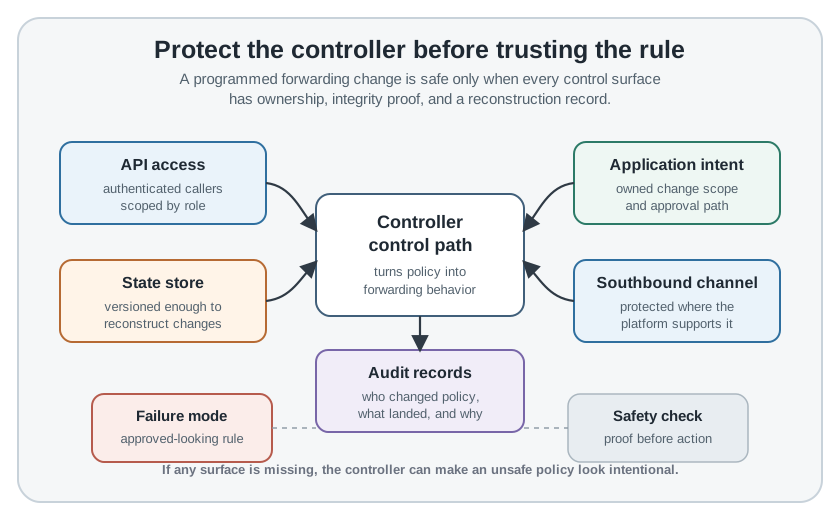
Its API, application permissions, state store, southbound channel, and audit trail must be treated as part of the security boundary.

  • A compromised or confused controller can make an approved-looking rule unsafe.
  • API callers should be authenticated, authorized by role, and scoped to workload groups they are allowed to change.
  • Telemetry also needs context.

Why it matters

The controller has unusual power because it can turn policy into forwarding behavior.

Controller security checks cover API access, application intent ownership, state-store integrity, protected southbound channels, change approval, and audit reconstruction before a forwarding rule is trusted.
iotclass.org

Major section

Controller Protection and Telemetry (continued)
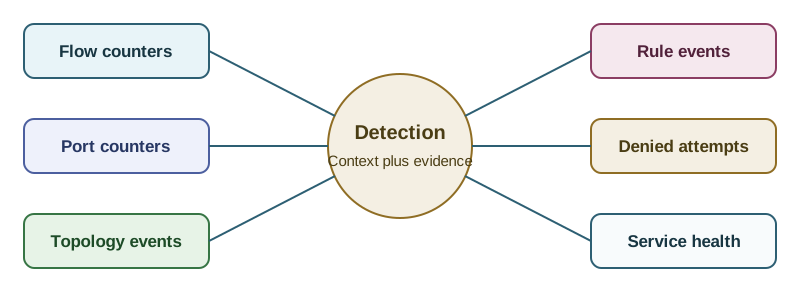
A break in any of those surfaces can create a rule that looks intentional while bypassing the real approval path.

  • Flow counters, port counters, topology events, rule changes, denied attempts, and service health are raw signals.
  • That context is what separates detection from disruption.
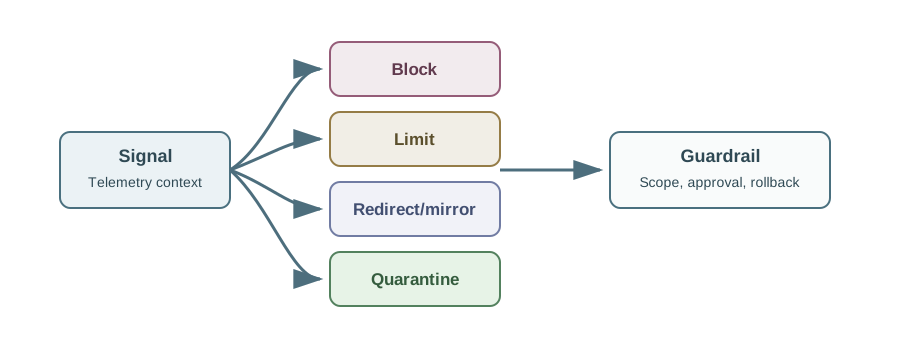
  • The safest automated response is usually staged.
iotclass.org

Major section

Controller Protection and Telemetry (continued)

The controller has unusual power because it can turn policy into forwarding behavior.

  • A denied-attempt counter may mean reconnaissance, a misconfigured gateway image, a broker migration, or a stale group assignment.
  • The same event should appear in operational logs or the SIEM with enough source, destination, policy, and action detail for an incident responder to decide whether to isolate, rate-limit, mirror, or simply fix inventory.
  • Old state can steer traffic into the wrong boundary.
iotclass.org

Major section

Controller Protection and Telemetry (continued)

Mirror or log first when confidence is low, limit or redirect when service health can tolerate it, and quarantine only when the trigger, ownership, and blast radius are proven.

  • A gateway group that carries freezer alarms or access-control events may need local continuity even while its data-center path is restricted.
  • The controller can make the change quickly, but the system is only secure when the resulting traffic, service health, and rollback evidence are visible.
  • This continues controller protection and telemetry: Telemetry is useful when it links the signal, baseline, policy context, affected asset, action, and result.
iotclass.org

Deck summary

Key takeaways

It must still reach its record store.

  • It should not report a clean state when it cannot see the path.
  • SDN can improve data-center security when it gives operators precise policy, current traffic observations, bounded response actions, and an audit record that survives the incident.
  • The controller is useful because it can express policy and program forwarding behavior quickly.
  • Micro-segmentation is stronger than a subnet label only when it records allowed relationships, denied relationships, rule ownership, and observations from the data plane.
iotclass.org

Retrieval practice

Recall check 1 of 3

Cloud Clara says: answer from memory, then check your reasoning.

Q1An IoT data-center team says SDN will improve security for camera gateways and telemetry brokers. Which first record keeps that claim testable?

AA controller screenshot showing the camera group exists, plus a note that broker and management paths will be checked later.
BA workload record with gateway groups, broker path, denied paths, proof, owner, and review.
CA reference diagram labeling SDN as the security layer, with workload details deferred to deployment.
DA broad automation rule that quarantines any gateway group after one unusual packet in the data center.
Show answer

Answer: B SDN security decisions become trustworthy when policy intent, forwarding state, telemetry, response limits, and audit records are connected for a specific workload.

iotclass.org

Retrieval practice

Recall check 2 of 3

Cloud Clara says: answer from memory, then check your reasoning.

Q2A policy allows gateway telemetry to a broker and denies gateway-to-gateway traffic. Which proof best shows the segmentation is working?

AA policy statement and planned counter review after the next maintenance window.
BA controller inventory list plus group names for all camera and gateway devices.
CA vendor statement that SDN supports micro-segmentation for data centers.
DRule diff, device ack, broker counters, denied attempts, and change record.
Show answer

Answer: D Segmentation proof should connect group intent to rule changes, device acknowledgements, allowed traffic observations, denied traffic observations, and a durable record.

iotclass.org

Retrieval practice

Recall check 3 of 3

Cloud Clara says: answer from memory, then check your reasoning.

Q3An SDN controller detects repeated denied attempts from an IoT gateway group. What must the team check before allowing an automatic quarantine action?

AOnly that the denied-attempt counter increased and the controller can still reach the gateway group.
BThat the controller can issue a quarantine rule quickly without checking broker or service impact.
CCheck baseline, scope, owner, rule diff, approval, impact, rollback, and audit.
DThat another environment used the same controller product for a similar data-center policy.
Show answer

Answer: C Controller-driven response should be bounded by trustworthy telemetry, authority, blast-radius limits, service-health checks, rollback, and audit proof.

iotclass.org

Print reference

Answers

Answer key.

  1. B · SDN security decisions become trustworthy when policy intent, forwarding state, telemetry, response limits, and audit records are connected for a specific workload.
  2. D · Segmentation proof should connect group intent to rule changes, device acknowledgements, allowed traffic observations, denied traffic observations, and a durable record.
  3. C · Controller-driven response should be bounded by trustworthy telemetry, authority, blast-radius limits, service-health checks, rollback, and audit proof.
iotclass.org