Cloud, SDN & Production Architectures · Study deck

SDN Controller Selection and Comparison

A gateway is a node that joins one network to another.

Cloud Clara is your guide for this deck.

controllers
Cloud Clara, the module guide, in a scene from this chapter.
iotclass.org

After studying this chapter

Learning objectives

You will be able to:

  • Compare SDN controller candidates using selection lenses (service intent, topology scope, interface fit, state ownership, availability, lifecycle support)
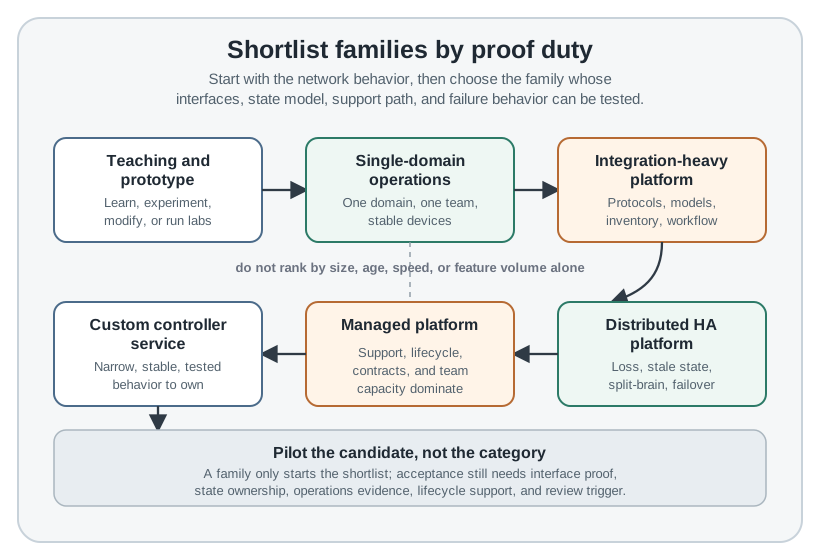
  • Classify controller candidates into fit families (teaching/prototype, single-domain, integration-heavy, distributed HA, managed platform, custom)
  • Build a proof matrix that separates what a candidate must prove, should prove, and should not be assumed
  • Run a representative pilot (rule install, rollback, receiver proof, degraded-mode test) before accepting a controller for production scope
iotclass.org

Major section

Begin With One Change the Network Must Make

A gateway is a node that joins one network to another.

  • QoS means rules that give some traffic a chosen level of service.
  • Telemetry means records sent from a system so its state can be watched.
  • A controller may help set and check that rule.
  • A feature list does not prove site fit.
iotclass.org

Major section

Begin With One Change the Network Must Make (continued)

A rich controller can make change fast, but it adds state, access, and update duties.

  • A simple tool may be easier to run, but it may lack a needed view or interface.
  • Those routes turn one service test into a bounded choice.
  • When control returns, compare wanted and real state before more change.
iotclass.org

Major section

Selection Lenses · Controller Fit Families
Controller comparison should start with questions, not names.

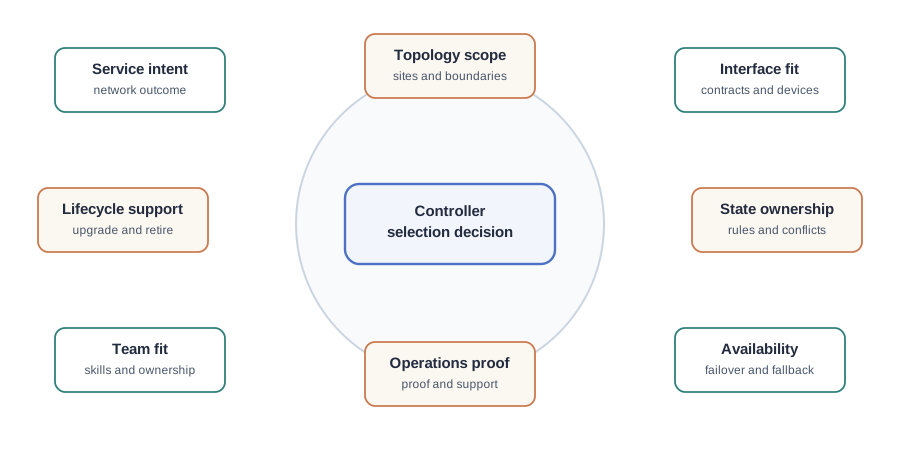
  • Its specific claim is: SDN controller selection lenses covering service intent, topology scope, interface fit, state ownership, availability behavior, operations proof, team fit, and lifecycle support.
  • Controller candidates change over time.
  • The next controller fit families step needs Shortlist families by proof duty as a visual checkpoint.

Key terms

Best when the goal
Best when the goal is learning, rapid experiments, custom algorithms, or small controlled labs.

Why it matters

A controller family is not automatically better because it is larger, faster, smaller, newer, or easier to code against.

SDN controller selection lenses covering service intent, topology scope, interface fit, state ownership, availability behavior, operations proof, team fit, and lifecycle support.
iotclass.org

Major section

Proof Matrix

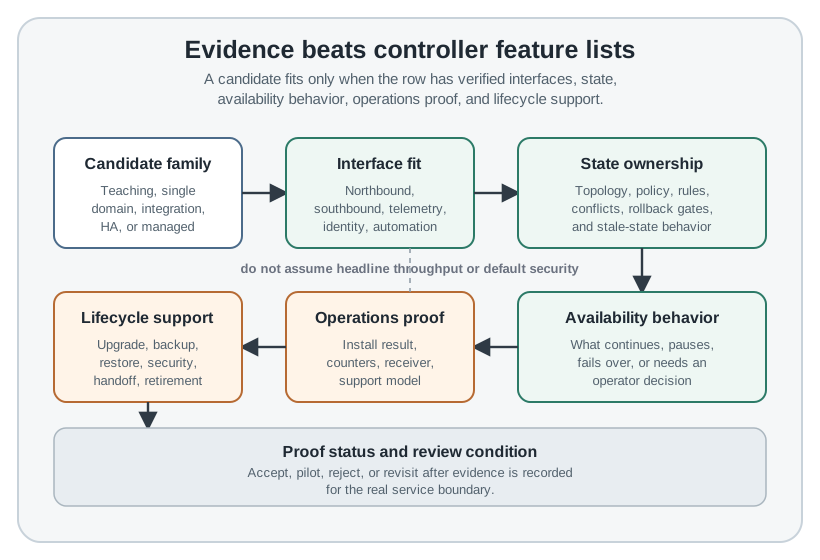
With do not assume headline throughput or default security included, their combined meaning is: Controller evidence matrix for comparing candidate families against interface fit, state ownership, availability behavior, operations proof, lifecycle support, and proof status.

  • Upgrade path, backup and restore, observability, support ownership, test automation, and degraded-mode behavior.
Controller evidence matrix for comparing candidate families against interface fit, state ownership, availability behavior, operations proof, lifecycle support, and proof status.
iotclass.org

Major section

Interface and Integration Fit · Use-Case Boundary Addendum

This prevents a candidate from looking acceptable because it has many APIs while still lacking the specific use-case proof needed for the deployment.

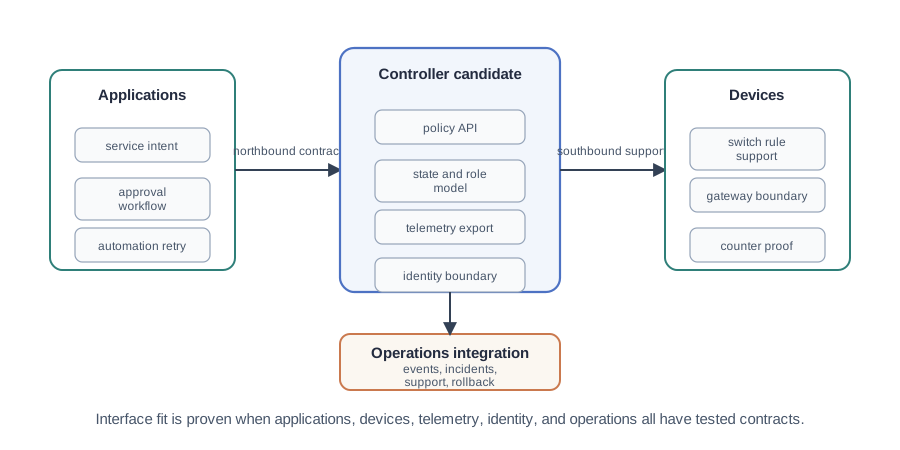
  • Between them, the interface and integration fit relationship becomes visible: SDN controller interface and integration fit.
SDN controller interface and integration fit
iotclass.org

Major section

Availability and Operations Fit · IoT Deployment Fit

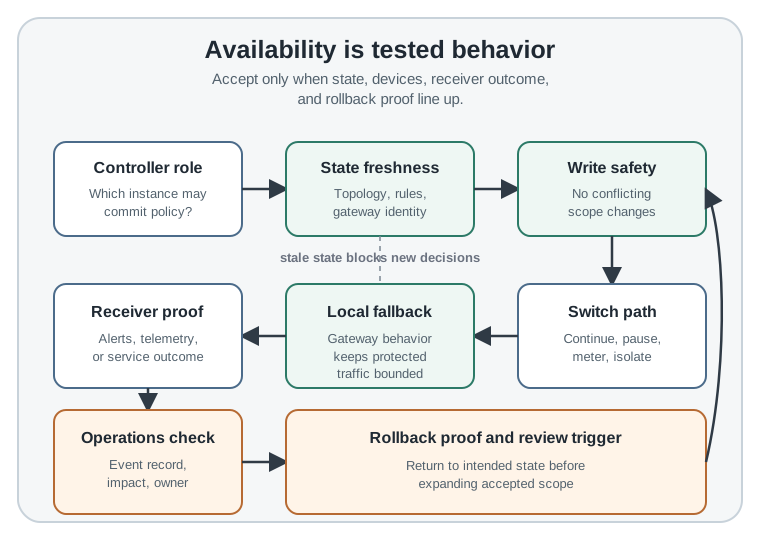
Availability is not a checkbox.

  • This path preserves the chapter’s availability and operations fit argument: SDN controller availability and operations fit proof route.
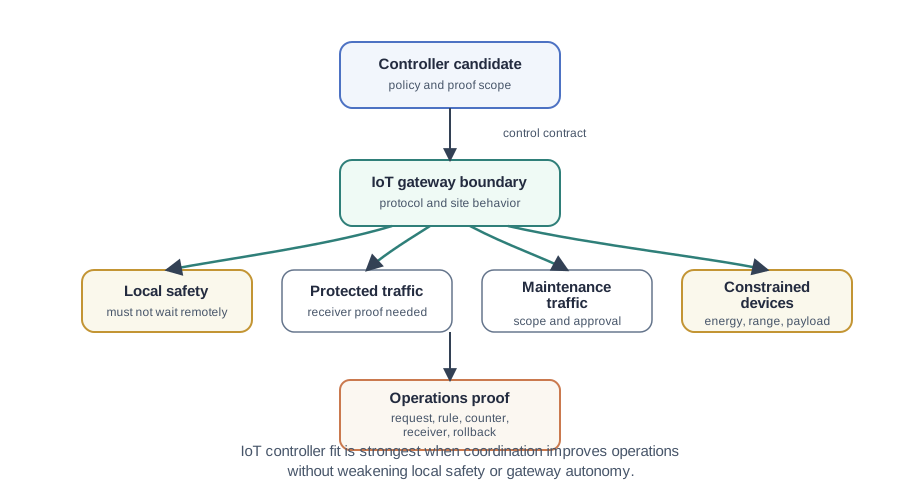
  • For IoT networks, availability checks must include local gateway behavior and protected receiver proof.
  • IoT controller selection is constrained by gateways, physical process behavior, device limits, and field operations.
SDN controller availability and operations fit proof route
iotclass.org

Major section

Proof Loop · Common Pitfalls

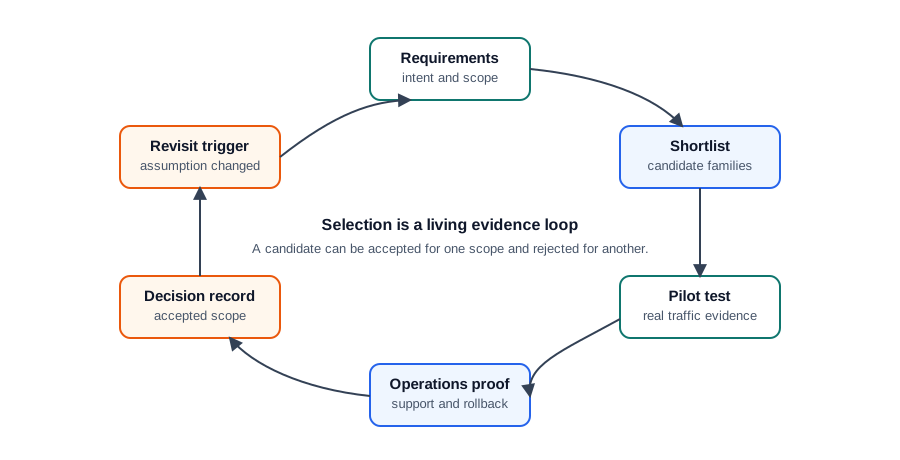
Selection proof should feed back into the architecture.

  • A candidate that fails the pilot may still be useful for a smaller scope, but it should not become the default by accident.
  • Throughput is only useful after the traffic model, rule churn, controller role, and measurement method are understood.
  • Skipping degraded-mode tests.
  • Assuming lab fit means production fit.
SDN controller selection proof loop connecting requirements, candidate shortlist, pilot test, operations proof, architecture decision, and review condition.
iotclass.org

Major section

Selection Is Proof Fit

An SDN controller is not selected by ranking names.

  • That observation connects this visual to the chapter's running narrative: use it to justify the next design decision and to record what evidence would confirm it in operation.
  • A name is not enough.
  • Those jobs share switches, but they do not share the same risk.

Why it matters

The three labels prevent a one-box selection is proof fit reading.

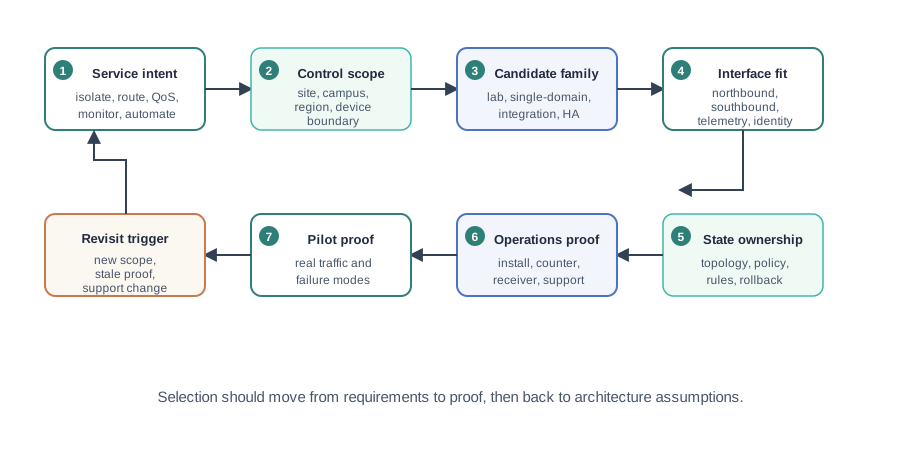
Choose a controller by following the proof route: name the service intent, set the control scope, shortlist the family, prove interface and state fit, capture operations evidence, pilot the real failure mode, and record the review trigger.
iotclass.org

Major section

Selection Is Proof Fit (continued)

Service fit: the candidate matches the intended network behavior and traffic class.

  • Small-screen read:: Selection moves from service intent and scope to candidate family, interface fit, state ownership, operations proof, pilot proof, and review trigger.
  • A practical selection starts with one representative path.
  • Operations fit: installation, upgrade, support, observability, backup, failover, and decommissioning are owned.
iotclass.org

Major section

Selection Is Proof Fit (continued)

Without that boundary, a controller choice becomes a preference for a product family rather than proof that the deployment behavior is safe.

  • A controller that is excellent for a teaching lab may be a poor production default if it cannot expose the right request contract, prove receiver outcomes, or survive the required degraded mode.
  • For an IoT building network, the controller may be asked to isolate maintenance laptops, preserve door-access alerts, meter camera streams, and keep environmental telemetry visible during a service event.
  • Interface fit: applications, devices, telemetry, identity, and automation use contracts the team can test.
iotclass.org

Major section

Controller Selection Record

This keeps the comparison tied to deployment facts instead of feature volume.

  • A controller selection record should be short enough to review and specific enough to test.
  • The accepted scope should say exactly what was proven.
  • Production acceptance should wait if the team has not tested stale topology, cluster-role failover, backup and restore, support handoff, or upgrade behavior.
iotclass.org

Major section

Controller Selection Record (continued)

Device firmware change, API change, automation owner change, or credential model change.

  • It should reject vague claims such as "supports SDN" or "has high availability" until they are connected to the actual devices, traffic classes, controller roles, and receiver outcomes in scope.
  • Topology expansion, clustering change, second automation path, or stale-state incident.
  • Runbook, logs, counters, backup and restore check, upgrade rehearsal, support owner, and decommissioning step.
iotclass.org

Major section

Controller Selection Record (continued)

For a maintenance-isolation use case, install a rule with an expiry, confirm maintenance traffic is limited, confirm door-access alerts still arrive, read the affected counters, force controller contact loss, and perform rollback.

  • Ownership transfer, support-status change, failed upgrade, or recovery drill gap.
  • The record should produce an accepted scope and a rejected scope.
  • That distinction matters: a candidate can be valid for lab training or a single building while still being rejected for multi-site failover or safety-adjacent traffic.
iotclass.org

Major section

State Makes Rankings Stale

A candidate can look correct while it is using an old topology, an expired gateway identity, a missing receiver signal, or an untested cluster role.

  • Stale state is the hidden failure mode.
  • The implementation detail that matters is the chain between an intent request and the dataplane rule.
  • Lifecycle change creates the same risk over months.

Why it matters

Controller rankings decay because controller projects, managed services, device firmware, switch pipelines, API contracts, and operating teams change.

iotclass.org

Major section

State Makes Rankings Stale (continued)

A new tenant or camera stream can widen the scope of a rule that was originally safe for maintenance laptops.

  • The durable part of the decision is the state and lifecycle model: which controller can write which rules, using which topology view, with which conflict owner, and with which recovery path when conditions change.
  • Each step needs a freshness check and a visible failure mode.
  • A firmware update can alter table capacity or counter behavior.
iotclass.org

Major section

State Makes Rankings Stale (continued)

High availability does not remove this risk unless the design also prevents conflicting writes and defines what switches or gateways should do while controller contact is degraded.

  • If any step silently accepts old state, the system can install a rule that looks authorized but no longer matches the physical or operational reality.
  • The controller decision should therefore carry versioned assumptions and a retest path: topology source, controller role, southbound capability, protected receiver, fallback behavior, rollback command, and owner.
  • When one assumption changes, the accepted scope should shrink until the proof is current again.
iotclass.org

Deck summary

Key takeaways

A gateway is a node that joins one network to another.

  • A rich controller can make change fast, but it adds state, access, and update duties.
  • Controller comparison should start with questions, not names.
  • With do not assume headline throughput or default security included, their combined meaning is: Controller evidence matrix for comparing candidate families against interface fit, state ownership, availability behavior, operations proof, lifecycle support, and proof status.
  • This prevents a candidate from looking acceptable because it has many APIs while still lacking the specific use-case proof needed for the deployment.
iotclass.org

Retrieval practice

Recall check 1 of 3

Cloud Clara says: answer from memory, then check your reasoning.

Q1A building operator compares SDN controllers for door-access alerts, telemetry, camera streams, and maintenance updates on shared switches. Which first comparison keeps the controller choice traceable?

ACompare traffic classes, scope, rule support, proof, stale-state handling, rollback, and owners.
BRank candidates by published throughput, then separate door alerts, cameras, telemetry, and maintenance traffic after the switch path is already in pilot.
CPick the smallest controller because fewer APIs always reduce production risk across the shared switch path and gateway boundary.
DChoose the controller that appears most often in SDN diagrams, then assume its gateway behavior matches the building deployment.
Show answer

Answer: A Controller comparison should begin with the protected traffic classes, topology scope, interfaces, state ownership, observed receiver outcomes, degraded-mode behavior, rollback ownership, support ownership, and the condition that forces review.

iotclass.org

Retrieval practice

Recall check 2 of 3

Cloud Clara says: answer from memory, then check your reasoning.

Q2A controller candidate passes a lab rule-install test, but the team has not tested rollback, stale topology, receiver outcome, or support ownership. What should the selection record say?

AAccept only the tested scope; require rollback, stale-state, receiver, and support proof.
BAccept it for production because one successful rule install proves the controller works across the full service path.
CReject all SDN controller use because the first pilot did not prove every deployment condition or support path.
DReplace the scoped record with a product-feature table so missing rollback and receiver tests look easier to compare.
Show answer

Answer: A Controller selection records should preserve accepted scope, rejected scope, unresolved assumptions, and the evidence required before widening deployment.

iotclass.org

Retrieval practice

Recall check 3 of 3

Cloud Clara says: answer from memory, then check your reasoning.

Q3Why can an old SDN controller comparison become unsafe even when the original candidate still exists?

ARetest when topology, support, roles, APIs, owners, or failure behavior change.
BBecause every controller becomes obsolete when a newer release appears, so teams should reselect the newest platform first.
CBecause high-availability controllers remove stale-state risk, so degraded-mode testing can move after deployment.
DBecause implementation language controls state freshness more than topology ownership, device support, or operating procedures.
Show answer

Answer: A Controller decisions must be revisited when state, support, device, interface, or failure-mode assumptions change.

iotclass.org

Print reference

Answers

Answer key.

  1. A · Controller comparison should begin with the protected traffic classes, topology scope, interfaces, state ownership, observed receiver outcomes, degraded-mode behavior, rollback ownership, support ownership, and the condition that forces review.
  2. A · Controller selection records should preserve accepted scope, rejected scope, unresolved assumptions, and the evidence required before widening deployment.
  3. A · Controller decisions must be revisited when state, support, device, interface, or failure-mode assumptions change.
iotclass.org