Cloud, SDN & Production Architectures · Study deck
SDN Anomaly Detection: Deployment and Proof Loops
In software-defined networking (SDN), a controller changes rules that direct traffic.
Cloud Clara is your guide for this deck.

After studying this chapter
Learning objectives
You will be able to:
- Fit anomaly controls to an IoT gateway deployment.
- Build a proof loop for containment and recovery.
- Explain: A building gateway begins contacting many internal destinations that are not part of its normal telemetry path.
- Explain: The proof supports limiting the unusual class and redirecting a sample for inspection, but it does not yet justify blocking all gateway traffic.
Major section
Walkthrough: Gateway Scan Triage
A building gateway begins contacting many internal destinations that are not part of its normal telemetry path.
- The goal is to decide whether the behavior is a scan, a planned management task, a topology change, or a monitoring artifact.
- Topology events for recent path changes.
- Receiver proof showing whether expected telemetry still arrives.
Major section
Walkthrough: Gateway Scan Triage (continued)
The proof supports limiting the unusual class and redirecting a sample for inspection, but it does not yet justify blocking all gateway traffic.
- Response: The response gate chooses a temporary rate limit for the unusual internal-destination class and redirects matching traffic for inspection.
- Telemetry and management exceptions remain explicit.
- The rule has an owner, expiry, and rollback note.
Major section
Proof Loop
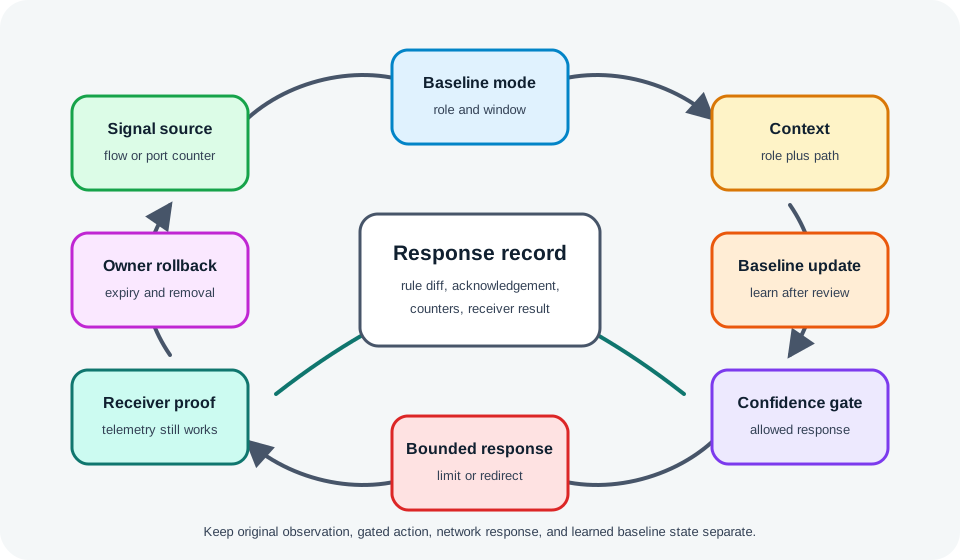
Anomaly detection should improve after every checked event.
- The loop is incomplete until the result updates a baseline, policy note, owner record, or response gate.
- The signal source and operating-mode baseline establish what was unusual before any rule changes traffic.
- Context and a confidence gate decide whether a limit, redirect, isolate, or block action is allowed.
Major section
Common Pitfalls
Using one global threshold: different device roles, traffic classes, paths, and operating modes need different baselines.
- Letting alerts write broad rules: detection should pass through a confidence and service-risk gate before strong action.
- Ignoring expected exceptions: maintenance, updates, recovery, and startup can look unusual if the baseline does not include mode context.
- Confusing containment with remediation: a network rule can reduce risk, but the device and application still need investigation.
Major section
An Alert Is Not The Answer
A gateway may show unusual destinations, a sensor group may change rate, or a camera segment may burst traffic.
- An SDN anomaly alert is a question about behavior, not a verdict.
- That keeps anomaly detection practical for IoT.
- The response should be bounded by proof, service risk, and rollback rather than by alert severity alone.
Major section
An Alert Is Not The Answer (continued)
OpenFlow flow counters or Open vSwitch rule counters can show the new destination class.
- The useful skill is to ask what changed, which baseline it was compared with, which service could be harmed, and what response can reduce risk without turning the network into the outage.
- A destination-fan-out alert is meaningful only after the detector joins the new internal destinations to that role model.
- Controller state can show whether the path was expected.
Major section
An Alert Is Not The Answer (continued)
The alert should name the gateway group, the normal broker path, the unusual destination set, the observation window, the topology version, and the service that might be harmed by an SDN response.
- The first decision is not "block or ignore." It is whether the evidence is strong enough for a bounded action.
- Broker-side counters can prove whether required telemetry still arrives.
- Good anomaly handling therefore has two promises.
Major section
An Alert Is Not The Answer (continued)
It reduces risk from behavior that does not fit the device role, and it protects the traffic the facility still needs.
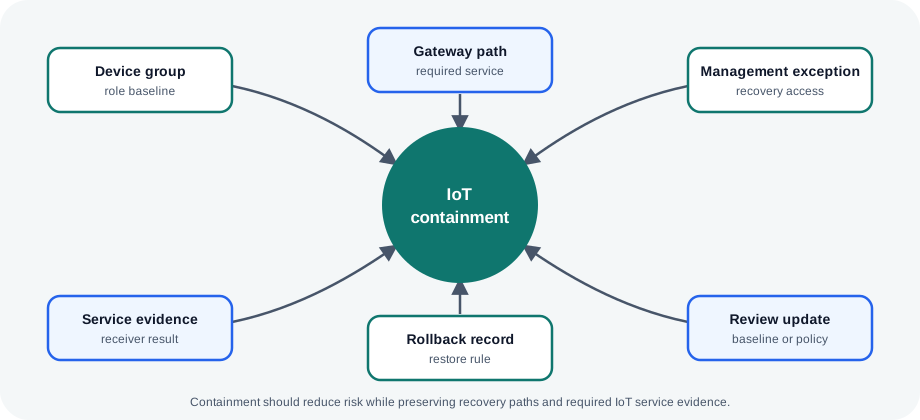
- A freezer alarm gateway, door controller, or camera gateway may need telemetry, management recovery, and update paths even while suspicious lateral traffic is contained.
- The record should preserve the pre-response evidence so a later analyst can tell whether the alert was compromise, misconfiguration, maintenance, or a detector blind spot.
- A recent firmware rollout, maintenance scan, DHCP change, or topology repair can explain behavior that would otherwise look hostile.
Major section
Write The Response Budget
The action budget should be just as explicit.
- At higher confidence, limit the unusual destination class for a short window.
- Isolate or block only when the owner, expiry, rollback command, and service proof are already written.
- The goal is for an operator on the next shift to know what the SDN system was allowed to do and why it did not break required IoT service paths.
Major section
Containment Changes Signals
A containment rule does not only reduce traffic; it changes the observation environment.
- After a limit, redirect, isolate, or block action, later counters may reflect the response itself rather than the original behavior.
- The detector also needs a feedback rule.
- Mixing them makes the next alert harder to interpret.
- Baseline learning should be conservative.
Major section
Containment Changes Signals (continued)
A topology event can explain a path change but not prove the broker stayed healthy.
- A true incident can update a signature, a false positive can update an exclusion, and a maintenance event can update the operating-mode calendar.
- A broker metric can prove received messages but not explain unexpected lateral attempts.
- The same separation protects rollback.
Major section
Containment Changes Signals (continued)
Implementation details matter because each signal has a different failure mode.
- The under-the-hood discipline is to separate four states: original observation, gated decision, network response, and learned baseline change.
- A flow counter can rise because a gateway is scanning, because a maintenance tool is discovering devices, or because a rule moved traffic into a different table.
- This separation prevents the SDN system from teaching itself that every successful containment action was a false alarm.
Major section
Containment Changes Signals (continued)
A useful detector stores enough raw context to reconstruct the event: source group, destination group, port or protocol, controller policy version, rule priority, timeout, baseline id, and receiver result.
- If a temporary limit hides the fan-out traffic, the post-response quiet period is not evidence that the new behavior is normal.
- If the containment rule degrades telemetry, the operator needs to remove the rule or reduce it without losing the incident record.
- If the rule reduces lateral traffic while the broker remains healthy, the team still needs endpoint or application investigation before changing normal behavior.
Deck summary
Key takeaways
A building gateway begins contacting many internal destinations that are not part of its normal telemetry path.
- The proof supports limiting the unusual class and redirecting a sample for inspection, but it does not yet justify blocking all gateway traffic.
- Anomaly detection should improve after every checked event.
- Using one global threshold: different device roles, traffic classes, paths, and operating modes need different baselines.
- A gateway may show unusual destinations, a sensor group may change rate, or a camera segment may burst traffic.
Retrieval practice
Recall check 1 of 2

Cloud Clara says: answer from memory, then check your reasoning.
Q1An SDN anomaly detector sees a gateway contacting many new internal destinations, but expected telemetry is still arriving normally. What is the safest first response when policy permits temporary containment?
Show answer
Answer: B The safest SDN response keeps detection and containment proportional.
Retrieval practice
Recall check 2 of 2
Cloud Clara says: answer from memory, then check your reasoning.
Q2An SDN detector limits unusual gateway traffic and the alert clears. What record is still needed before changing the baseline?
Show answer
Answer: A SDN anomaly response changes the signals used for later decisions, so baseline updates need pre-response evidence, response state, receiver proof, protected-path checks, and an investigation result.
Print reference
Answers
Answer key.
- B · The safest SDN response keeps detection and containment proportional.
- A · SDN anomaly response changes the signals used for later decisions, so baseline updates need pre-response evidence, response state, receiver proof, protected-path checks, and an investigation result.