Privacy & Compliance · Study deck
Implementing IoT Security Controls
Picture a care-home door sensor that should report only through its approved path.
Privacy Priya is your guide for this deck.

After studying this chapter
Learning objectives
You will be able to:
- Explain: The cloud service accepts commands only from named operator roles, while the maintenance process proves that update packages are signed, rollback has been tested, and drift from the approved configuration raises an alert.
- Explain: The point of layering is that a gap in one control is caught or contained by another: if a boundary rule is misconfigured, identity and monitoring still limit and reveal the damage.
- Explain: The deeper layer explains why controls must be a coordinated set rather than a checklist, and why the hardest IoT problem is keeping them true over a long field life.
Major section
Start Simple
Firmware is the software stored on a device.
- A gateway is the local device or service that joins the sensor path to wider systems.
- A control is useful only when those parts enforce a clear rule and leave proof.
- A green dashboard does not prove that a blocked route or recovery step works.
Major section
Start Simple (continued)
This opening does not claim that one control covers every risk.
- Practitioner selects a set of preventive, detective, response, and recovery controls.
- Under the Hood examines overlap, gaps, drift, exceptions, evidence age, and the changes that reopen review.
- In IoT, controls must survive real devices, constrained firmware, gateways, cloud services, field updates, and long maintenance cycles.
Major section
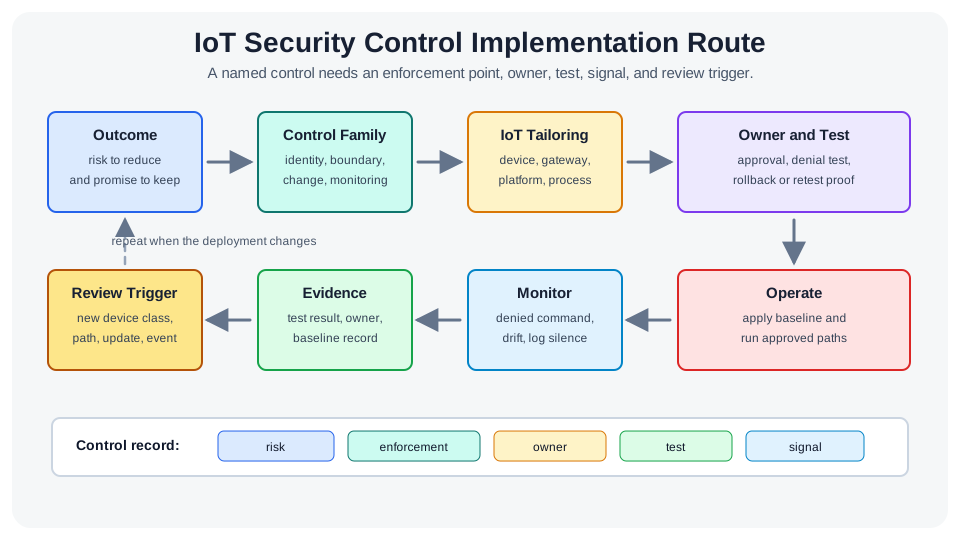
Overview: From a Framework Outcome to a Running Control
Implementation is the bridge between the two.
- The key shift is that a control is not finished when it is named. "We have access control" is a slogan.
- A room sensor has a unique credential and a known firmware version.
- Controls also come in four kinds that work together: preventive controls reduce opportunity, detective controls reveal change, and responsive and recovery controls restore the system with evidence.
Major section
Overview: From a Framework Outcome to a Running Control (continued)
A gateway admits only approved device identities, forwards telemetry to the MQTT broker, blocks peer-to-peer device traffic, and records denied attempts.
- The cloud service accepts commands only from named operator roles, while the maintenance process proves that update packages are signed, rollback has been tested, and drift from the approved configuration raises an alert.
- If you only need the intuition, this layer is enough: pick the outcome, choose a control, name the exact enforcement point and owner, and keep evidence that it works.
- The sections below expand each link, beginning with the families that organize related controls.
Major section
Overview: From a Framework Outcome to a Running Control (continued)
For IoT this must span the whole device lifecycle, because a control means little if it cannot survive constrained devices, long field life, and remote updates.
- And controls protect privacy only when they are matched to the actual data risk and data flow.
- The outcome is the goal; the control is the enforced safeguard at a named point in the device, gateway, network, service, or process.
- Preventive, detective, responsive, and recovery controls form a set; no single one carries the whole system.
Major section
Practitioner: Select, Tailor, and Operate
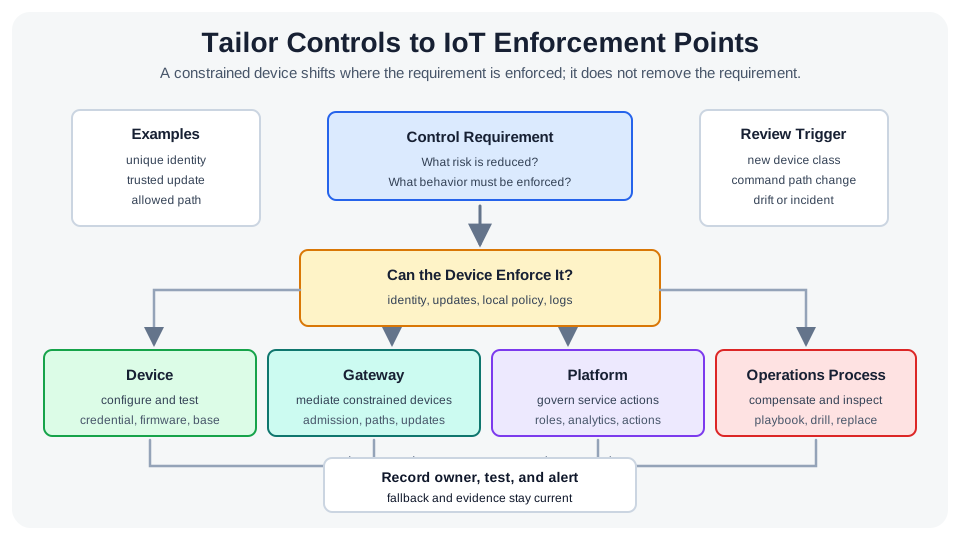
The full catalog is broad, so IoT teams start by mapping controls to the parts of the system that can actually enforce them.
- Five families do most of the work: identity and access, configuration and change, communication and boundary, monitoring, and response and recovery.
- IoT devices are often constrained, long-lived, and hard to reach physically.
- A constrained sensor that cannot verify updates itself, for example, can sit behind a gateway that validates update packages on its behalf.
Major section
Practitioner: Select, Tailor, and Operate (continued)
Moving enforcement to a gateway or process is therefore not a waiver: it creates a different implementation and proof obligation.
- Configuration and change.
- Approved baseline, controlled change, drift, rollback.
- Allowed paths, protocol limits, separated command paths.
- Strong controls describe what is permitted, not only what is blocked.
Major section
Practitioner: Select, Tailor, and Operate (continued)
For identity, identify each actor, state its allowed actions, bind access to context (device state, version, purpose), and keep a clean revocation path.
- For configuration, record the approved baseline (firmware, enabled services, endpoints, logging, update channel), require change review, check drift continuously, and keep a tested rollback.
- For communication, write each rule as source, destination, purpose, allowed protocol, and evidence, so devices send telemetry to a gateway rather than to arbitrary peers, and management interfaces are reachable only from approved operator paths.
- If you can select a family, tailor its enforcement point, and prove it with a test, you can stop here.
Major section
Under the Hood: Layers, Compensation, and Drift
The deeper layer explains why controls must be a coordinated set rather than a checklist, and why the hardest IoT problem is keeping them true over a long field life.
- No single layer should carry the system.
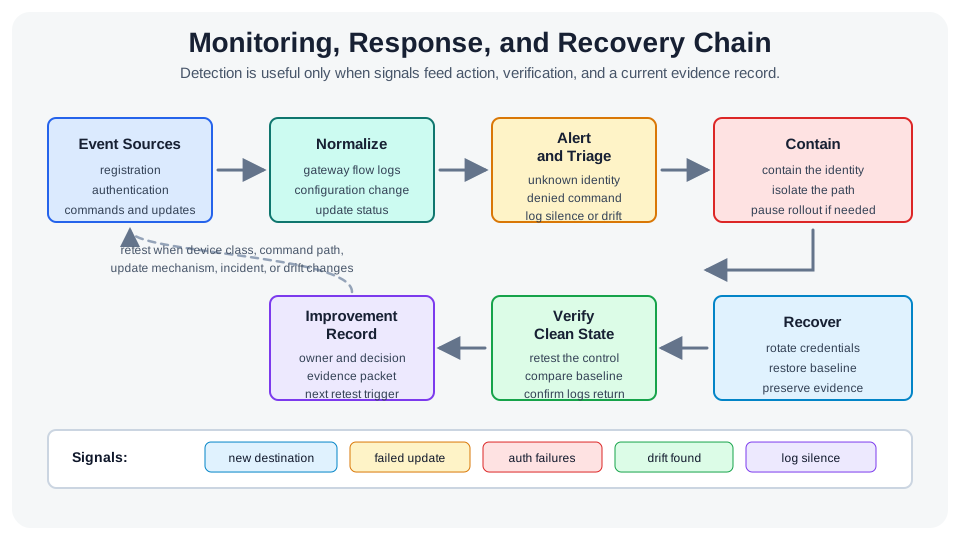
- Detective controls are only useful if they feed action.
- Each actor can be authorized and revoked cleanly.
Major section
Under the Hood: Layers, Compensation, and Drift (continued)
The final retest trigger closes the loop when code, configuration, or topology changes.
- The point of layering is that a gap in one control is caught or contained by another: if a boundary rule is misconfigured, identity and monitoring still limit and reveal the damage.
- A design that leans entirely on one strong layer, such as a firewall, fails completely the moment that layer is bypassed.
- Enrollment that rejects duplicates; a revocation test.
Major section
Under the Hood: Layers, Compensation, and Drift (continued)
Evidence has the same problem: a record gathered once for a deadline is stale almost immediately.
- When a constrained device cannot enforce a control itself, the requirement does not disappear; it shifts to a compensating control elsewhere.
- Shared identities make least privilege and revocation impossible.
- Unverified updates allow tampered or rolled-back firmware.
Major section
Under the Hood: Layers, Compensation, and Drift (continued)
The useful record is the one maintained through release, monitoring, incidents, and change, with a named owner and a retest trigger.
- The critical discipline is to make the assumption explicit. "The gateway handles it" is not a control until the record names the gateway rule, the owner, the test, the alert, and the fallback action.
- A device reaches services or peers it should never touch.
- Departures from the baseline are noticed.
Major section
Under the Hood: Layers, Compensation, and Drift (continued)
Concrete signals—unknown identity, denied command, new destination, failed update, log silence, or drift—must map to containment, recovery, and verification rather than stop at an alert.
- This ordered chain connects monitoring to the chapter's running control record: a named signal, owner, action, recovery proof, and condition for checking the control again.
- A clean, known-good state can be restored.
- An incident has no proven path back to normal.
Major section
Under the Hood: Layers, Compensation, and Drift (continued)
A control that passed at release can quietly fail after a new endpoint, an update package, a changed gateway rule, an added data path, or an expanded support process.
- The defense is to compare observed state against the approved baseline continuously and to treat unexpected service exposure, log silence, and unknown software as review triggers.
- A trustworthy review asks where each control is enforced, what compensates when the device cannot, and what test proves it still works.
- Network filtering, device hardening, encryption, and monitoring each reduce a different slice of risk and each can fail in a different way.
Deck summary
Key takeaways
Firmware is the software stored on a device.
- This opening does not claim that one control covers every risk.
- Implementation is the bridge between the two.
- A gateway admits only approved device identities, forwards telemetry to the MQTT broker, blocks peer-to-peer device traffic, and records denied attempts.
- For IoT this must span the whole device lifecycle, because a control means little if it cannot survive constrained devices, long field life, and remote updates.
Retrieval practice
Recall check 1 of 4

Privacy Priya says: answer from memory, then check your reasoning.
Q1A deployment has network filtering, but the devices cannot identify themselves uniquely, cannot report their configuration state, and cannot receive authenticated updates. What is the strongest review finding?
Show answer
Answer: B Boundary filtering reduces exposure, but it cannot substitute for the device-lifecycle capabilities that controls depend on.
Retrieval practice
Recall check 2 of 4
Privacy Priya says: answer from memory, then check your reasoning.
Q2A sensor is supposed to send telemetry only through a gateway, but a test shows it can connect directly to the cloud service. Which control needs attention first?
Show answer
Answer: C The intended path is sensor to gateway to service.
Retrieval practice
Recall check 3 of 4
Privacy Priya says: answer from memory, then check your reasoning.
Q3A gateway rule passed release tests, then a new endpoint appears. What should the control owner do?
Show answer
Answer: A A control can drift after release; its evidence must be renewed.
Retrieval practice
Recall check 4 of 4
Privacy Priya says: answer from memory, then check your reasoning.
Q4A constrained sensor cannot verify firmware signatures itself and cannot report its configuration state. Which option gives a valid compensation for the firmware-update gap?
Show answer
Answer: A A constrained device shifts where a control is enforced rather than removing it; the compensating control must be explicit and tested.
Print reference
Answers
Answer key.
- B · Boundary filtering reduces exposure, but it cannot substitute for the device-lifecycle capabilities that controls depend on.
- C · The intended path is sensor to gateway to service.
- A · A control can drift after release; its evidence must be renewed.
- A · A constrained device shifts where a control is enforced rather than removing it; the compensating control must be explicit and tested.