Privacy & Compliance · Study deck
NIST Cybersecurity Framework for IoT
Imagine a care service that depends on home alert units.
Privacy Priya is your guide for this deck.

After studying this chapter
Learning objectives
You will be able to:
- apply the NIST framework as a map of outcomes, not a specific product
- use the framework functions to profile a gap in an IoT deployment
- connect the framework's structure to privacy and evidence requirements
- Explain: A stolen password, missed update, or silent device could delay help.
Major section
Start Simple
A stolen password, missed update, or silent device could delay help.
- A long security checklist is useful only when each item protects a real service and has an owner.
- The NIST Cybersecurity Framework is a shared way to organise security work.
- A warning matters because someone can decide what to do.
Major section
Start Simple (continued)
A list of devices matters because the team cannot protect an unknown unit.
- A saved copy matters because the care service can return without losing needed history.
- The framework does not choose every control or prove compliance by itself.
- Under the Hood examines risk, control strength, records, and assurance.
Major section
Overview: A Map of Outcomes, Not a Product
The NIST Cybersecurity Framework is a voluntary, risk-based way to organize the work of protecting systems.
- Its strength is that it describes outcomes to achieve rather than a fixed list of products to buy, so it fits organizations of very different sizes and a device fleet as easily as a data center.
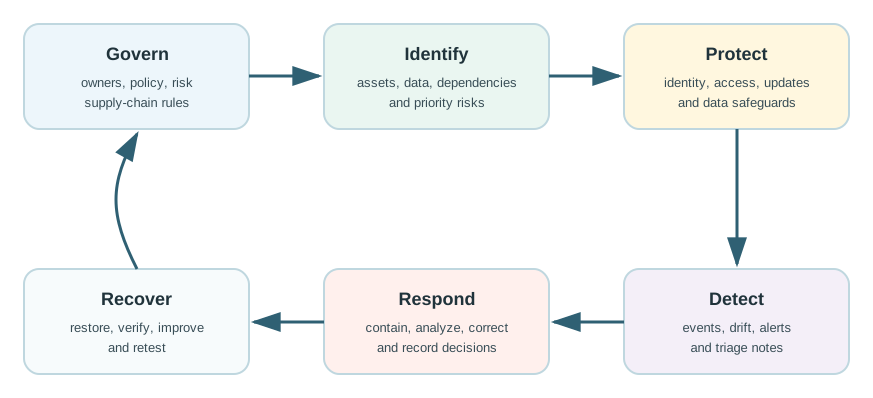
- The current version groups everything into six Functions: Govern, Identify, Protect, Detect, Respond, and Recover.
- NIST also publishes a companion Privacy Framework with a parallel structure for managing privacy risk.
- If you only need the intuition, this layer is enough: use the six Functions as a checklist of outcomes.
Major section
Overview: A Map of Outcomes, Not a Product (continued)
Govern the risk, know your assets, protect them, detect problems, respond, and recover.
- The checklist does not fly the plane, but it makes sure no critical step is forgotten and gives everyone a shared structure to follow under pressure.
- The framework's Functions are those phases for cybersecurity: a structure that keeps a team from protecting the obvious things while forgetting to detect, respond, or recover.
- Privacy is a companion frame.
Major section
Overview: A Map of Outcomes, Not a Product (continued)
The value is the sequence: each Function leaves evidence for the next one, so a reviewer can see how governance becomes operational proof.
- Governance assigns risk ownership; identification establishes the device, gateway, service, and dependency inventory; protection defines the baseline; detection exposes drift; response contains it; recovery restores service and feeds improvement back to governance.
- The route therefore connects framework language to the concrete records and tests developed throughout this safeguards chapter.
- The framework names results to achieve, which each team maps to its own controls and context.
Major section
Practitioner: Apply the Functions and Profile the Gap
For a campus sensor fleet, the scope might include wall-mounted occupancy sensors, BLE tags, PoE gateways, an MQTT broker, a cloud dashboard, the vendor support portal, and the maintenance laptop used for firmware updates.
- That profile gap is the work queue.
- Framework Outcome It Supports.
- Unknown devices that cannot be tracked or trusted.
Major section
Practitioner: Apply the Functions and Profile the Gap (continued)
Control over who and what can reach interfaces.
- The description of outcomes you currently achieve and the ones you target is called a Profile, and the distance between the two is your prioritized work.
- Devices shipping and staying in weak states.
- Devices that cannot be patched after a flaw.
Major section
Practitioner: Apply the Functions and Profile the Gap (continued)
The current Profile records what is true now: some devices have serial numbers in the asset tool, gateways accept unique credentials, logs reach the SIEM, and recovery depends on a manual vendor ticket.
- A high-risk gap might be "no authenticated firmware update for hallway gateways," tied to Protect and Recover.
- A lower-risk gap might be "asset owner missing for a small storage-room sensor," tied to Govern and Identify.
- This keeps the framework from becoming vocabulary and makes it a steering mechanism for the next sprint, change review, supplier discussion, and audit prep.
Major section
Practitioner: Apply the Functions and Profile the Gap (continued)
NIST's IoT guidance describes a core baseline of capabilities a connected device should be able to support, which gives the Protect and Detect Functions something specific to require of hardware and firmware.
- A current Profile records which outcomes the system achieves now; a target Profile records what it should achieve given its risk.
- Implementation Tiers describe how rigorous and repeatable the risk governance is, from informal and reactive toward adaptive and well-managed.
- Tiers are not a grade to chase for its own sake; they help a team decide how much rigor a given risk justifies.
Major section
Under the Hood: Structure, Privacy, and Evidence
The deeper layer explains how the framework is built, how the Privacy Framework extends it, and why the whole thing is only as good as the evidence behind each claimed outcome.
- The framework is layered.
- The most important idea it adds is that privacy risk is not only about breaches.
- Establish governance before scaling controls.
Major section
Under the Hood: Structure, Privacy, and Evidence (continued)
A claimed outcome with no evidence is just a hope.
- Each outcome can be linked to informative references, which point to detailed controls in other standards, so the framework organizes work without reinventing every control.
- The framework is named but no outcome is met.
- A target Profile is copied without scoping.
Major section
Under the Hood: Structure, Privacy, and Evidence (continued)
At this depth, the NIST frameworks are a layered structure of outcomes that organize both work and evidence.
- On top of this sit Implementation Tiers, which describe the rigor of risk governance, and Profiles, which capture current and target outcome states.
- Privacy risk from processing is ignored.
- Detect, Respond, and Recover are neglected.
Deck summary
Key takeaways
A stolen password, missed update, or silent device could delay help.
- A list of devices matters because the team cannot protect an unknown unit.
- The NIST Cybersecurity Framework is a voluntary, risk-based way to organize the work of protecting systems.
- Govern the risk, know your assets, protect them, detect problems, respond, and recover.
- The value is the sequence: each Function leaves evidence for the next one, so a reviewer can see how governance becomes operational proof.
Retrieval practice
Recall check 1 of 3
Privacy Priya says: answer from memory, then check your reasoning.
Q1How is the NIST Cybersecurity Framework best described?
Show answer
Answer: C The framework is a flexible structure of outcomes, not a product or a pass-or-fail certification.
Retrieval practice
Recall check 2 of 3
Privacy Priya says: answer from memory, then check your reasoning.
Q2In NIST CSF terms, what is a Profile?
Show answer
Answer: B A current Profile and a target Profile let a team prioritize the gap between where they are and where they need to be.
Retrieval practice
Recall check 3 of 3
Privacy Priya says: answer from memory, then check your reasoning.
Q3A connected product has strong security and suffers no breach, yet its always-on collection still creates a privacy problem. Which framework best fits a review of this risk?
Show answer
Answer: A The Privacy Framework recognizes that privacy events can occur from normal, authorized processing even with perfect security, which is exactly this case.
Print reference
Answers
Answer key.
- C · The framework is a flexible structure of outcomes, not a product or a pass-or-fail certification.
- B · A current Profile and a target Profile let a team prioritize the gap between where they are and where they need to be.
- A · The Privacy Framework recognizes that privacy events can occur from normal, authorized processing even with perfect security, which is exactly this case.