Privacy & Compliance · Study deck
Layered Safeguards for IoT
Picture a medicine fridge with a lock, a temperature alarm, and a daily review.
Privacy Priya is your guide for this deck.

After studying this chapter
Learning objectives
You will be able to:
- Explain: A review should narrow that framework to the domains, control objectives, and controls that fit the IoT service rather than treating an ISO label as proof that every data state is protected.
- Explain: This approach is often called defense in depth, and it is the difference between a system that is one mistake away from disaster and one that can absorb a mistake.
- Explain: A precise design checks that each added layer fails for different reasons than the others, because correlated failure is how a system that looks deeply protected collapses all at once.
Major section
Start Simple
The lock may stop casual access.
- The record should show which guard worked, which did not, and how long the gap lasted.
- More controls do not always mean more safety.
- The deeper sections group physical, technical, and team measures so every layer has a purpose, limit, owner, and review date.
Major section
Overview: Protection in Layers
The central idea of good protection is that no single control is trusted on its own.
- This approach is often called defense in depth, and it is the difference between a system that is one mistake away from disaster and one that can absorb a mistake.
- Protection also has to cover more than prevention.
Major section
Overview: Protection in Layers (continued)
A mature stance assumes that some controls will fail or be bypassed, so it plans to detect problems quickly, respond effectively, and recover afterward.
- Trying only to prevent, with no way to notice or react when prevention fails, is a brittle design that looks strong until the day it does not.
- You do not rely only on the front door lock.
- Evidence must connect those layers through tests, alerts, access reviews, and drills.
Major section
Overview: Protection in Layers (continued)
Instead, several layers are arranged so that when one fails, another still stands.
- You add an alarm so a break-in is noticed, a plan for who responds and how, and backups so you can recover if something is lost or damaged.
- You also layer them, so that one failure, a propped-open door, does not leave everything exposed.
- If you can explain layered protection and the prevent-detect-respond-recover lifecycle, you have the core idea.
Major section
Practitioner: Choose, Tailor, and Operate Controls
The practical work is choosing controls that fit the risk, arranging them in independent layers, and operating the ones that need attention over time.
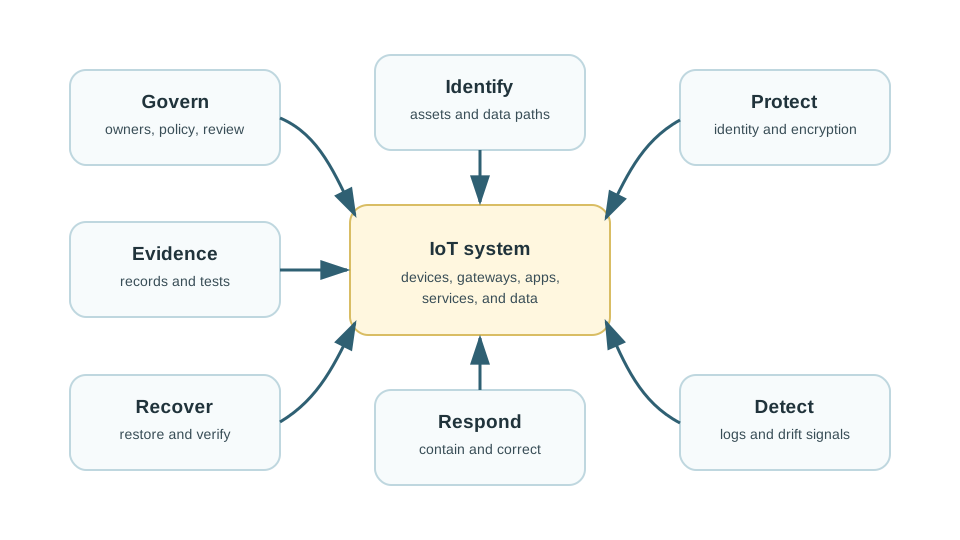
- A widely used way to organize this is the NIST Cybersecurity Framework, whose current version groups protection into a small set of functions.
- Unknown devices that no one is protecting.

Major section
Practitioner: Choose, Tailor, and Operate Controls (continued)
Incidents that go unseen until harm is done.
- Information assurance is the operating view behind many safeguards: protect and defend information and the systems that handle it, while preserving availability, integrity, authentication, confidentiality, and non-repudiation.
- Their meeting point defines one evidence request instead of a broad security label.
- Integrity also has levels.
Major section
Practitioner: Choose, Tailor, and Operate Controls (continued)
It also includes restoration, detection, and reaction capabilities, so it fits naturally with the protect-detect-respond-recover lifecycle rather than stopping at secrecy.
- For availability, that evidence may include spare capacity, recovery drills, failover behaviour, and monitoring.
- An uptime slogan alone does not fill those cells.
- Management standards sit above individual controls.
Major section
Practitioner: Choose, Tailor, and Operate Controls (continued)
A healthcare, emergency, or financial record may need critical-level validation, traceability, and trustworthiness evidence, while a lower-impact analytics record may need lighter checks.
- Authentication and non-repudiation make the service list practical.
- Authentication proves that a transmission, message, device, or person is the claimed originator and is allowed to receive or perform the requested action.
- The countermeasure dimension should be recorded at the same granularity as the system.
Major section
Practitioner: Choose, Tailor, and Operate Controls (continued)
A gateway retains event logs and cached telemetry until upload succeeds.
- In IoT, those claims usually need signed events, trusted timestamps, protected logs, and clear identity ownership rather than only a password prompt.
- Organizational controls include operating procedures, configuration standards, authentication and password policies, acceptable-use rules, remote-access policies, network-maintenance rules, and incident-handling procedures.
- A software update changes how a thermostat or robot controller interprets sensor values.
Major section
Practitioner: Choose, Tailor, and Operate Controls (continued)
The most important practitioner judgment is matching the strength of a control to the value of what it guards.
- People controls include training and awareness so users and administrators know how to handle confidential information and run the controls correctly.
- A rural sensor exports data by sneaker-net, while a city sensor sends readings over Wi-Fi or cellular.
- A control that is too heavy to sustain quietly decays, which is its own risk.
Major section
Practitioner: Choose, Tailor, and Operate Controls (continued)
A review should narrow that framework to the domains, control objectives, and controls that fit the IoT service rather than treating an ISO label as proof that every data state is protected.
- More sensitive data and higher-impact devices justify stronger, more numerous controls; routine data does not need the same weight.
- Tailoring avoids two failures at once: under-protecting the data that matters, and over-burdening low-risk features with controls no one will maintain.
- The practitioner move is to plan for these limits in advance.
- If you can choose, layer, tailor, and operate controls across the lifecycle, you can stop here.
Major section
Under the Hood: Independence, Evidence, and Failure Modes
Layers that fail for different reasons.
- The deeper layer explains why layered defense only works when the layers are genuinely independent, and why a control that cannot be shown to work cannot be relied upon.
- The recurring failure is the appearance of depth without the substance.
- Two layers defeated by one root cause.
Major section
Under the Hood: Independence, Evidence, and Failure Modes (continued)
That assumption breaks when two layers share a common weakness.
- Two controls that both depend on the same credential, the same flat network, or the same unpatched component are not really two layers; one root cause defeats them together.
- A mapping of sensitivity to controls.
- Silent incidents that no one sees.
Major section
Under the Hood: Independence, Evidence, and Failure Modes (continued)
Governance is what keeps the safeguards a system rather than a pile of disconnected measures.
- A precise design checks that each added layer fails for different reasons than the others, because correlated failure is how a system that looks deeply protected collapses all at once.
- The current cybersecurity framework makes governance a function in its own right, alongside identify, protect, detect, respond, and recover.
- Backups that fail when finally needed.
Major section
Under the Hood: Independence, Evidence, and Failure Modes (continued)
At this depth, safeguards are a system of independent layers across the whole protection lifecycle, governed, tailored to risk, and proven by evidence.
- Governance is the work of setting the risk strategy, assigning roles and accountability, and overseeing that the other functions actually happen.
- It matters because controls without an owner and a shared direction drift: each team does something reasonable, but no one is accountable for whether the whole is adequate.
- Layer protection so failures are uncorrelated, cover detect, respond, and recover rather than only prevent, and keep records that show each control works.
Deck summary
Key takeaways
The lock may stop casual access.
- The central idea of good protection is that no single control is trusted on its own.
- A mature stance assumes that some controls will fail or be bypassed, so it plans to detect problems quickly, respond effectively, and recover afterward.
- Instead, several layers are arranged so that when one fails, another still stands.
- The practical work is choosing controls that fit the risk, arranging them in independent layers, and operating the ones that need attention over time.
Retrieval practice
Recall check 1 of 3

Privacy Priya says: answer from memory, then check your reasoning.
Q1Which design best reflects defense in depth for an IoT system?
Show answer
Answer: C Independent layers plus a plan to detect and respond mean a single failed control is absorbed rather than catastrophic.
Retrieval practice
Recall check 2 of 3
Privacy Priya says: answer from memory, then check your reasoning.
Q2A team has strong prevention, encryption, and access control, but no way to notice or react if a control is bypassed. Which functions are missing, and why does it matter?
Show answer
Answer: A Protection must cover the whole lifecycle; detection and response are what catch and contain the failures prevention misses.
Retrieval practice
Recall check 3 of 3
Privacy Priya says: answer from memory, then check your reasoning.
Q3A system adds a second protection layer, but both the first and second layers rely on the same shared admin credential. Why is this weak defense in depth?
Show answer
Answer: B Defense in depth relies on independent failure; layers sharing one point of failure collapse together, which is the opposite of depth.
Print reference
Answers
Answer key.
- C · Independent layers plus a plan to detect and respond mean a single failed control is absorbed rather than catastrophic.
- A · Protection must cover the whole lifecycle; detection and response are what catch and contain the failures prevention misses.
- B · Defense in depth relies on independent failure; layers sharing one point of failure collapse together, which is the opposite of depth.