Emerging Paradigms · Study deck
S2aaS Benefits and Barriers
Picture a school air sensor whose readings could also help a heat-response team.
Blueprint Bina is your guide for this deck.

After studying this chapter
Learning objectives
You will be able to:
- Explain how S2aaS creates value for sensor owners, data consumers, platform operators, and public-interest stakeholders.
- Distinguish useful reuse from risky reuse when sensor data reveals behavior, location, occupancy, or operational state.
- Identify technical, economic, governance, social, and operational barriers to S2aaS adoption.
- Apply trust gates for consent, quality, policy, compensation, and audit before sharing a sensor stream.
Major section
Begin With One Stream and a New User
More reuse can lower cost, but it can spread privacy and quality risk.
- A low price may draw users, but it may not fund care or repair.
- Strict gates can protect people, but they may slow a valid public use.
- This first pass does not prove demand, consent, or fair value.
Major section
Begin With One Stream and a New User (continued)
For shared sensing, build the sharing record and trust gates; check reuse failure, weak rights, cold starts, disputes, and unequal cover before accepting the result.
- The new use may still reveal when rooms are used.
- Each result should be clear.
- The system should log the choice.
- A person should own the appeal.
Major section
Begin With One Stream and a New User (continued)
A sound plan can state what each group gets and what each group may stop.
- A fault should not turn into silent open access.
- Value is more than a sale.
- The owner needs care and a fair return.
- The user needs useful data and clear limits.
Major section
Start Simple · In 60 Seconds
In S2aaS Benefits and Barriers, the practical question is who owns the sensing resource, what quality is promised, and what policy keeps the service safe to consume.
- Sensing-as-a-Service creates value when existing sensing capability can be reused by more than one trustworthy consumer.
- S2aaS is therefore not just a marketplace problem.
- The same stream can support operations, research, public services, and commercial applications, but value only lasts when the platform also manages consent, quality, allowed use, compensation, liability, and coverage gaps.
Major section
Checkpoint: Minimum Viable Understanding · Who Is Allowed To Benefit?
Value is multi-sided: Owners, consumers, platform operators, and public-interest users need different proof before they will participate.
- Sensor data is non-rival but not risk-free: One reading can serve many consumers, yet each additional use can increase privacy, safety, or liability exposure.
Major section
Concept Map · Why S2aaS Can Create Value
S2aaS value depends on a balance between reuse and responsibility.
- The same sensing capability can support multiple applications without deploying duplicate devices.
- Every reuse needs clear rules for consent, quality, allowed use, retention, payment, and accountability.
- Non-rival data still has real constraints.
- Owners can recover value from sensing infrastructure that already supports their operations.
Major section
Value Design Principles · Marketplace Rule
The safest way to reason about S2aaS value is to ask what each stakeholder contributes and what each one needs in return.
- If the platform cannot explain why a consumer is allowed to use a stream, the stream is not ready for marketplace reuse.
Relevance
Publish streams that solve a named need, not every possible reading.
Consumer trust
Show calibration state, freshness, completeness, latency, and known gaps.
Privacy and liability
Bind each subscription to purpose, retention, redistribution, and rate limits.
Major section
Pricing, Caching, Efficiency · Stakeholder Alignment
A slow-changing environmental stream, a safety-adjacent alarm, and a research export can all come from shared sensing, but they place different burdens on physical sensors, gateways, storage, policy checks, support, and consumers.
- S2aaS is more likely to work when every participant can answer a different question.
Major section
Challenge Landscape · Privacy and Personal Sensing
S2aaS adoption challenges are not isolated.
- Weak coverage reduces consumer trust.
- For every proposed shared stream, the operator should name who checks quality, who handles a privacy complaint, and which evidence can suspend access when a guardrail fails.
- Common data rules and quality records address weak links and doubtful readings.
Major section
Privacy Rule · Marketplace Adoption Risks
Anonymization is not a complete safety control for sensor data.
- Repeated time and location patterns can still reveal people, routines, assets, or operations.
- Many S2aaS systems fail before the technology is the limiting factor.
- The platform also has to solve participation and trust.
- Consumers will not subscribe without useful coverage.
Major section
Selection Workflow: Shared Environmental Sensing · Checkpoint: Adoption Readiness Checklist
Scenario: A city department, a university lab, and a community health group all need neighborhood-level heat and air-quality observations.
- It should not expand to indoor occupancy, insurance scoring, or enforcement uses without a new governance approval.
- The use case is specific enough to judge data minimization and quality needs.
- The owner has authority to share the stream.
- Consent or governance approval covers the intended use.
Major section
Common Pitfalls · Overview: Value Needs Trust Gates
More consumers can increase value, but each use also changes privacy, liability, and operational exposure.
- A stream without calibration, freshness, completeness, and gap information can create false confidence.
- A stream approved for environmental research is not automatically approved for enforcement, advertising, insurance, or employee monitoring.
Major section
Summary · Key Takeaway
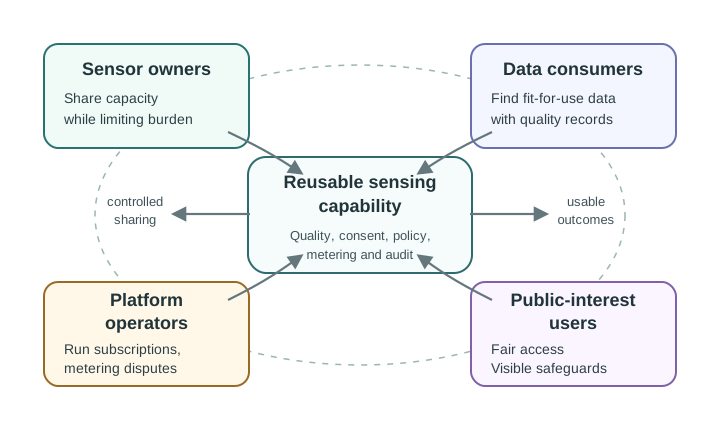
Owners can gain value from existing sensing infrastructure, consumers can access data without building every deployment themselves, platform operators can standardize trust infrastructure, and public-interest users can make better decisions when coverage is fair.
- The same reuse can also create privacy, quality, liability, pricing, and equity risks.
- A durable S2aaS platform therefore treats trust gates, quality metadata, allowed use, compensation, coverage checks, and audit as core product features.
- S2aaS creates value by making sensing reusable and accessible, but the challenges are real: data quality, privacy, ownership, economics, reliability, and accountability.
Deck summary
Key takeaways
More reuse can lower cost, but it can spread privacy and quality risk.
- For shared sensing, build the sharing record and trust gates; check reuse failure, weak rights, cold starts, disputes, and unequal cover before accepting the result.
- A sound plan can state what each group gets and what each group may stop.
- In S2aaS Benefits and Barriers, the practical question is who owns the sensing resource, what quality is promised, and what policy keeps the service safe to consume.
- Value is multi-sided: Owners, consumers, platform operators, and public-interest users need different proof before they will participate.
Retrieval practice
Recall check 1 of 5

Blueprint Bina says: answer from memory, then check your reasoning.
Q1A city wants to share outdoor heat readings from participating buildings with planners, a university lab, and a community group. Which first trust record keeps the value claim defensible?
Show answer
Answer: A A traceable S2aaS value decision ties the proposed reuse to authority, consent, quality, minimization, coverage, compensation, allowed use, audit, revocation, and retest evidence.
Retrieval practice
Recall check 2 of 5
Blueprint Bina says: answer from memory, then check your reasoning.
Q2What is the strongest reason S2aaS can create value?
Show answer
Answer: D B) The same governed sensing capability can be reused by multiple consumers.
Retrieval practice
Recall check 3 of 5
Blueprint Bina says: answer from memory, then check your reasoning.
Q3A platform wants to share home energy readings with a research group. Which design is strongest?
Show answer
Answer: B C) Use purpose-specific consent, aggregation where possible, retention limits, and audit logs.
Q4What converts data-sharing authority and risk limits into enforceable rules?
Show answer
Answer: B It converts authority and risk limits into enforceable rules.
Retrieval practice
Recall check 4 of 5
Blueprint Bina says: answer from memory, then check your reasoning.
Q5Complete the S2aaS sharing risk check.
Show answer
Answer: A A sharing decision should check purpose approval, quality fit, and retention limits before a stream is exposed to a consumer.
Retrieval practice
Recall check 5 of 5
Blueprint Bina says: answer from memory, then check your reasoning.
Q6A shared heat-map stream is approved for city planning. A marketing partner asks for raw building-level readings, calibration gaps appear in lower-resource neighborhoods, owners report extra maintenance, and audit logs do not show redistribution. What is most defensible?
Show answer
Answer: D This protects the original use case while repairing policy, quality, coverage, owner-burden, audit, and revocation controls.
Print reference
Answers 1 of 2
Answer key.
- A · A traceable S2aaS value decision ties the proposed reuse to authority, consent, quality, minimization, coverage, compensation, allowed use, audit, revocation, and retest evidence.
- D · B) The same governed sensing capability can be reused by multiple consumers.
- B · C) Use purpose-specific consent, aggregation where possible, retention limits, and audit logs.
- B · It converts authority and risk limits into enforceable rules.
- A · A sharing decision should check purpose approval, quality fit, and retention limits before a stream is exposed to a consumer.
Print reference
Answers 2 of 2
Answer key.
- D · This protects the original use case while repairing policy, quality, coverage, owner-burden, audit, and revocation controls.