Emerging Paradigms · Study deck
S2aaS Real-World Platforms
Picture a campus sharing room-air readings with students, caretakers, and a research team.
Blueprint Bina is your guide for this deck.

After studying this chapter
Learning objectives
You will be able to:
- Evaluate a real-world sensing platform by responsibilities instead of brand names.
- Identify the minimum contract records a platform must expose before sensor data can be reused safely.
- Check portability and exit readiness without relying on dated product comparisons.
- Apply a structured evaluation flow to a campus or public-interest sensing platform.
Major section
Start Simple
The real choice appears when devices change, a second user arrives, data needs correction, or the campus must move away.
- A polished dashboard is not proof of a portable service.
- Shared tools can compare and retain data, but they should not be the only path to a time-bound safe step.
- Practitioner compares duties, cost, support, and exit.
Major section
Start Simple (continued)
This opening does not select a brand or claim that one platform fits every stage.
- Under the Hood examines interfaces, storage, identity, event flow, limits, migration, and the proof needed through change.
- If the team cannot move the meaning and rights, the platform choice is still open.
- A good tool must pass all four.
Major section
In 60 Seconds
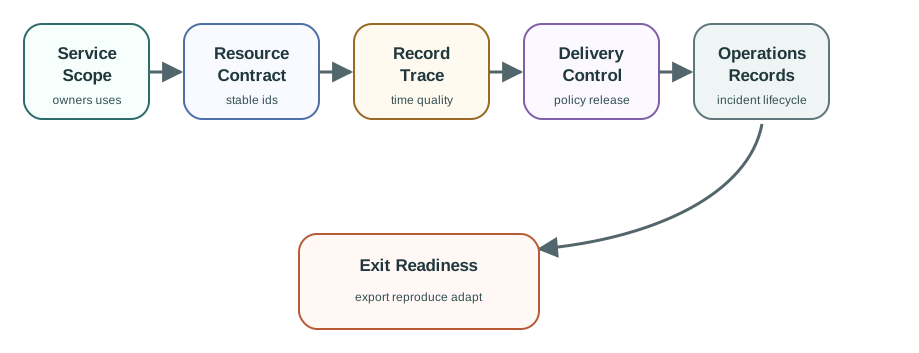
Real-world S2aaS platforms differ in names, interfaces, and business models, but they can be evaluated with the same responsibility map.
- A feature list is not enough.
Major section
Minimum Viable Understanding
Real-world platforms are evaluated by responsibility coverage.: Names and product features change; contracts and record requirements remain.
- Exit readiness is a design requirement.: Data, identity, policy, and consumer integrations should not be trapped inside one platform.
Major section
Real-World S2aaS Platform Examples
The safest way to study real-world S2aaS platforms is to classify what they do for participants.
- A platform may be a device-ingestion service, a public data exchange, a community sensing network, a sector marketplace, or a federation of institutional services.
- Multiple owners publish domain-specific sensing resources with contracts, quality records, and controlled delivery.
Major section
Responsibility Map
The overview depth layer shows the platform responsibilities to inspect before trusting a real-world S2aaS service.
- A platform can be simple and still be well designed if each responsibility is explicit.
Major section
Platform Archetypes
Strong at dashboards, alerts, controls, and workflows.
- Strong at keeping data under local owners while sharing approved results.
- Good for viewing readings, but not enough for S2aaS if it lacks consumer contracts, quality states, governed access, and exit paths.
Major section
Platform Portability
Portability does not mean every platform is interchangeable.
- Source-to-resource mapping is undocumented.
- Historical data cannot be exported with provenance.
- Policy and consent state cannot be reconstructed.
- Operators rely on manual knowledge outside records.
Major section
Community Platform Quality
Community and shared platforms are valuable because they can cover more places than a single owner could instrument alone.
- Calibration or comparison records when available.
Major section
Campus Shared Sensing Platform
A campus facilities team wants to share comfort, air-quality, occupancy, and energy indicators with building operators, researchers, and a public dashboard.
- Researchers may request approved historical exports.
- The public dashboard receives coarse current status only.
- Catalog:: Each room, zone, and public status resource has a stable virtual-resource id, observed properties, freshness rule, and owner.
Major section
Platform Readiness Checklist
Platform archetype is identified before features are compared.
- Catalog supports discovery by capability, location or asset, quality, owner, and allowed use.
- Delivery controls cover API, stream, dashboard, report, and export modes.
- Quality states are visible and actionable.
- Assertions about scale, availability, support, and commercial terms are verified outside the chapter before procurement.
Major section
Concept Relationships
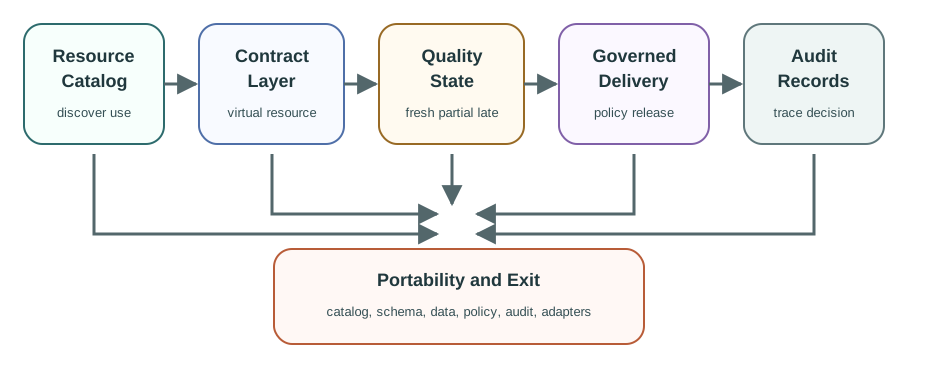
Platform archetype frames the evaluation by showing where risk is likely to appear.
- Resource catalog connects source owners, virtual resources, allowed use, and consumer discovery.
- Virtual-resource contract keeps consumer integrations stable while physical sources and internal tools change.
- Quality state makes freshness, uncertainty, maintenance, and degraded data visible.
- Governed delivery applies policy before data leaves the platform boundary.
Major section
Common Pitfalls
A dashboard can be useful, but S2aaS also needs discovery, quality state, governed delivery, and audit records.
- Corrected or estimated data should be labeled.
- Consumers must know when a value is raw, corrected, partial, delayed, or suppressed.
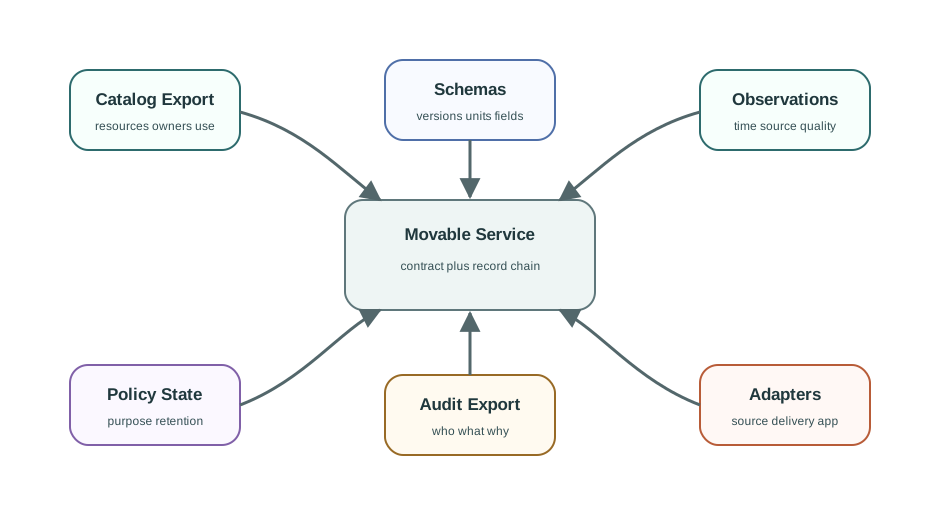
- If you have never exported the catalog, schemas, observations, policy state, and audit records, you do not know whether the service can move.
Major section
Platform Exit Record
With that boundary fixed, examine observation record: export timestamps, units, source ids, virtual-resource ids, quality states, transformation versions, provenance, and correction notes.
- The order matters: each later judgment depends on the owner, state, constraint, or failure evidence retained by the preceding step, so the resulting record can support the next chapter decision.
Major section
Why Feature Lists Age Badly
Product features change faster than platform responsibilities.
- With that boundary fixed, examine hidden coupling: consumer integrations depend on physical device ids, internal topics, table names, or vendor-only workflows.
- Close the review by checking hidden exit cost: observations can be exported, but subscriptions, policy, audit, and provenance must be reconstructed manually.
Major section
Summary
Real-world S2aaS platforms should be evaluated by responsibilities, not by brittle feature lists.
- A defensible platform exposes a discoverable catalog, stable virtual-resource contracts, visible quality state, governed delivery, operations records, audit traces, and an exit path.
Deck summary
Key takeaways
The real choice appears when devices change, a second user arrives, data needs correction, or the campus must move away.
- This opening does not select a brand or claim that one platform fits every stage.
- Real-world S2aaS platforms differ in names, interfaces, and business models, but they can be evaluated with the same responsibility map.
- Real-world platforms are evaluated by responsibility coverage.: Names and product features change; contracts and record requirements remain.
- The safest way to study real-world S2aaS platforms is to classify what they do for participants.
Retrieval practice
Recall check 1 of 3

Blueprint Bina says: answer from memory, then check your reasoning.
Q1Which platform capability is required before a device-ingestion service becomes a reusable S2aaS platform?
Show answer
Answer: B B) A governed virtual-resource contract with quality state, policy, and provenance.
Q2What quality issue is especially important in a community sensing network?
Show answer
Answer: A A) Contributors may install sensors in inconsistent locations and conditions.
Retrieval practice
Recall check 2 of 3

Blueprint Bina says: answer from memory, then check your reasoning.
Q3Which records are most important when moving an S2aaS service to another platform?
Show answer
Answer: B B) Catalog records, schemas, observations, policy state, subscriptions, and audit records.
Retrieval practice
Recall check 3 of 3

Blueprint Bina says: answer from memory, then check your reasoning.
Q4Place each platform responsibility where it lives in the S2aaS operating model so you can compare providers without mistaking a feature list for service evidence.
Show answer
Answer: A The operating model separates the offer, its controlled delivery, and accountable exit so you can evaluate provider responsibility across the whole service lifecycle.
Q5Complete the readiness check for moving an S2aaS platform without losing the service contract.
Show answer
Answer: A Exit readiness requires exportable catalog and schema records, observations and audit records, and policy plus subscription state.
Print reference
Answers
Answer key.
- B · B) A governed virtual-resource contract with quality state, policy, and provenance.
- A · A) Contributors may install sensors in inconsistent locations and conditions.
- B · B) Catalog records, schemas, observations, policy state, subscriptions, and audit records.
- A · The operating model separates the offer, its controlled delivery, and accountable exit so you can evaluate provider responsibility across the whole service lifecycle.
- A · Exit readiness requires exportable catalog and schema records, observations and audit records, and policy plus subscription state.