Emerging Paradigms · Study deck
S2aaS Architecture Patterns
A campus team records room temperature for its heating system.
Blueprint Bina is your guide for this deck.

After studying this chapter
Learning objectives
You will be able to:
- Identify the core architecture patterns used in Sensing-as-a-Service platforms.
- Explain how catalog, virtual-resource, event-pipeline, delivery, quality, and audit patterns work together.
- Choose a minimal pattern set for an early implementation without locking the platform into brittle technology choices.
- Describe what records must move with a sensor observation before it becomes a governed service result.
Major section
Start Simple · In 60 Seconds
A campus team records room temperature for its heating system.
- The data owner must make the promise clear.
- A simple catalogue entry should lead to those facts.
- This test does not make one stream suitable for every purpose.
- These moves make the pattern serve the contract, rather than forcing the contract to fit a product.
Major section
Which Pattern Owns The Risk? · Minimum Viable Understanding
Patterns are reusable responsibilities: A pattern says what the platform must do, not which vendor product must be installed.
- Virtual resources protect consumers from infrastructure churn: Consumers subscribe to governed service objects, not raw devices.
Major section
S2aaS Implementation Patterns · Pattern Map
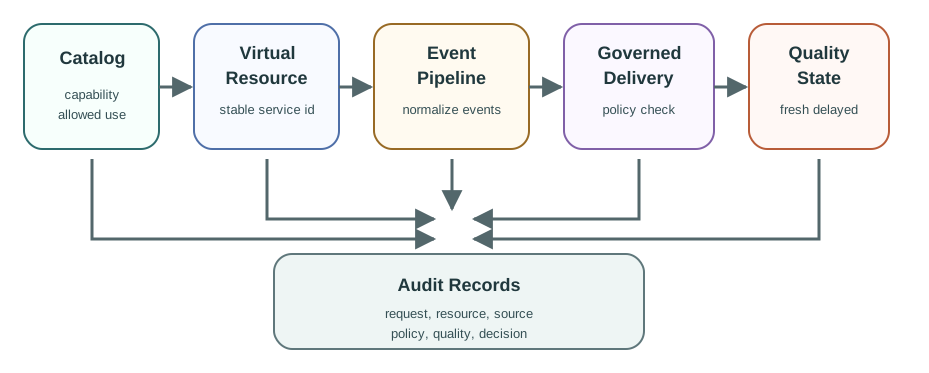
An S2aaS platform can be built from many technologies, but the same pattern responsibilities appear again and again.
- The safest design conversation starts with those responsibilities.
- The overview depth layer shows the core implementation patterns and the records that connect them.
- The map is intentionally independent of vendor names.
Major section
Pattern 1: Sensor Catalog and Discovery · Design Check
If the catalog only says "temperature sensor," it is not enough for S2aaS.
- A consumer needs to know where the measurement applies, how fresh it is, what quality state it carries, and whether the requested use is allowed.
Major section
Pattern 2: Virtual Resource Facade
The virtual-resource pattern exposes a stable service object over physical sensors, edge aggregates, fused signals, derived indicators, and reports.
- This pattern is what lets the platform replace a device, move processing, change a gateway, or adjust sampling without forcing every consumer integration to change.
- Device-specific quirks that consumers must work around.
- The virtual resource is not a decorative abstraction.
Major section
Event Pipeline and Normalization · Normalization Is Not Trust
The event-pipeline pattern receives observations, validates the envelope, normalizes the event, applies mapping rules, and prepares the update for service delivery.
- The pattern is the same even when the tool changes.
- Converting a payload into a standard shape does not make it trustworthy.
- The platform still needs quality checks, provenance, policy binding, and delivery controls before the event becomes a reusable service result.
Major section
Pattern 4: Governed Delivery · Pattern Rule
The governed-delivery pattern decides whether a consumer may receive a resource update, historical response, report, or export.
- It should be enforced consistently for API calls, streams, dashboards, and bulk delivery.
- Purpose and allowed use.
- Rate and volume controls.
- S2aaS succeeds when delivery controls are centralized enough to be consistent and visible enough to be audited.
Major section
Quality State and Degraded Modes · Pattern 6: Audit Records and Operations
Consumers need a compact signal that says whether a value is current, delayed, estimated, partial, unavailable, or under maintenance.
- maintenance: source or pipeline is under planned work.
- unavailable: no serviceable value should be delivered.
- revoked: access is blocked by policy or lifecycle decision.
- Operator action when a manual change occurred.
Major section
Request Flow
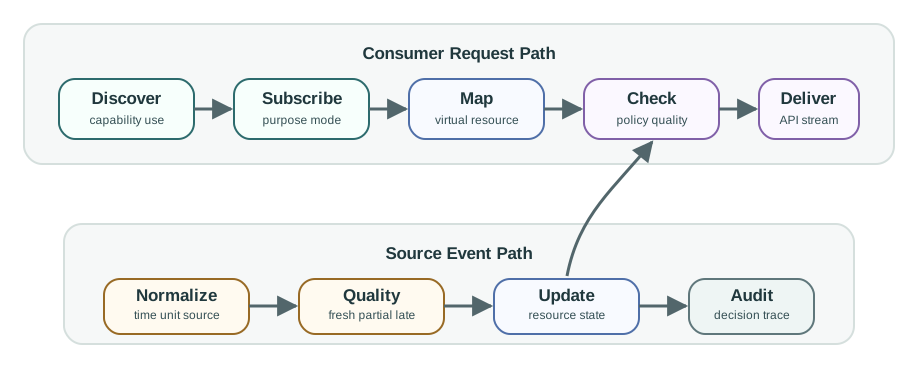
The consumer finds a resource by capability, quality, location, and allowed use.
- The platform records what happened, which policy was applied, what quality state was visible, and why a request was allowed or denied.
- Their juxtaposition makes S2aaS request flow showing catalog discovery, subscription, virtual resource mapping, event normalization, governed delivery, and audit records visible.
Major section
Choosing a Pattern Mix · Avoid Premature Tool Lock-In
Not every implementation needs the same amount of machinery on day one.
- The pattern mix should match risk, scale, and change frequency.
- Catalog and virtual resource records.
- Incident and lifecycle records.
- Purpose and retention controls.
Major section
Campus Environmental Sensing
A campus wants to share indoor comfort and air-quality data with facilities staff, research dashboards, and a public building-status page.
- Gateways can aggregate low-risk comfort values into five-minute summaries.
- Research consumers need historical query access, while the public page only needs current status.
- If load grows, the implementation can replace the queue, storage, or dashboard tool without changing the catalog or consumer API contract.
Major section
Pattern Readiness Checklist · Concept Relationships
Every pattern has a named owner and contract.
- Delivery checks apply to APIs, streams, dashboards, reports, and exports.
- Quality states are visible to consumers and operators.
- The design can replace a tool without changing the consumer-facing service contract.
- Virtual-resource pattern stabilizes consumer contracts while physical and processing infrastructure changes.
Major section
Common Pitfalls · Patterns by Responsibility
Naming a database, broker, or gateway does not define the service contract.
- Letting consumers depend on physical device ids makes replacement and maintenance visible as consumer breakage.
- Adding logs after launch rarely reconstructs missing policy, quality, source, and delivery context.
- Design audit records into each pattern.
Major section
Campus Pattern Set · Why Product Lists Break Contracts
With that boundary fixed, examine virtual resource: keep zone-comfort-a stable while sensors, gateways, aggregation windows, and comfort-score versions change.
- The order matters: each later judgment depends on the owner, state, constraint, or failure evidence retained by the preceding step, so the resulting record can support the next chapter decision.
- A product list hides which responsibility is supposed to fail closed.
- Teams can say "the broker handles streams" while no one owns replay policy, degraded quality, tenant-specific delivery, export revocation, or audit retention.
Major section
Summary · Key Takeaway
The catalog pattern supports discovery.
- The event-pipeline pattern preserves observation context.
- The governed-delivery pattern enforces use rules.
- The quality-state pattern makes degraded data visible.
- The audit-record pattern explains what happened later.
Deck summary
Key takeaways
A campus team records room temperature for its heating system.
- Patterns are reusable responsibilities: A pattern says what the platform must do, not which vendor product must be installed.
- An S2aaS platform can be built from many technologies, but the same pattern responsibilities appear again and again.
- If the catalog only says "temperature sensor," it is not enough for S2aaS.
- The virtual-resource pattern exposes a stable service object over physical sensors, edge aggregates, fused signals, derived indicators, and reports.
Retrieval practice
Recall check 1 of 4
Blueprint Bina says: answer from memory, then check your reasoning.
Q1Which statement best describes the virtual-resource pattern?
Show answer
Answer: C B) It creates a stable governed service object over physical, edge, or derived sources.
Retrieval practice
Recall check 2 of 4
Blueprint Bina says: answer from memory, then check your reasoning.
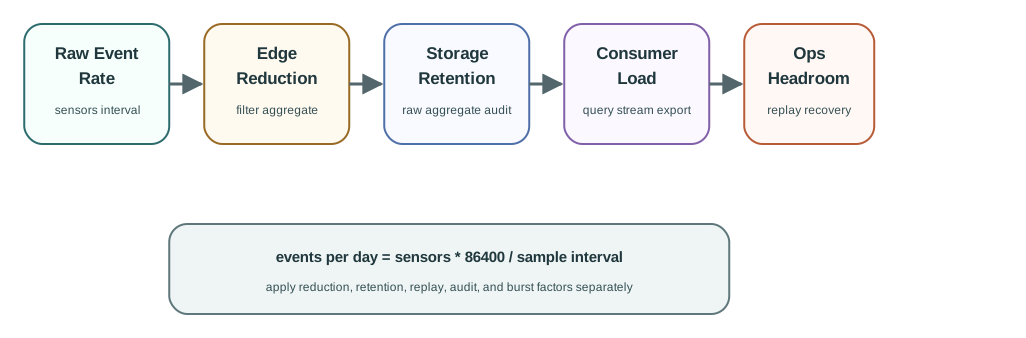
Q2Why should capacity estimates separate raw ingest, edge reduction, storage retention, and consumer query load?
Show answer
Answer: D A) Those factors are controlled by different patterns and can fail independently.
Retrieval practice
Recall check 3 of 4
Blueprint Bina says: answer from memory, then check your reasoning.
Q3A consumer receives stale data during a gateway outage. Which trace is most useful?
Show answer
Answer: C C) Request id, virtual resource id, source id, quality state, policy version, and delivery path.
Q4What lets consumers find a sensor service and its declared capabilities?
Show answer
Answer: C It lets consumers find a sensor service and its declared capabilities.
Retrieval practice
Recall check 4 of 4
Blueprint Bina says: answer from memory, then check your reasoning.
Q5Complete the delivery decision rule for an S2aaS virtual resource.
Show answer
Answer: A Governed delivery checks allowed purpose, acceptable quality state, and audit records before a virtual-resource value is released.
Print reference
Answers
Answer key.
- C · B) It creates a stable governed service object over physical, edge, or derived sources.
- D · A) Those factors are controlled by different patterns and can fail independently.
- C · C) Request id, virtual resource id, source id, quality state, policy version, and delivery path.
- C · It lets consumers find a sensor service and its declared capabilities.
- A · Governed delivery checks allowed purpose, acceptable quality state, and audit records before a virtual-resource value is released.