Emerging Paradigms · Study deck
S2aaS Multi-Layer Architecture
Picture a farm that offers soil readings to a water planner.
Blueprint Bina is your guide for this deck.

After studying this chapter
Learning objectives
You will be able to:
- Explain the major layers in an S2aaS implementation without tying them to a specific vendor stack.
- Define layer contracts for physical sensing, edge intake, virtual resources, service APIs, and operations records.
- Describe how observations move from raw device output to governed consumer delivery.
- Identify the policy, quality, provenance, and audit metadata that must survive each handoff.
Major section
Start Simple
The reading begins at a field probe, passes through a site unit, enters a shared list, and reaches a buyer's model.
- Each layer can delay, rename, filter, or deny the same record.
- At each handoff, write what is added, changed, stored, or rejected.
- A clean buyer view does not prove that the lower layers kept the original meaning.
Major section
Start Simple (continued)
The wider service can plan and compare, but it should not become a hidden time-bound control path.
- This opening does not choose a vendor or final layer count.
- Under the Hood examines discovery, access, data handling, charging, scale, and the records that join layer failures into one review.
- If any answer is no, repair that handoff first.
Major section
In 60 Seconds · Minimum Viable Understanding
A multi-layer S2aaS architecture separates physical sensing from virtual resources, service delivery, and operations records.
- The layers are not just boxes in a diagram.
- Each layer has a contract: what it receives, what it emits, what it owns, what quality state it must attach, and what policy or audit record it must preserve.
- Good layer contracts let sensors, gateways, virtual resources, APIs, and operations change without breaking consumers or weakening governance.
Major section
Layer Contracts · Handoff Rule · Layer 1: Physical Sensing
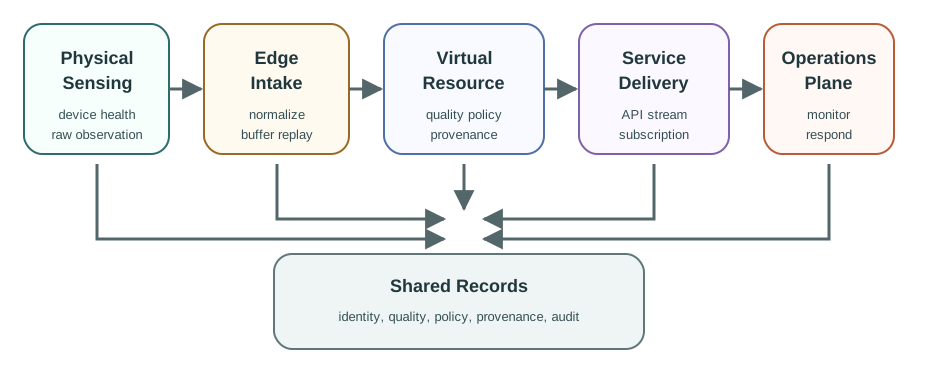
The compact layer contract model in the overview depth layer is intentionally about responsibilities, not tool names.
- If a layer passes a value upward without freshness, unit, provenance, quality state, and policy context, the next layer cannot safely turn that value into a service.
- The physical layer contains deployed sensors, actuators when relevant, local power, enclosure, calibration, location or asset binding, and device identity.
- The physical layer should not decide who may consume a commercial or governed service.
Major section
Layer 2: Edge Intake and Normalization · Gateway Output Needs Trust Checks
Gateways and edge services translate protocols, buffer observations, normalize payloads, suppress obvious duplicates, attach local context, and keep collection working during temporary outages.
- Replay status so downstream layers can avoid double counting.
- Protocol translation is not the same as service validation.
- A gateway may convert a payload into JSON, but the platform still needs quality checks, policy binding, resource modeling, and audit before the data becomes a reusable S2aaS product.
Major section
Layer 3: Virtual Resource Model
The virtual resource layer is the main S2aaS boundary.
- A virtual resource may represent one sensor, a zone aggregate, a fused signal, an event stream, a report, or a derived indicator.
- Consumers can keep using the same resource while physical sensors are replaced, gateways move, sampling changes, or processing moves from central to edge.
- The virtual resource protects the service contract from infrastructure churn.
Major section
Layer 4: Service Delivery and API · Design Check
The service delivery layer exposes governed resources through APIs, streams, dashboards, reports, exports, and webhooks.
- This layer should enforce policy before data leaves the platform boundary.
- Revocation and deletion rules before cached or exported data is served.
- The API should expose virtual resources and quality state.
Major section
Handoff Flow
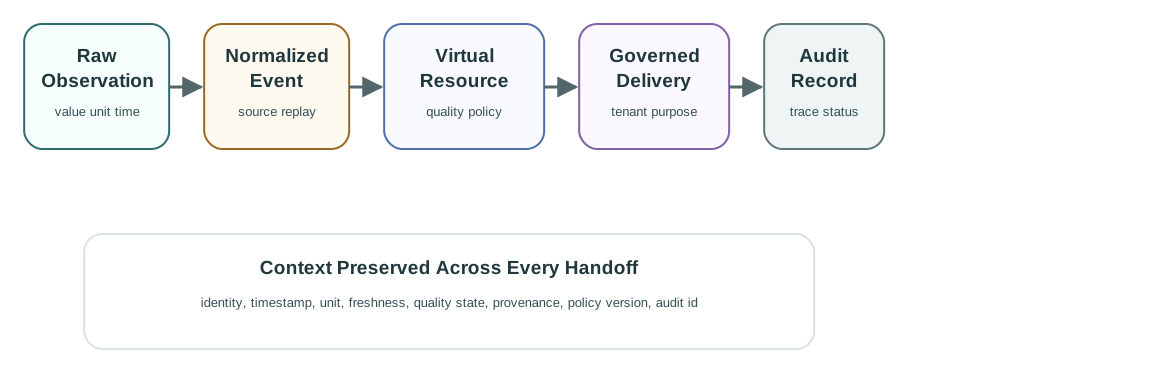
Layered architecture only works if handoffs preserve context.
- A clean handoff is not simply "send the value upward." It is a documented package of observation, quality, identity, policy, and audit records.
Major section
Layer Independence and Coupling · Worked Example: Room Comfort S2aaS
Layering is useful only when layers can evolve independently without losing accountability.
- A sensor is replaced with a newer model.
- The physical and edge layers update source identity and calibration metadata, while the virtual resource id and consumer API remain stable.
- A new export format is added.
- A retention rule changes.
Major section
Multi-Layer Readiness Checklist · Concept Relationships
Every layer has a named owner and contract.
- Edge intake records normalization, replay, buffering, and delayed-state proof.
- Virtual resources have stable ids, quality rules, policy binding, and provenance.
- API delivery enforces tenant, purpose, retention, rate, quality, and revocation terms.
- Degraded modes are visible at the API or report level.
Major section
Common Pitfalls · Overview: Handoffs Carry The Contract
Direct physical-device APIs make every hardware change a consumer-facing change and leave no clear place for policy, quality, and provenance.
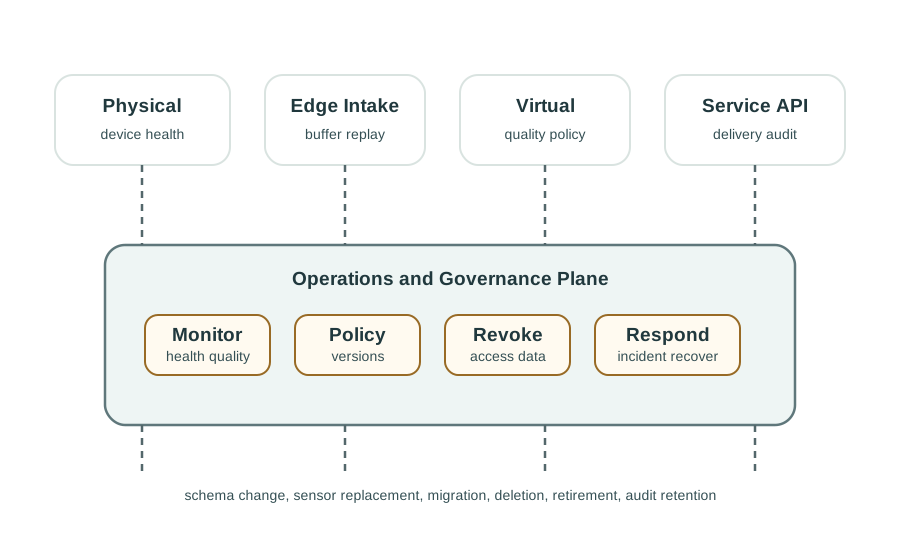
- Monitoring, incident response, revocation, deletion, and lifecycle control must cross all layers, not live only in the API gateway.
- Edge processing still needs quality rules, replay handling, policy versioning, and audit context before delivery.
Major section
Room Comfort Handoff Record · Why Layer Boundaries Leak
For a room comfort S2aaS resource, the handoff record should make a consumer complaint traceable across the full stack.
- The order matters: each later judgment depends on the owner, state, constraint, or failure evidence retained by the preceding step, so the resulting record can support the next chapter decision.
- Layering can hide risk when teams treat boundaries as technical adapters instead of accountability contracts.
- A message can cross a boundary while losing the exact fields needed for privacy, quality, billing, revocation, or incident response.
Major section
Summary · Key Takeaway
S2aaS multi-layer architecture separates physical sensing, edge intake, virtual resources, service delivery, and operations records.
- The most important design work is defining layer contracts.
- Each handoff should preserve identity, quality state, provenance, policy context, and audit records.
- Operations and governance must remain visible across the full stack so incidents, revocation, deletion, migration, and quality changes can be explained.
Deck summary
Key takeaways
The reading begins at a field probe, passes through a site unit, enters a shared list, and reaches a buyer's model.
- The wider service can plan and compare, but it should not become a hidden time-bound control path.
- A multi-layer S2aaS architecture separates physical sensing from virtual resources, service delivery, and operations records.
- The compact layer contract model in the overview depth layer is intentionally about responsibilities, not tool names.
- Gateways and edge services translate protocols, buffer observations, normalize payloads, suppress obvious duplicates, attach local context, and keep collection working during temporary outages.
Retrieval practice
Recall check 1 of 5
Blueprint Bina says: answer from memory, then check your reasoning.
Q1What makes an S2aaS layer contract complete?
Show answer
Answer: B B) It defines inputs, outputs, ownership, quality state, policy context, and failure behavior.
Retrieval practice
Recall check 2 of 5
Blueprint Bina says: answer from memory, then check your reasoning.
Q2Why should consumers normally subscribe to virtual resources instead of physical sensors?
Show answer
Answer: B C) Virtual resources preserve service identity, policy, quality, and delivery terms while physical infrastructure changes.
Retrieval practice
Recall check 3 of 5
Blueprint Bina says: answer from memory, then check your reasoning.
Q3A consumer reports stale data. Which trace is most useful?
Show answer
Answer: D C) API request, virtual resource, quality state, edge event, physical source, policy version, and operator action.
Retrieval practice
Recall check 4 of 5
Blueprint Bina says: answer from memory, then check your reasoning.
Q4What validates and timestamps an observation before forwarding it from the edge?
Show answer
Answer: A The edge validates, timestamps, and forwards the observation at the boundary.
Q5Complete the handoff validation rule before a virtual resource update is delivered.
Show answer
Answer: A A safe handoff preserves quality state, policy authorization, and auditability across layers before delivery.
Retrieval practice
Recall check 5 of 5
Blueprint Bina says: answer from memory, then check your reasoning.
Q6A room-comfort API delivers a value after an edge replay, but the response has no replay flag, no provenance id, and no policy version. What should the multi-layer service do first?
Show answer
Answer: D A safe multi-layer S2aaS delivery preserves replay state, provenance, quality, policy, tenant, and audit context; otherwise the value should be held or clearly degraded.
Print reference
Answers 1 of 2
Answer key.
- B · B) It defines inputs, outputs, ownership, quality state, policy context, and failure behavior.
- B · C) Virtual resources preserve service identity, policy, quality, and delivery terms while physical infrastructure changes.
- D · C) API request, virtual resource, quality state, edge event, physical source, policy version, and operator action.
- A · The edge validates, timestamps, and forwards the observation at the boundary.
- A · A safe handoff preserves quality state, policy authorization, and auditability across layers before delivery.
Print reference
Answers 2 of 2
Answer key.
- D · A safe multi-layer S2aaS delivery preserves replay state, provenance, quality, policy, tenant, and audit context; otherwise the value should be held or clearly degraded.