Emerging Paradigms · Study deck
What Is Sensing-as-a-Service?
Picture a bus team offering cabin heat readings to a city health study.
Blueprint Bina is your guide for this deck.

After studying this chapter
Learning objectives
You will be able to:
- Explain: Traditional IoT deployments often build a dedicated sensing network for one application: one agency deploys air-quality sensors, one building owner deploys occupancy sensors, one fleet operator deploys temperature probes, and each system is integrated separately.
- Explain: A good S2aaS design names the roles, chooses the right service layer, publishes useful metadata, enforces tenant boundaries, and makes quality and allowed use visible enough for consumers to trust.
- Explain: The buyer does not own the devices, routes, or repairs, yet still needs to know what each value means and when it can be trusted.
- Identify S2aaS platform roles
Major section
Start Simple
The buyer does not own the devices, routes, or repairs, yet still needs to know what each value means and when it can be trusted.
- The sensing owner must make that promise clear before reuse begins.
- Say what happens when a device moves, misses a check, or changes its scale.
- This opening does not settle every market or legal term.
Major section
Start Simple (continued)
A stream can be easy to buy and still be unfit for a decision.
- Shared readings can support study and planning, but reuse does not grant control of the bus.
- Under the Hood examines discovery, terms, isolation, scale, payment, and how changes travel to every user.
- If any answer is no, the reading is not ready to be sold or shared.
Major section
In 60 Seconds
Sensing-as-a-Service (S2aaS) makes sensing capability available through a service interface.
- Physical sensors still exist, but consumers do not have to deploy, maintain, calibrate, or directly integrate every device they use.
Major section
Minimum Viable Understanding
S2aaS is shared sensing, not sensor-free sensing.: Someone still owns and maintains physical sensors.
- The service layer matters.: Raw readings, processed streams, and finished dashboards serve different consumer needs.
- Quality must be explicit.: Location, sampling interval, calibration state, completeness, latency, and allowed use are part of the product.
Major section
Why S2aaS Exists
Traditional IoT deployments often build a dedicated sensing network for one application: one agency deploys air-quality sensors, one building owner deploys occupancy sensors, one fleet operator deploys temperature probes, and each system is integrated separately.
- The platform exposes sensing capabilities from many owners and lets consumers discover, subscribe to, and pay for the data they need.
Major section
The S2aaS Roles
S2aaS is easiest to reason about as a three-role system.
- Deploys or controls physical sensors.
- The owner is responsible for maintenance, calibration records, connectivity, and the rules under which data can be shared.
- These roles can be held by separate organizations, or one organization can hold more than one role.
Major section
Fit Decision
S2aaS is useful when the consumer values access more than device ownership.
- Data is useful to multiple consumers.
- Physical placement can be shared or standardized.
- Quality can be described with clear service terms.
- Consumers can tolerate an API contract instead of direct device control.
Major section
Fit Decision (continued)
Privacy and ownership rules can be enforced by policy and platform controls.
- The sensor must be placed inside a private process or secure facility.
- The consumer needs exclusive use or custom hardware behavior.
- Data rights are unclear or consent cannot be obtained.
- Quality cannot be measured or audited.
Major section
Economics Without Drift
S2aaS economics depend on the gap between the cost of operating trustworthy sensing infrastructure and the revenue or value created by reuse.
- More tenants do not automatically make the model viable.
- The platform still pays for calibration, connectivity, replacement, security, support, billing, privacy controls, and data-quality operations.
Major section
Concept Relationships
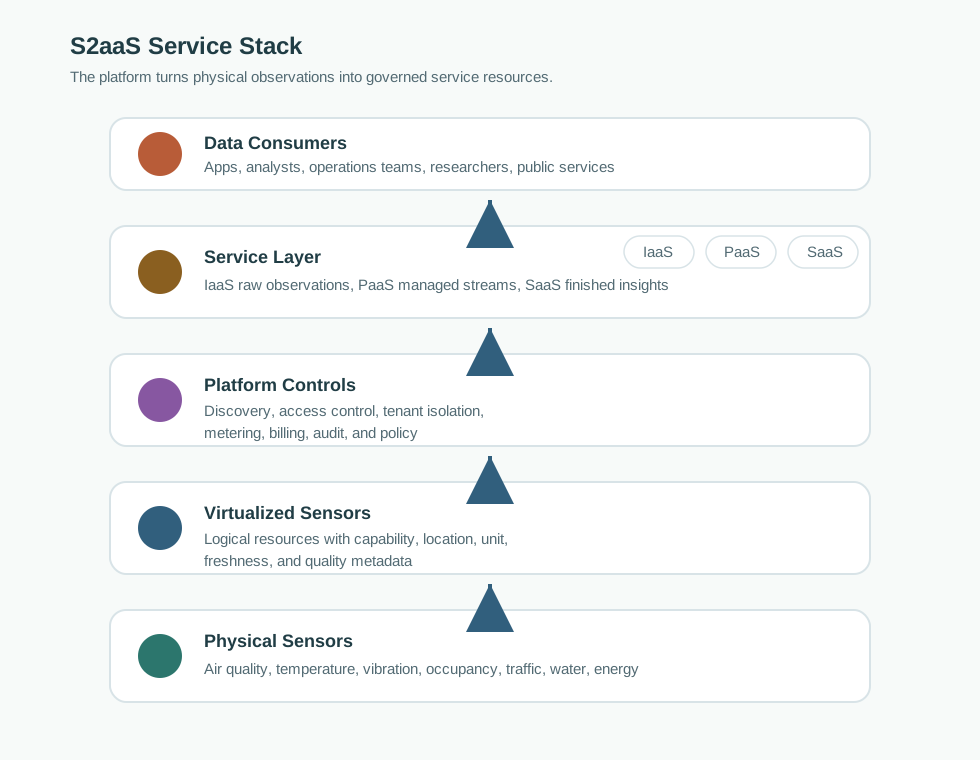
Physical sensors produce observations that have location, unit, time, and quality context.
- Marketplace roles define who owns sensors, who operates the platform, and who consumes data.
- Governance controls make sharing safe enough to reuse across tenants.
Major section
Common Pitfalls
A simple API is not enough.
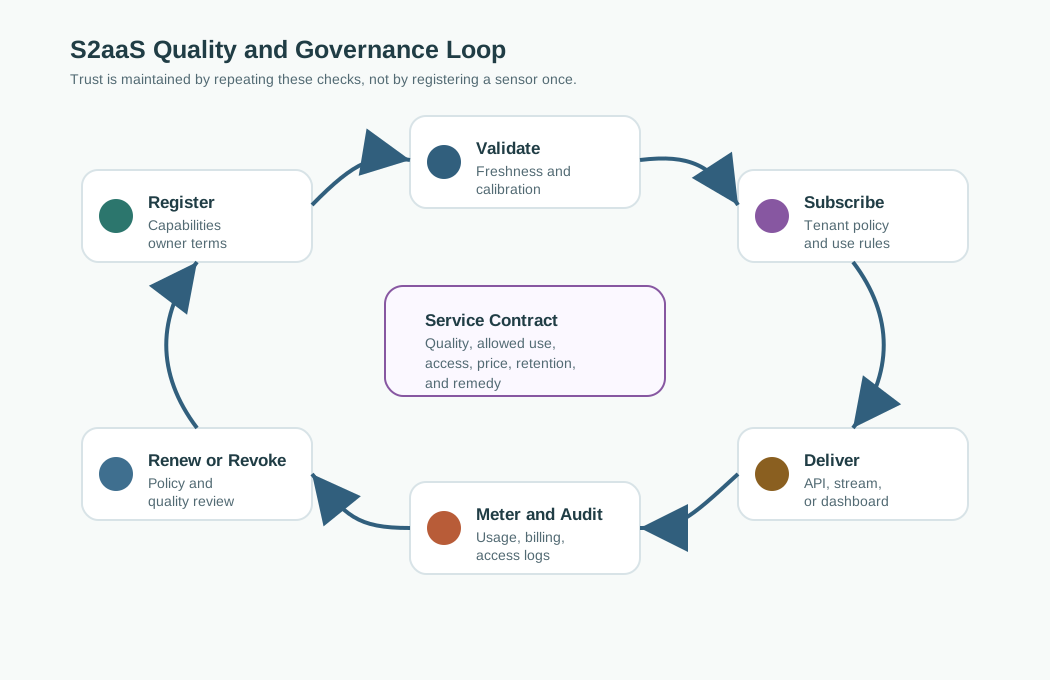
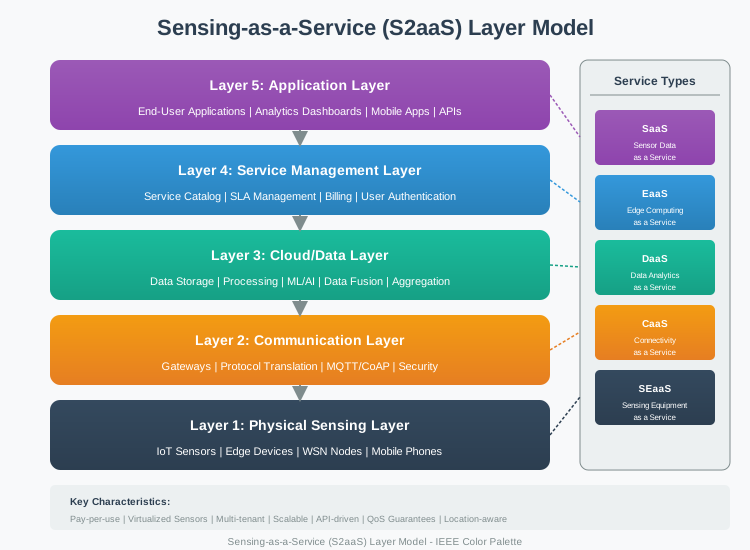
- S2aaS requires discovery, virtualization, access control, quality metadata, metering, and reuse across consumers.
- Sensor data may reveal location, occupancy, movement, behavior, or operational state.
- Consumers need to know whether readings are fresh, calibrated, complete, and spatially relevant.
- Missing quality metadata makes the service hard to trust.
Major section
Summary
The core shift is not that sensors disappear; it is that applications can discover and consume virtualized sensing resources without owning every device.
- A good S2aaS design names the roles, chooses the right service layer, publishes useful metadata, enforces tenant boundaries, and makes quality and allowed use visible enough for consumers to trust.
Deck summary
Key takeaways
The buyer does not own the devices, routes, or repairs, yet still needs to know what each value means and when it can be trusted.
- A stream can be easy to buy and still be unfit for a decision.
- Sensing-as-a-Service (S2aaS) makes sensing capability available through a service interface.
- S2aaS is shared sensing, not sensor-free sensing.: Someone still owns and maintains physical sensors.
- Traditional IoT deployments often build a dedicated sensing network for one application: one agency deploys air-quality sensors, one building owner deploys occupancy sensors, one fleet operator deploys temperature probes, and each system is integrated separately.
Retrieval practice
Recall check 1 of 5

Blueprint Bina says: answer from memory, then check your reasoning.
Q1A traffic-planning team wants to subscribe to shared roadside noise readings for night-work approvals. Which record best proves the S2aaS decision is ready?
Show answer
Answer: A S2aaS readiness depends on the service promise and evidence around ownership, quality, privacy, and rejected conditions.
Retrieval practice
Recall check 2 of 5

Blueprint Bina says: answer from memory, then check your reasoning.
Q2What does Sensing-as-a-Service (S2aaS) actually provide?
Show answer
Answer: A S2aaS delivers sensing capability through a service interface, but physical sensors are still owned and maintained by someone.
Retrieval practice
Recall check 3 of 5

Blueprint Bina says: answer from memory, then check your reasoning.
Q3What is the most accurate description of Sensing-as-a-Service?
Show answer
Answer: C C) A model where sensing capability is exposed through a service interface backed by shared physical infrastructure.
Retrieval practice
Recall check 4 of 5

Blueprint Bina says: answer from memory, then check your reasoning.
Q4Which responsibility belongs most clearly to the S2aaS platform operator?
Show answer
Answer: B B) Enforcing discovery, access control, usage metering, quality metadata, and tenant isolation.
Retrieval practice
Recall check 5 of 5

Blueprint Bina says: answer from memory, then check your reasoning.
Q5Place each S2aaS responsibility where it lives so you can trace a physical observation into a governed service that a consumer can trust.
Show answer
Answer: E Follow the observation from maintained hardware through a logical resource and policy boundary to a consumer-facing service so you can see where quality, access, and accountability enter the chain.
Q6Complete the service-side check that decides whether an S2aaS request is inside a subscription.
Show answer
Answer: A A platform must enforce metric, zone, and rate limits so tenants receive only the sensing service they are allowed to use.
Print reference
Answers 1 of 2
Answer key.
- A · S2aaS readiness depends on the service promise and evidence around ownership, quality, privacy, and rejected conditions.
- A · S2aaS delivers sensing capability through a service interface, but physical sensors are still owned and maintained by someone.
- C · C) A model where sensing capability is exposed through a service interface backed by shared physical infrastructure.
- B · B) Enforcing discovery, access control, usage metering, quality metadata, and tenant isolation.
Print reference
Answers 2 of 2
Answer key.
- E · Follow the observation from maintained hardware through a logical resource and policy boundary to a consumer-facing service so you can see where quality, access, and accountability enter the chain.
- A · A platform must enforce metric, zone, and rate limits so tenants receive only the sensing service they are allowed to use.