Emerging Paradigms · Study deck

S2aaS Data Ownership and Privacy

Picture a council-owned air sensor beside a school.

Blueprint Bina is your guide for this deck.

s2aasdataownership
Blueprint Bina, the module guide, in a scene from this chapter.
iotclass.org

After studying this chapter

Learning objectives

You will be able to:

  • Distinguish physical sensor ownership from data control, data stewardship, data-subject rights, and consumer licenses.
  • Compare owner-retained, consumer-licensed, and shared-governance ownership models.
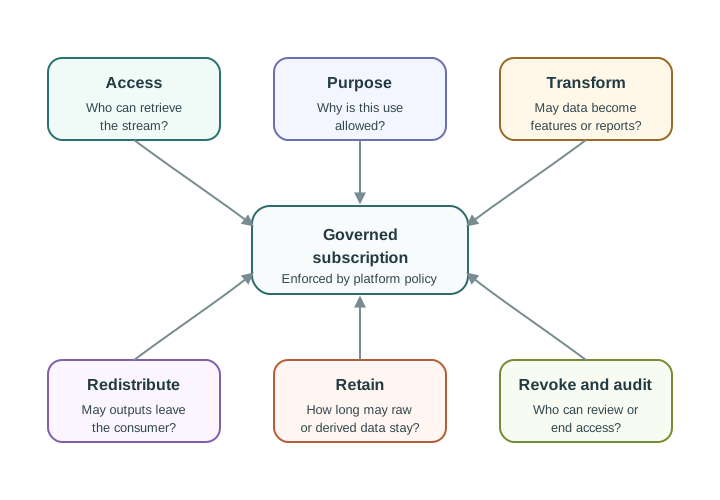
  • Define a data rights contract for access, purpose, transformation, redistribution, retention, revocation, and audit.
  • Choose privacy controls for personal, operational, public, and aggregated sensor data.
iotclass.org

Major section

Minimum Viable Understanding

Ownership and control are separate.: The organization that owns the device may not have unlimited rights to use or sell every signal it observes.

  • Rights must be explicit.: Access, purpose, transformation, redistribution, retention, revocation, and audit rules belong in the subscription contract.
  • Data subjects matter.: People, tenants, workers, patients, students, drivers, or households represented by the data may have privacy interests even when they do not own the sensor.
  • Anonymization is only one control.: Sensor patterns can reveal behavior, location, occupancy, or operations, so minimization, aggregation, purpose limitation, and audit are also needed.
iotclass.org

Major section

Ownership Is Not One Question

Owns or controls the deployed sensor, gateway, or site.

  • In ordinary conversation, "data ownership" sounds like one party owns the data and everyone else does not.
  • S2aaS is more complicated.
  • This role usually controls maintenance, access to the device, and whether the stream may be published.
iotclass.org

Major section

Ownership Is Not One Question (continued)
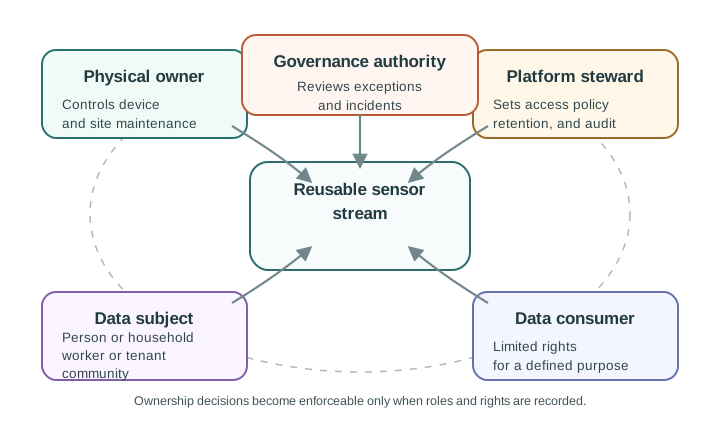
A building may own a sensor, a tenant may be represented by occupancy data, a platform may store the stream, and a consumer may license a derived feed for a narrow purpose.

  • This role may not own the data, but it must enforce the rules.
  • Privacy interests can exist even when the data is indirect.
  • The consumer's rights are limited by purpose, retention, redistribution, and quality constraints.
iotclass.org

Major section

Rights Framework

A data rights framework converts broad ownership language into operational rules the platform can enforce.

  • Derived data can create new ownership questions.
  • A consumer may combine occupancy counts with weather, energy, or sales data to build a new model.
S2aaS rights framework showing access, purpose, transformation, redistribution, retention, revocation, and audit controls feeding into a governed subscription.
iotclass.org

Major section

Privacy Classification

Homes, health settings, schools, workplaces, care facilities, and law-enforcement contexts need additional governance because misuse can directly affect people.

  • Privacy risk depends on what the stream can reveal, not only what the sensor is named.
  • Outdoor weather, aggregate environmental readings, public equipment status, or coarse infrastructure telemetry may be reusable with quality metadata, retention limits, and basic audit.
  • Industrial process state, security systems, logistics routes, and facility occupancy may expose business operations even when they do not identify people.
iotclass.org

Major section

Governance Structure

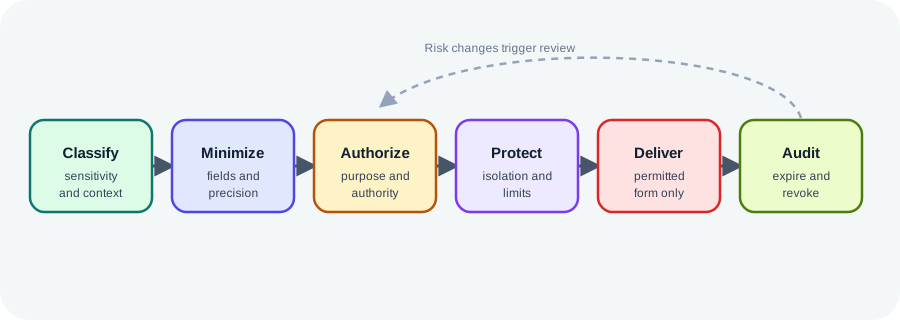
A mature S2aaS platform turns policy into operational controls.

  • Identity, scopes, encryption, tenant isolation, rate limits, retention jobs, consent records, policy checks, and audit logs.
  • Allowed purpose, quality terms, redistribution limits, derivative rules, liability boundaries, inspection rights, and termination.
  • Risk assessment, stakeholder representation, transparency reports, incident process, appeals, and periodic reassessment.
iotclass.org

Major section

Concept Relationships

Privacy controls reduce unnecessary detail and enforce purpose boundaries.

  • Physical ownership controls devices and site operations.
  • Data stewardship controls platform handling, retention, access, and audit.
  • Data-subject interests arise when people or sensitive operations are represented by the stream.
  • Consumer licenses define what the subscriber may do with data and derivatives.
iotclass.org

Major section

Common Pitfalls

A site owner may control the device but still need privacy, labor, tenant, research, or community governance before sharing behavior-revealing data.

  • Aggregates, alerts, features, scores, and model outputs can preserve sensitive patterns.
  • Long retention increases breach, misuse, and re-identification risk.
  • Consent or authority has to be specific, revocable where required, connected to a purpose, and enforceable in access decisions.
iotclass.org

Major section

Summary

S2aaS data ownership is a governance design problem.

  • Device owners, platform stewards, data subjects, consumers, and oversight bodies can all have legitimate roles.
  • A strong platform makes rights explicit: who can access a stream, why, at what precision, for how long, with which derivative and redistribution limits, and under what audit and revocation rules.
  • Privacy protection requires minimization, aggregation, purpose limitation, access tiers, retention controls, and operational audit, not just removal of direct identifiers.
iotclass.org

Deck summary

Key takeaways

Ownership and control are separate.: The organization that owns the device may not have unlimited rights to use or sell every signal it observes.

  • Owns or controls the deployed sensor, gateway, or site.
  • A building may own a sensor, a tenant may be represented by occupancy data, a platform may store the stream, and a consumer may license a derived feed for a narrow purpose.
  • A data rights framework converts broad ownership language into operational rules the platform can enforce.
  • Homes, health settings, schools, workplaces, care facilities, and law-enforcement contexts need additional governance because misuse can directly affect people.
iotclass.org

Retrieval practice

Recall check 1 of 4

Blueprint Bina says: answer from memory, then check your reasoning.

Q1Who is most likely to control physical maintenance and whether a deployed sensor may publish a stream?

APhysical owner or site operator
BAny consumer who can query the API
CA chart viewer with dashboard access
DA third-party model trained on old exports
Show answer

Answer: A A) Physical owner or site operator.

iotclass.org

Retrieval practice

Recall check 2 of 4

Blueprint Bina says: answer from memory, then check your reasoning.

Q2A consumer is allowed to use aggregated noise data for research. It wants to combine the data with property records and sell neighborhood rankings. What should the platform do?

AAllow it automatically, because the original data was already aggregated before delivery
BCheck derivative-use and redistribution rights before allowing the new output
CDelete all of the platform's sensor data immediately to remove any liability
DTreat the ranking product as legally unrelated to the original research subscription
Show answer

Answer: B B) Check derivative-use and redistribution rights before allowing the new output.

iotclass.org

Retrieval practice

Recall check 3 of 4

Blueprint Bina says: answer from memory, then check your reasoning.

Q3Why is removing names from a sensor dataset not enough?

ASensor data never contains patterns detailed enough to be useful for identification
BNames are the only identifier that privacy regulation recognizes as personal data
CTime, location, occupancy, and behavior patterns can still make records linkable
DRemoving names automatically makes retention and purpose limits unnecessary
Show answer

Answer: C C) Time, location, occupancy, and behavior patterns can still make records linkable.

iotclass.org

Retrieval practice

Recall check 4 of 4

Blueprint Bina says: answer from memory, then check your reasoning.

Q4Place each s2aas data ownership concept where it lives so you can tell who authorises reuse, what reuse is allowed, and how the lifecycle is proved.

AOwner Authority
BData Subject
CConsumer License
DPurpose Limit
Show answer

Answer: A The three regions separate establish rights, bound reuse, close lifecycle so you can tell who authorises reuse, what reuse is allowed, and how the lifecycle is proved.

Q5Complete the policy check for an S2aaS data request.

Apurpose_ok = request['purpose'] in policy['allowed_purposes']
Bpurpose_ok = True
Cpurpose_ok = request['purpose'] not in policy['allowed_purposes']
Dpurpose_ok = policy['owner'] != ''
Show answer

Answer: A The platform should block a request when the purpose is not approved, requested retention exceeds the policy, or redistribution is requested without permission.

iotclass.org

Print reference

Answers 1 of 2

Answer key.

  1. A · A) Physical owner or site operator.
  2. B · B) Check derivative-use and redistribution rights before allowing the new output.
  3. C · C) Time, location, occupancy, and behavior patterns can still make records linkable.
  4. A · The three regions separate establish rights, bound reuse, close lifecycle so you can tell who authorises reuse, what reuse is allowed, and how the lifecycle is proved.
iotclass.org

Print reference

Answers 2 of 2

Answer key.

  1. A · The platform should block a request when the purpose is not approved, requested retention exceeds the policy, or redistribution is requested without permission.
iotclass.org