Emerging Paradigms · Study deck
Virtual Sensors and Service Models
Imagine a farm team buying access to a soil reading collected by another company.
Blueprint Bina is your guide for this deck.

After studying this chapter
Learning objectives
You will be able to:
- Model an S2aaS platform as physical sensors, virtual resources, discovery metadata, service layers, and consumers.
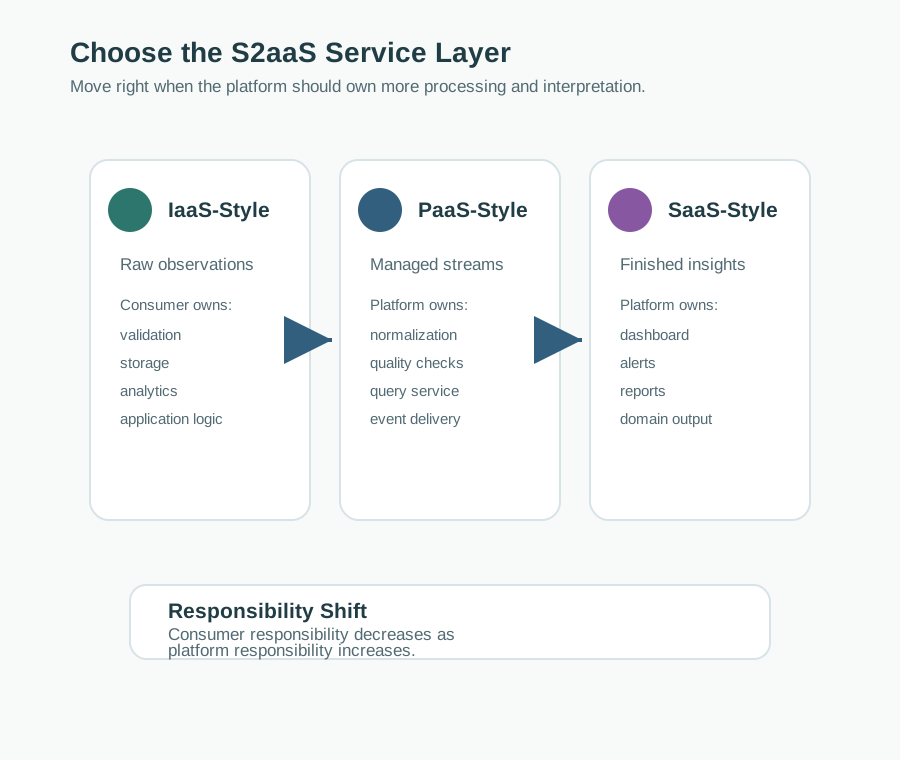
- Choose between IaaS, PaaS, and SaaS-style sensing for a given consumer responsibility level.
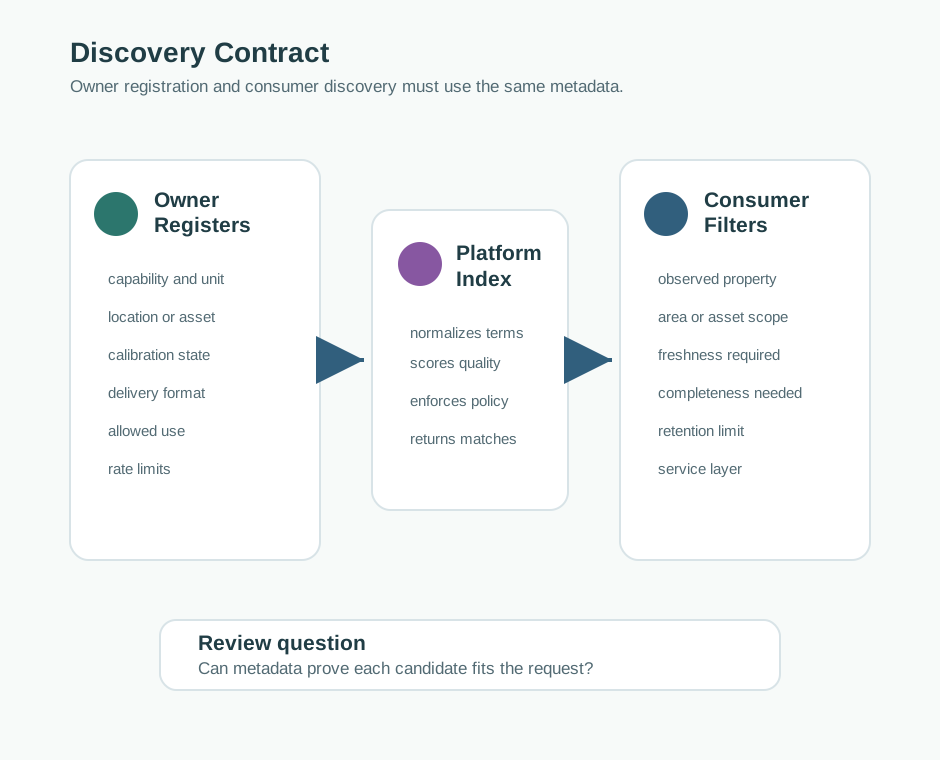
- Define the minimum metadata needed for sensor registration and discovery.
- Explain how multi-tenancy, metering, and policy controls make shared sensing safe enough to reuse.
Major section
Start Simple
The number is easy to reach.
- The farm still needs to know where it came from, how old it is, what quality was checked, and whether it may guide watering.
- Sensing as a Service means offering access to measurements for other users or systems.
- The user needs notice before such a change alters a decision.
- It should name planned gaps.
Major section
Start Simple (continued)
The service owner should name the source, unit, place, update rate, quality rule, permitted use, price, and support contact.
- The farm should know how to save needed records, remove access, and replace the source without hiding a gap.
- The provider should know which copies may remain and for how long.
- The offer should make limits easy to find.
Major section
Start Simple (continued)
A cheaper source may update less often or offer less support.
- A more expensive one may still be wrong for the field decision.
- They should find the source, collection time, checks, allowed use, and change history.
- If any step depends on a private message or memory, the service is not ready for safe reuse.
Major section
Start Simple (continued)
In Virtual Sensors and Service Models, the practical question is who owns the sensing resource, what quality is promised, and what policy keeps the service safe to consume.
- It should state places not covered.
- It should state checks not run.
- A user can then choose a safe task instead of treating all reachable data as equal.
Major section
Checkpoint: Minimum Viable Understanding
A virtual sensor is a contract: It describes what a consumer can request, where the data comes from, how fresh it is, and which use is allowed.
- Service layers allocate responsibility: IaaS leaves more work with the consumer; SaaS moves more work into the provider.
- Discovery is part of the product: A consumer must be able to search by capability, location, quality, time, policy, and price model.
- Multi-tenancy needs controls: Sharing is only safe when tenants are isolated, rate-limited, metered, and audited.
- Quality metadata prevents false confidence: Calibration, completeness, latency, sampling interval, and fallback behavior must travel with the data.
Major section
Selection Workflow: Virtual Sensor Model
A virtual sensor is the stable object that consumers use.
- It may map to one physical sensor, a redundant group, a fused stream, or a time-bounded dataset.
- The virtual sensor should not hide important uncertainty.
- It should expose enough metadata for consumers to decide whether the resource fits.
- Both algorithms must be re-evaluated.
Major section
Selection Workflow: Virtual Sensor Model (continued)
CoV-I forms one virtual sensor from homogeneous physical nodes inside one geographic boundary. “Homogeneous” means the candidates observe the same property with compatible units and semantics; it does not mean their quality is identical.
- where every term is normalized and the weights come from the consumer contract.
- Here Ei can represent expected energy cost rather than remaining energy, so its sign stays meaningful.
- A sensor may satisfy several roles only if capacity and policy permit.
Major section
Selection Workflow: Virtual Sensor Model (continued)
That equation is valid only when error assumptions are defensible; correlated colocated sensors do not provide as much independent evidence as the formula suggests.
- CoV-II forms a virtual-sensor group from heterogeneous nodes across regions: The output is a coordinated service, not a claim that unlike measurements can be averaged.
- A heat-risk service might require temperature and humidity in each district, plus occupancy in selected buildings.
- plus latency, budget, ownership, energy, and cross-region transfer constraints. kr is the redundancy or coverage requirement for role r.

Major section
Discovery and Registration
Registration is the owner-side promise.
- Discovery is the consumer-side search.
- The same metadata must support both.
- A consumer cannot compare two candidates unless each record names its capability, unit, location, freshness, and permitted use.
- The platform should reject a request when those fields do not establish a trustworthy match.
Major section
Marketplace Roles and Incentives
S2aaS has three core roles.
- They should be modeled separately even when one organization plays more than one role.
- Owns or controls physical deployment.
- The incentive model fails when one role is ignored.
- Owners will not publish useful resources if policy and operational burden are unclear.
Major section
Subscription Lifecycle
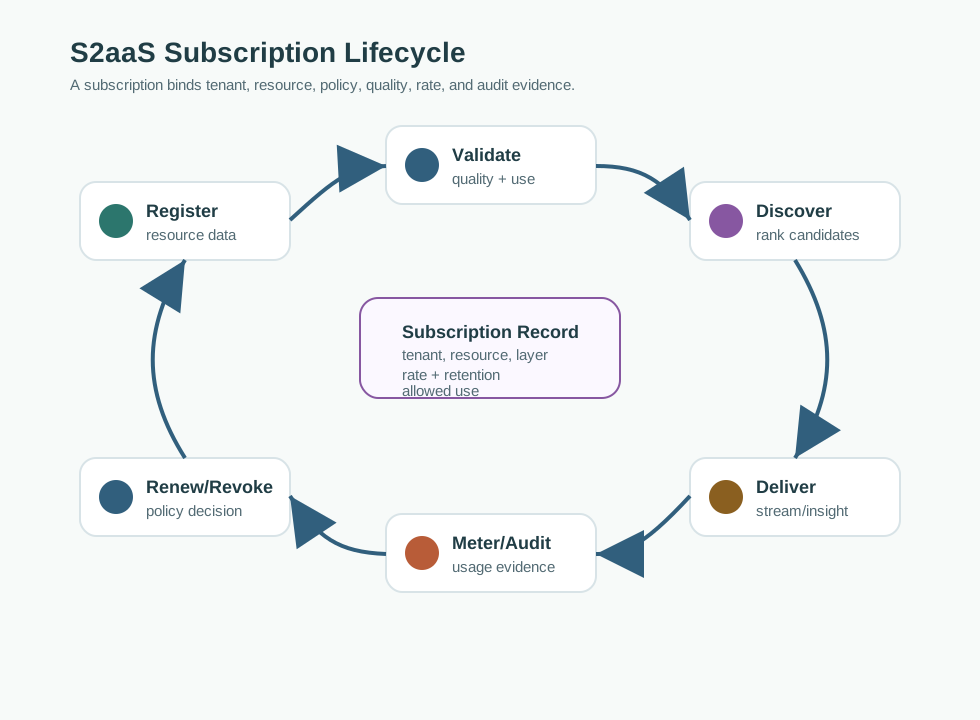
A subscription is not just an API key.
- The check covers age, gaps, place, privacy, and allowed use.
- Search ranks only sensors that meet those bounds.
- Delivery stays under tenant and rate limits.
- Metering saves use, failed calls, quality, access, and policy choices.
Major section
Quality Model
For low-risk analytics, a platform may allow degraded service with a visible quality flag.
- Quality in S2aaS is multi-dimensional.
- A reading can be accurate but too late, fresh but incomplete, allowed for internal use but not redistribution, or valid in one location but not another.
- For safety-relevant or compliance-sensitive workflows, the platform should fail closed when required quality records are missing.
Major section
Common Pitfalls
Discovery is not only keyword search.
- It must match measurement semantics, location, freshness, quality, policy, and delivery constraints.
- If the service layer does not say who handles calibration, validation, storage, alerts, and support, consumers will assume guarantees the platform may not provide.
- Sensor data can expose behavior, location, occupancy, process state, or health-adjacent signals.
Deck summary
Key takeaways
The number is easy to reach.
- The service owner should name the source, unit, place, update rate, quality rule, permitted use, price, and support contact.
- A cheaper source may update less often or offer less support.
- In Virtual Sensors and Service Models, the practical question is who owns the sensing resource, what quality is promised, and what policy keeps the service safe to consume.
- A virtual sensor is a contract: It describes what a consumer can request, where the data comes from, how fresh it is, and which use is allowed.
Retrieval practice
Recall check 1 of 4

Blueprint Bina says: answer from memory, then check your reasoning.
Q1What is the best definition of a virtual sensor in S2aaS?
Show answer
Answer: D B) A logical service resource that maps physical observations to a governed interface.
Retrieval practice
Recall check 2 of 4
Blueprint Bina says: answer from memory, then check your reasoning.
Q2A research group wants raw vibration observations and will run its own signal-processing pipeline. Which model fits best?
Show answer
Answer: C A) IaaS-style sensing.
Retrieval practice
Recall check 3 of 4
Blueprint Bina says: answer from memory, then check your reasoning.
Q3Which item should be part of an S2aaS subscription record?
Show answer
Answer: D C) Tenant identity, resource, allowed use, rate limit, retention, and service layer.
Q4What matches a sensing request to available sensor descriptions?
Show answer
Answer: A It matches requirements to available sensor descriptions.
Retrieval practice
Recall check 4 of 4
Blueprint Bina says: answer from memory, then check your reasoning.
Q5Complete the discovery filter for an S2aaS platform.
Show answer
Answer: A Discovery should match the observed property, freshness constraint, and allowed-use policy before a sensor is shown as a candidate.
Print reference
Answers
Answer key.
- D · B) A logical service resource that maps physical observations to a governed interface.
- C · A) IaaS-style sensing.
- D · C) Tenant identity, resource, allowed use, rate limit, retention, and service layer.
- A · It matches requirements to available sensor descriptions.
- A · Discovery should match the observed property, freshness constraint, and allowed-use policy before a sensor is shown as a candidate.