Routing & RPL · Study deck

RPL Summary Tools

Picture a mesh diagram that looks healthy while marked packets never reach the service.

Packet Pete is your guide for this deck.

summary-toolsrecordspacket-capture
Packet Pete, the module guide, in a scene from this chapter.
iotclass.org

After studying this chapter

Learning objectives

You will be able to:

  • Explain: This ordered reading connects the ordering quiz discussion to the chapter's running argument: a routing decision is credible only when its control state, forwarding result, failure response, and retest trigger can be checked together.
  • Explain: This matters because a routing label or formed topology alone cannot prove that the required traffic path works or recovers at its boundaries.
  • Explain: Depending on the implementation and mode, it may show preferred parent, Rank, neighbor information, routing entries, source routes, or root-side reachability.
  • recognize when a tool output is only a snapshot, not a long-term reliability proof
iotclass.org

Major section

Start With the Proof You Need

The picture shows structure, not delivery.

  • A protocol means shared rules for exchanging messages.
  • Routing Protocol for Low-Power and Lossy Networks, or RPL, organizes routes for constrained device networks.
  • Directed acyclic graph means a one-way structure with no route back to an earlier point.

Key terms

Destination-oriented directed acyclic graph
Destination-oriented directed acyclic graph means the form that directs those routes toward a root; it is shortened to DODAG.
iotclass.org

Major section

Start With the Proof You Need (continued)
Destination-oriented directed acyclic graph means the form that directs those routes toward a root; it is shortened to DODAG.

  • This runway does not prove every RPL behavior from one record.
  • The deeper sections separate topology, control traffic, route state, packet delivery, tool limits, and review decisions.
  • A routing tool is useful when it proves a specific claim.
iotclass.org

Major section

In 60 Seconds

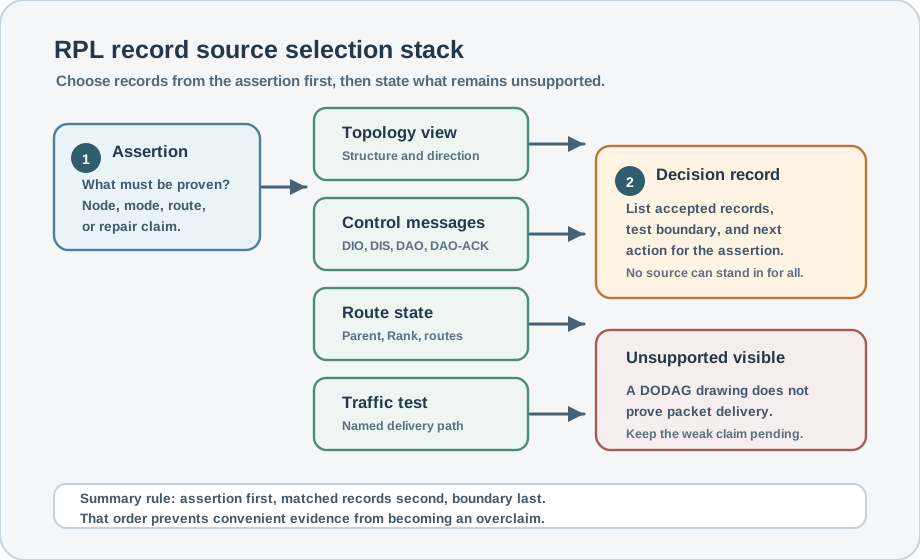
RPL check tools are useful only when they answer a specific routing assertion.

  • A packet capture can show DIO, DIS, DAO, and DAO-ACK activity.
  • A route-state snapshot can show parent choice, Rank, route entries, and mode-dependent state placement.
  • A traffic test can show whether an upward, downward, or peer path actually carries packets.
iotclass.org

Major section

What Summary Tools Are For

Summary tools help learners organize records.

  • They should not hide the reasoning.
  • Weak tool use usually starts when a learner collects data first and invents the assertion afterward.
  • The safer order is to write the assertion, choose the record source, capture the records, and then state the boundary.

Why it matters

This matters because a routing label or formed topology alone cannot prove that the required traffic path works or recovers at its boundaries.

RPL record source selection stack showing a named assertion mapped to topology, control-message, route-state, and traffic-test records before a bounded decision record is accepted.
iotclass.org

Major section

Record Sources

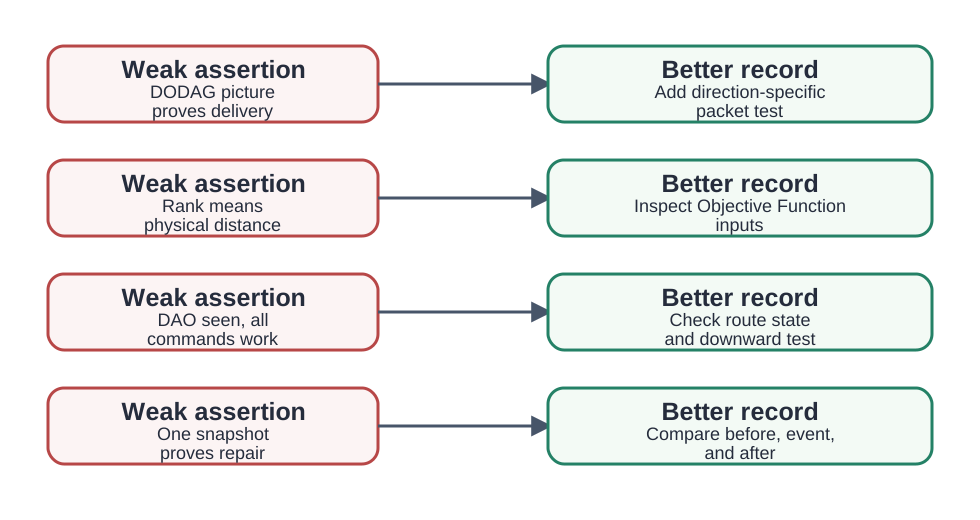
If a learner asserts repair behavior, the snapshot must be paired with before/after records or event logs.

  • Packet capture is the strongest record for observed protocol messages and tested packet delivery.
  • A route-state snapshot records what a node or root currently believes.
  • Logs are not enough by themselves when the assertion is about network-wide delivery.

Why it matters

A route-state snapshot is useful because RPL forwarding depends on state.

iotclass.org

Major section

Record Sources (continued)

Depending on the implementation and mode, it may show preferred parent, Rank, neighbor information, routing entries, source routes, or root-side reachability.

  • Node logs can explain why a node changed parent, reset a Trickle timer, joined a DODAG, or processed a control message.
  • A node may log a parent change while packets still fail for a specific direction.
  • The most common mistake is to run one upward test and then assert downward command delivery.
iotclass.org

Major section

Worked Decision Record

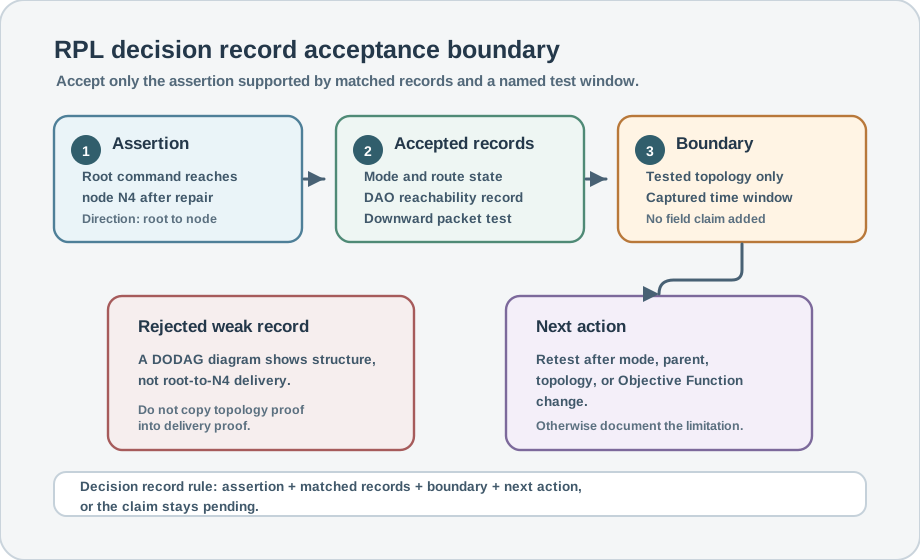
Downward commands from the root can reach node N4 after the network repairs around a failed parent.

  • The weak record confuses structural records with delivery records.

Why it matters

This matters because a routing label or formed topology alone cannot prove that the required traffic path works or recovers at its boundaries.

A useful RPL decision record accepts only the assertion supported by matched records, a named boundary, and a next action.
iotclass.org

Major section

Ordering Quiz

This matters because a routing label or formed topology alone cannot prove that the required traffic path works or recovers at its boundaries.

  • This ordered reading connects the ordering quiz discussion to the chapter's running argument: a routing decision is credible only when its control state, forwarding result, failure response, and retest trigger can be checked together.
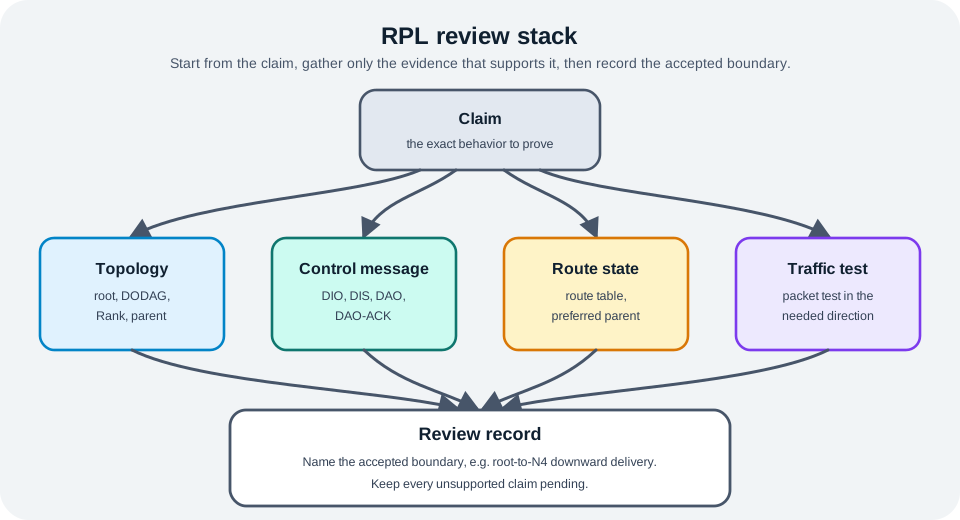
Summary tools should start from a claim, gather only the evidence types that can support that claim, and finish with a review record that says which boundary was accepted.
iotclass.org

Major section

Summary

RPL summary tools are record organizers, not automatic proof.

  • Packet captures, route-state snapshots, logs, traffic tests, and decision records answer different questions.
  • The strongest check starts with the assertion and then selects the record source.
  • Downward, upward, and peer traffic assertions must be checked separately.
iotclass.org

Deck summary

Key takeaways

The picture shows structure, not delivery.

  • Destination-oriented directed acyclic graph means the form that directs those routes toward a root; it is shortened to DODAG.
  • RPL check tools are useful only when they answer a specific routing assertion.
  • Summary tools help learners organize records.
  • If a learner asserts repair behavior, the snapshot must be paired with before/after records or event logs.
iotclass.org

Retrieval practice

Recall check 1 of 3

Packet Pete says: answer from memory, then check your reasoning.

Q1A packet capture shows DIO traffic, but no route-state snapshot or packet test is available. What can the tool record support?

ATopology proof, route-state placement, and packet-delivery acceptance
BScoped DIO control-message observations, with route state left unproven
CLong-term reliability across every radio condition
DApplication-command delivery to every node
Show answer

Answer: B RPL tools should keep topology, control-message, route-state, and packet-delivery records separate.

iotclass.org

Retrieval practice

Recall check 2 of 3

Packet Pete says: answer from memory, then check your reasoning.

Q2A learner has a DODAG diagram and a successful upward packet test from a sensor to the root. What assertion is still not supported?

ADownward commands from the root can reach that sensor
BThe sensor has an upward path to the root under the tested conditions
CThe DODAG has a root-centered structure in the captured diagram
DThe tested packet was observed during the capture window
Show answer

Answer: A RPL records must match the assertion.

iotclass.org

Retrieval practice

Recall check 3 of 3

Packet Pete says: answer from memory, then check your reasoning.

Q3A learner has a route-state snapshot from before a repair event and wants to use it as proof that downward commands still work afterward. What should the summary check require?

AA refreshed state record plus a downward packet test under the post-repair condition.
BOnly the old snapshot, because a route table never changes after RPL forms.
COnly a DODAG drawing, because structure proves delivery.
DA broader written claim without new evidence.
Show answer

Answer: A RPL summary tools should pair each assertion with current control, state, packet, and boundary evidence.

iotclass.org

Print reference

Answers

Answer key.

  1. B · RPL tools should keep topology, control-message, route-state, and packet-delivery records separate.
  2. A · RPL records must match the assertion.
  3. A · RPL summary tools should pair each assertion with current control, state, packet, and boundary evidence.
iotclass.org