Routing & RPL · Study deck
The RPL Standard (RFC 6550)
A building sensor's product sheet lists support for the RPL standard.
Packet Pete is your guide for this deck.

After studying this chapter
Learning objectives
You will be able to:
- check the RPL protocol pieces (messages, modes, headers) in the order RFC 6550 defines them
- treat RFC 6550 as the contract that RPL implementations must satisfy
- map RPL messages and modes onto their specification sections
- Explain: Lower link quality, remove the parent, restart the root, join a second graph, send a downward command, and inject old control state.
Major section
Start With the Contract
Lower link quality, remove the parent, restart the root, join a second graph, send a downward command, and inject old control state.
- A formed graph or a product label does not prove the needed packet path.
- This opening does not restate the full standard or certify a stack.
- Under the Hood examines graph rules, control objects, rank, parent choice, downward modes, headers, and recovery limits.
Major section
Overview: RFC 6550 Defines the RPL Contract
This matters because a routing label or formed topology alone cannot prove that the required traffic path works or recovers at its boundaries.
- That evidence resolves the question posed by Overview: RFC 6550 Defines the RPL Contract.
Major section
Turn a Support Claim into an Upward-and-Downward Test
These observations show how the claimed standard is being used; a diagram drawn after the test cannot replace the actual control messages.
- If all readings arrive but only 3 commands do, the two delivery proportions are 20 divided by 20 = 100% and 3 divided by 5 = 60%.
Major section
Turn a Support Claim into an Upward-and-Downward Test (continued)
A combined 23 out of 25, or 92%, conceals which direction is weak, and none of these small-sample proportions constitutes standard certification.
- The standard review should then repeat the command after removing the chosen parent, keeping the fault time and new route state beside the packet capture.
- A leaf may regain an upward route before the return path is repaired.
- Urgent local action should retain its own safe behaviour when routing repair exceeds the application's deadline, even if the implementation remains a valid RPL participant.
Major section
Summary
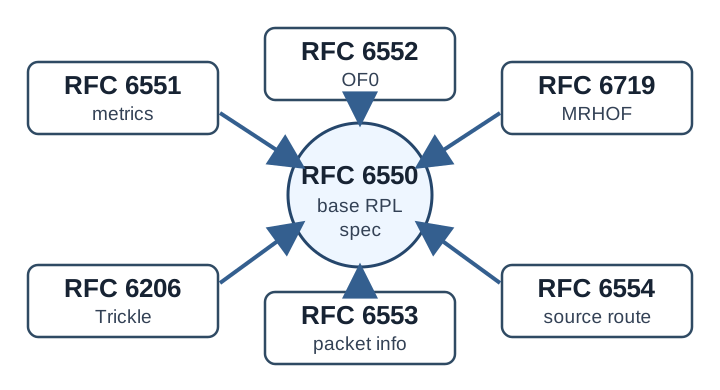
RFC 6550 defines the base RPL protocol for constrained IPv6 routing in low-power and lossy networks.
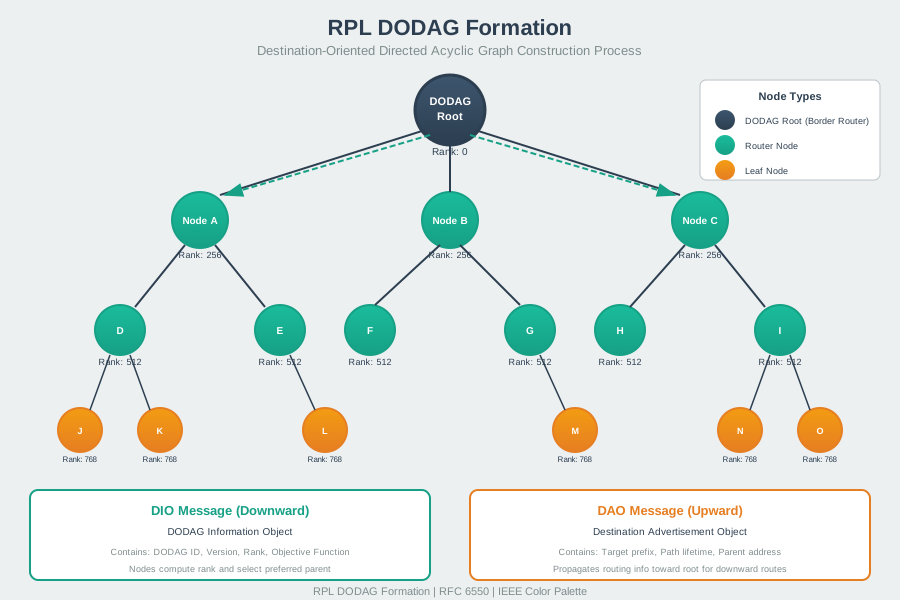
- An RPL Instance gives the routing context, while a DODAG organizes routers around a root.
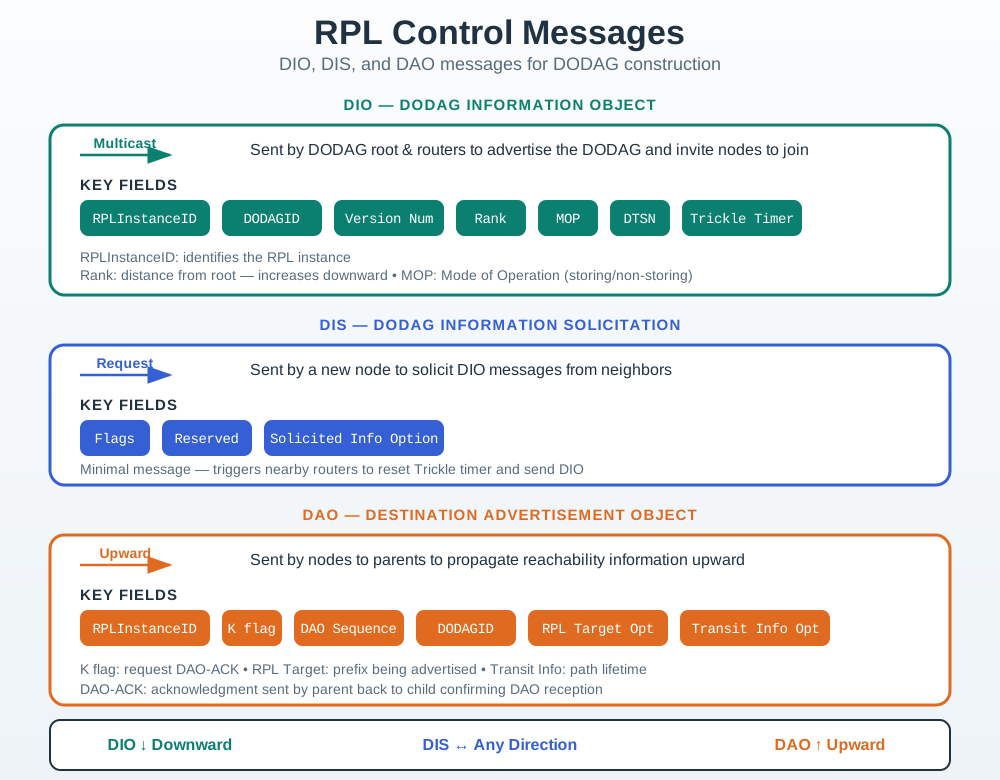
- DIO, DIS, DAO, and DAO-ACK are the main RPL control messages to understand before interpreting route state.
- Storing and Non-Storing modes differ mainly in where downward route state lives and how downward packets are carried.
Deck summary
Key takeaways
Lower link quality, remove the parent, restart the root, join a second graph, send a downward command, and inject old control state.
- This matters because a routing label or formed topology alone cannot prove that the required traffic path works or recovers at its boundaries.
- These observations show how the claimed standard is being used; a diagram drawn after the test cannot replace the actual control messages.
- A combined 23 out of 25, or 92%, conceals which direction is weak, and none of these small-sample proportions constitutes standard certification.
- RFC 6550 defines the base RPL protocol for constrained IPv6 routing in low-power and lossy networks.
Retrieval practice
Recall check 1 of 3

Packet Pete says: answer from memory, then check your reasoning.
Q1Which statement best describes the role of RFC 6550 in an RPL deployment?
Show answer
Answer: A RFC 6550 is the base RPL specification.
Retrieval practice
Recall check 2 of 3

Packet Pete says: answer from memory, then check your reasoning.
Q2A joined RPL node needs to choose a preferred parent for upward traffic. Which check should come before accepting the parent choice?
Show answer
Answer: A Parent selection must be interpreted inside the RPL Instance and must preserve the DODAG direction toward the root.
Retrieval practice
Recall check 3 of 3

Packet Pete says: answer from memory, then check your reasoning.
Q3In a Non-Storing RPL design, where is downward route state primarily held for source-routed delivery?
Show answer
Answer: A Non-Storing mode concentrates downward route state at the root and uses source routing for downward delivery.
Print reference
Answers
Answer key.
- A · RFC 6550 is the base RPL specification.
- A · Parent selection must be interpreted inside the RPL Instance and must preserve the DODAG direction toward the root.
- A · Non-Storing mode concentrates downward route state at the root and uses source routing for downward delivery.