Routing & RPL · Study deck

Storing vs Non-Storing Modes

Picture a control room sending a valve command down through a small field network.

Packet Pete is your guide for this deck.

routing-modesstoring-modenon-storing-mode
Packet Pete, the module guide, in a scene from this chapter.
iotclass.org

After studying this chapter

Learning objectives

You will be able to:

  • explain where downward route state lives in Storing versus Non-Storing mode
  • write a mode choice as an evidence record, not a default setting
  • use DAO and packet evidence to support a mode-choice claim
  • Explain: A protocol means the shared rules for a message exchange.
iotclass.org

Major section

Start With the Downward Packet

A protocol means the shared rules for a message exchange.

  • Sensor reports may arrive at the root even when the return path is broken.
  • The first question is where each device expects the downward route record to live.
  • RPL means Routing Protocol for Low-Power and Lossy Networks.
  • Telemetry means measurements and status sent for remote use.
iotclass.org

Major section

Start With the Downward Packet (continued)

A directed acyclic graph is a route shape with one-way links and no loop; DODAG means destination-oriented directed acyclic graph.

  • This runway does not prove that storing or non-storing mode is always better.
  • The deeper sections compare state placement, source routes, memory, packet size, repair behavior, and mixed traffic evidence.
  • RPL routing mode matters most when a packet must travel from the root toward a node.
iotclass.org

Major section

Overview: The Mode Decides Where Downward State Lives
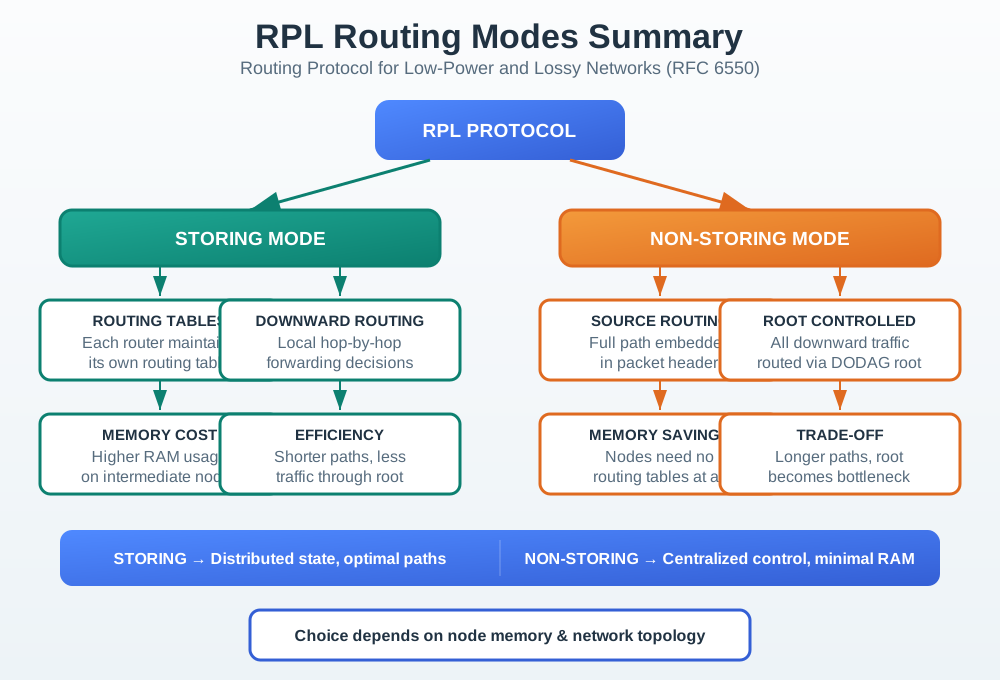
A device can usually send traffic upward by forwarding to its preferred parent.

  • Storing and Non-Storing mode become important when traffic must move downward from the root or across the DODAG between non-root nodes.
  • The core question is route-state placement.
  • In Storing mode, router-capable nodes keep downward routes for descendants.

Why it matters

This matters because a routing label or formed topology alone cannot prove that the required traffic path works or recovers at its boundaries.

RPL routing mode changes where downward route state is kept, not whether routing evidence is needed.
iotclass.org

Major section

Overview: The Mode Decides Where Downward State Lives (continued)

Mode choice also depends on the application mix.

  • In Non-Storing mode, the root keeps the downward path view and uses source-route information for packets that travel down the DODAG.
  • That placement changes the evidence, not the need for evidence.
  • The safest overview record is a comparison, not a slogan.
iotclass.org

Major section

Overview: The Mode Decides Where Downward State Lives (continued)

Router-capable nodes store descendant reachability and may forward downward packets using local route entries.

  • Storing mode asks whether intermediate routers have current descendant entries and enough memory to keep them.
  • The overview decision should name the traffic direction before treating either mode as simpler.
  • Node-to-node traffic needs explicit path evidence.
iotclass.org

Major section

Overview: The Mode Decides Where Downward State Lives (continued)

Non-Storing mode asks whether the root has the current path view and whether the resulting source-route information fits the packet and link constraints.

  • A network that mostly uploads readings may tolerate a different proof burden than a control system that sends frequent commands to sleeping devices.
  • It names where state is stored, which nodes are allowed to store it, how DAO evidence is checked, what packet overhead is expected, and what event forces retesting after the first deployment.
  • When a design has both telemetry and commands, review the two directions separately.
iotclass.org

Major section

Overview: The Mode Decides Where Downward State Lives (continued)

This matters because a routing label or formed topology alone cannot prove that the required traffic path works or recovers at its boundaries.

  • The mode can be acceptable for one direction while still needing extra evidence for the other.
  • That discipline keeps mode selection tied to observable route state instead of preference alone.
  • The root maintains downward path knowledge and includes source-route information for downward packets.
iotclass.org

Major section

Practitioner: Write the Mode Choice as Evidence
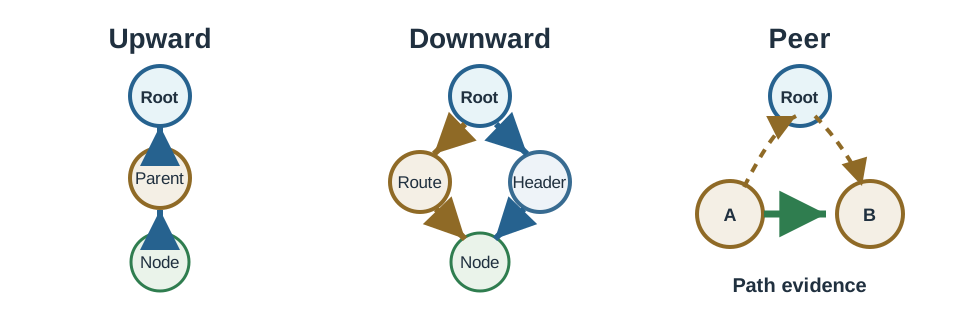
A practitioner should turn the mode choice into a short review record.

  • A root, router-capable intermediate node, and leaf-only node do not carry the same routing responsibility.
  • Upward packet traces, preferred-parent evidence, and command-path tests if commands exist.
  • Intermediate routers need correct descendant route state.

Why it matters

This matters because a routing label or formed topology alone cannot prove that the required traffic path works or recovers at its boundaries.

Traffic direction determines which routing-mode evidence matters.
iotclass.org

Major section

Practitioner: Write the Mode Choice as Evidence (continued)

Parent churn, root failover, node mobility, firmware changes, payload growth, and new command flows can all invalidate an older mode decision even when the topology picture still looks familiar.

  • The root needs current path knowledge and source-route packet proof.
  • Local route state may help only if the required ancestor and route entries exist.
  • Peer paths may depend on the root's source-routing role.
  • Route tables consume memory on router-capable nodes.
iotclass.org

Major section

Practitioner: Write the Mode Choice as Evidence (continued)

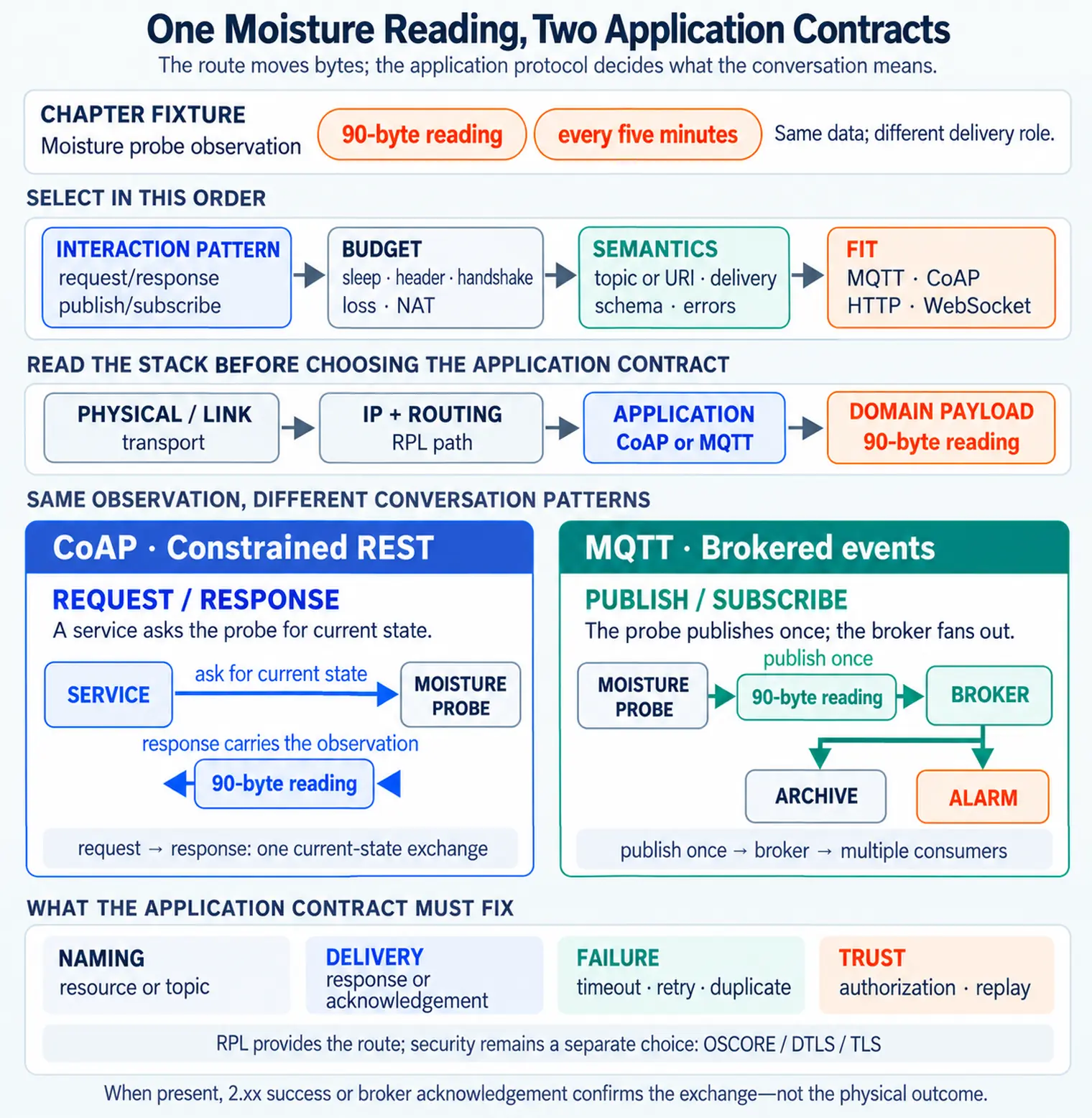
The hand-off in Figure: Application interaction pattern prevents this routing choice being mistaken for an application protocol choice.

  • Source-route information consumes packet space on downward paths.
  • The local turn in Figure: A storing-mode DODAG routes peer traffic from E shows exactly what distributed descendant state buys for the E-to-F peer flow.
  • The mode difference is easiest to see on a single peer flow.
iotclass.org

Major section

Practitioner: Write the Mode Choice as Evidence (continued)

The orange turn toward: F is possible because: B · descendant table stores both children, so: E → B → F reaches the nearest common ancestor without visiting the root.

  • The labels upward and: A writes source route [B,F] expose the trade: routers keep less descendant state, but peer traffic detours through the root and carries route information.
  • In Figure: Application interaction pattern, Interaction pattern and: Budget precede: Semantics; only then does: Fit name MQTT, CoAP, HTTP, or WebSocket.
  • B recognizes F as its own descendant and forwards directly, without involving the root.
iotclass.org

Major section

Practitioner: Write the Mode Choice as Evidence (continued)

In Non-Storing mode, only the root keeps downward path knowledge; B has no route-table entry for F even though B is the same physical common ancestor.

  • The peer path is still correct, but it is roughly twice as long as the Storing-mode path, and it now depends on the root staying reachable and holding a current route for F.
  • That gap is why the review rule above insists on explicit peer-path evidence.
  • Storing and non-storing mode describe downward state; they do not make every RPL-like route selector interchangeable.
iotclass.org

Major section

Under the Hood: DAO and Packet Evidence Carry the Claim

DAO evidence supports downward reachability, but it is not the same as application delivery.

  • It helps prove that the selected mode has route knowledge for a destination.
  • Packet tests still have to show that the claimed traffic can move through the current topology.

Why it matters

This matters because a routing label or formed topology alone cannot prove that the required traffic path works or recovers at its boundaries.

RPL routing mode changes where downward route state is kept, not whether routing evidence is needed.
iotclass.org

Major section

Under the Hood: DAO and Packet Evidence Carry the Claim (continued)

Storing mode asks router-capable nodes to keep useful descendant state.

  • Non-Storing mode asks the root to maintain the downward path view and fit source-route information into downward packets.
  • That evidence resolves the question posed by Under the Hood: DAO and Packet Evidence Carry the Claim.
  • Nodes may join the wrong context, misunderstand the mode, or compare paths with stale assumptions.
iotclass.org

Major section

Under the Hood: DAO and Packet Evidence Carry the Claim (continued)

Root change, firmware change, Objective Function change, or topology reset.

  • Downward route claims can be stale, missing, or stored at the wrong place for the selected mode.
  • Headers, source-route information, link limits, or fragmentation can undermine a path that looks valid in control evidence.
  • Payload growth, security wrapper change, link setting change, or new traffic direction.
  • DAO supports route knowledge; application delivery still needs packet evidence and receiver behavior.
iotclass.org

Major section

Summary

RPL Storing and Non-Storing modes differ mainly in where downward route state lives.

  • Storing mode lets router-capable nodes keep descendant reachability for downward forwarding.
  • Non-Storing mode places downward path responsibility at the root and uses source-route information.
  • Peer traffic and downward commands need explicit path evidence, not assumptions from the mode name.
iotclass.org

Deck summary

Key takeaways

A protocol means the shared rules for a message exchange.

  • A directed acyclic graph is a route shape with one-way links and no loop; DODAG means destination-oriented directed acyclic graph.
  • A device can usually send traffic upward by forwarding to its preferred parent.
  • Mode choice also depends on the application mix.
  • Router-capable nodes store descendant reachability and may forward downward packets using local route entries.
iotclass.org

Retrieval practice

Recall check 1 of 3

Packet Pete says: answer from memory, then check your reasoning.

Q1Which question best distinguishes RPL Storing mode from Non-Storing mode?

AWhether upward traffic can use a preferred parent.
BWhere downward route state lives and how downward packets move.
CWhether RPL can use DIO messages.
DWhether Rank is replaced by hop count.
Show answer

Answer: B A mode review starts by locating downward route state and then proving packet behavior for the traffic direction being claimed.

iotclass.org

Retrieval practice

Recall check 2 of 3

Packet Pete says: answer from memory, then check your reasoning.

Q2A greenhouse mesh sends sensor readings upward and sends valve commands downward to selected controllers. What is the strongest review habit?

AAccept the selected mode after three readings reach the root, and leave valve-command packet traces for the production pilot.
BChoose Storing mode when routers have enough memory, without checking descendant route entries or stale-route repair.
CSeparate upward telemetry from downward commands, then prove DAO and command-packet behavior.
DChoose Non-Storing mode when the root knows the topology, without checking source-route size or controller acknowledgement.
Show answer

Answer: C A practical RPL mode decision is evidence-bound: traffic direction, route-state location, control-plane evidence, packet proof, and retest triggers.

iotclass.org

Retrieval practice

Recall check 3 of 3

Packet Pete says: answer from memory, then check your reasoning.

Q3A greenhouse mesh uses RPL Non-Storing mode so the root can send irrigation-valve schedule updates to bed controllers. The team has DAO logs for one controller and wants to declare the command path proven. What should the reviewer require next?

AApproval from the DAO logs alone because RPL control evidence and irrigation command delivery are equivalent.
BOnly upward soil-moisture telemetry from the controller because downward routing is implied by parent selection.
CA note that packet size can be ignored because Non-Storing mode never changes packet behavior.
DA downward command trace with source-route data, packet-size fit, receiver acknowledgement, and accepted schedule state.
Show answer

Answer: D Under-the-hood RPL review connects control-plane evidence, route-state placement, packet behavior, and retest ownership.

iotclass.org

Print reference

Answers

Answer key.

  1. B · A mode review starts by locating downward route state and then proving packet behavior for the traffic direction being claimed.
  2. C · A practical RPL mode decision is evidence-bound: traffic direction, route-state location, control-plane evidence, packet proof, and retest triggers.
  3. D · Under-the-hood RPL review connects control-plane evidence, route-state placement, packet behavior, and retest ownership.
iotclass.org