Routing & RPL · Study deck

RPL Production Validation

Picture thirty soil nodes sending a dry-bed warning toward one root.

Packet Pete is your guide for this deck.

productionframeworkrouting-modes
Packet Pete, the module guide, in a scene from this chapter.
iotclass.org

After studying this chapter

Learning objectives

You will be able to:

  • Explain: The right question is not "Which mode is faster?" The right question is "Where must the downward route state live for this claim, and can the chosen devices support that state?".
  • Explain: This matters because a routing label or formed topology alone cannot prove that the required traffic path works or recovers at its boundaries.
  • Explain: For example: this firmware version can deliver upward temperature telemetry from this sensor group to this root under these link conditions.
  • Explain: Storing mode and Non-Storing mode should be reviewed as route-state placement choices.
iotclass.org

Major section

Start With One Routing Claim

RPL means the routing method used by low-power and lossy device networks.

  • A DODAG means the root-oriented, loop-free route shape that its nodes build.
  • Firmware is the stored device code and its version.
  • Telemetry means measurements and status sent from remote devices for review.
  • A reachable root does not prove delivery.

Why it matters

A tidy route diagram can remain visible while a changed parent, stale code, or crowded link prevents the warning from reaching the receiver.

iotclass.org

Major section

Start With One Routing Claim (continued)

This runway does not certify field life, recovery time, or every traffic pattern.

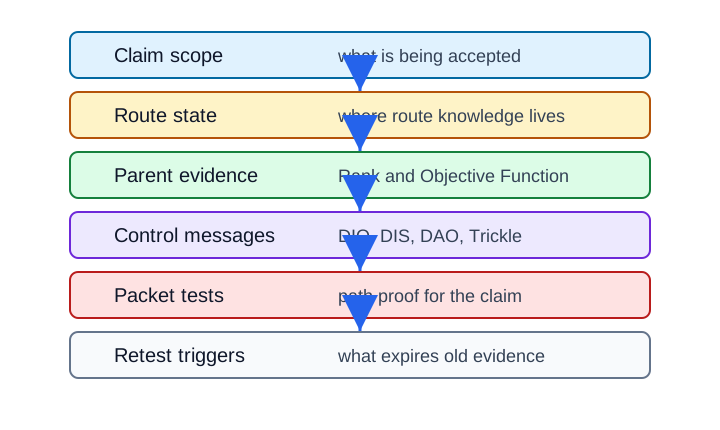
  • A production RPL review should begin with one claim small enough to prove.
  • For example: this firmware version can deliver upward temperature telemetry from this sensor group to this root under these link conditions.
  • Once the claim is that specific, the framework has something to test.
iotclass.org

Major section

In 60 Seconds

An RPL production framework is not a promise that a network will work in the field.

  • The framework starts with traffic claims, device constraints, Objective Function choice, routing-mode choice, and DODAG context.
  • It then requires control-plane evidence and packet evidence that match the claim.
  • The strongest review records also define monitoring signals and retest triggers so later changes do not silently invalidate the design.
iotclass.org

Major section

Minimum Viable Understanding

Production review starts with the traffic claim, not with a preferred mode.

  • Storing mode and Non-Storing mode are route-state decisions.
  • Objective Function choice must match the metric evidence the deployment can collect.
  • Packet acceptance tests must cover the traffic directions the application needs.

Why it matters

A production framework needs retest triggers because the evidence can expire.

iotclass.org

Major section

What The Framework Must Prove

The framework should turn a broad deployment statement into testable routing claims. "RPL is configured" is too weak.

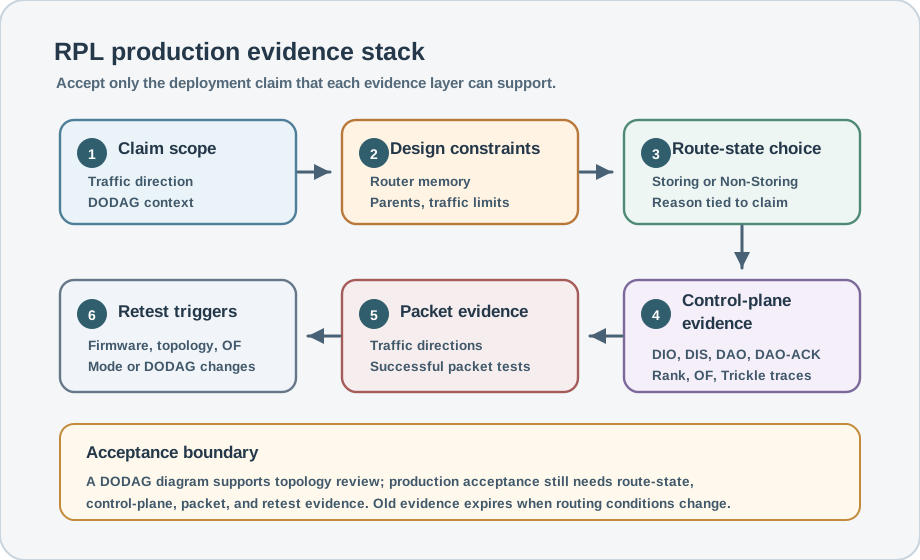
  • This prevents a common drift in RPL explanations: a diagram shows a DODAG, then the text treats the network as accepted.
  • A DODAG diagram supports topology review.

Why it matters

This matters because a routing label or formed topology alone cannot prove that the required traffic path works or recovers at its boundaries.

RPL production evidence stack showing claim scope, design constraints, route-state choice, control-plane evidence, packet evidence, and retest triggers as the acceptance boundary.
iotclass.org

Major section

Routing Mode Decision

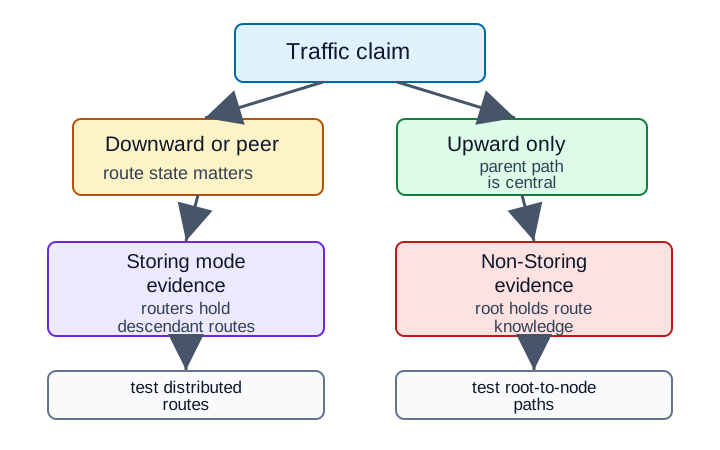
Storing mode and Non-Storing mode should be reviewed as route-state placement choices.

  • The right question is not "Which mode is faster?" The right question is "Where must the downward route state live for this claim, and can the chosen devices support that state?".
  • Downward behavior must be reviewed separately.

Why it matters

This matters because a routing label or formed topology alone cannot prove that the required traffic path works or recovers at its boundaries.

RPL routing-mode decision map showing traffic direction, route-state location, device constraints, control evidence, and acceptance tests leading to Storing or Non-Storing mode.
iotclass.org

Major section

Objective Function Decision

Either choice can be reasonable.

  • The Objective Function is the rule that turns parent evidence into a Rank and preferred-parent decision.
  • A production framework should record why the selected Objective Function matches the evidence available to the deployment.
  • The error is claiming a metric-based decision without metric evidence.

Key terms

OF0-style reasoning
OF0-style reasoning is easier to explain when the main evidence is simple path distance or step count toward the root.
iotclass.org

Major section

Packet And Operations Acceptance

This matters because a routing label or formed topology alone cannot prove that the required traffic path works or recovers at its boundaries.

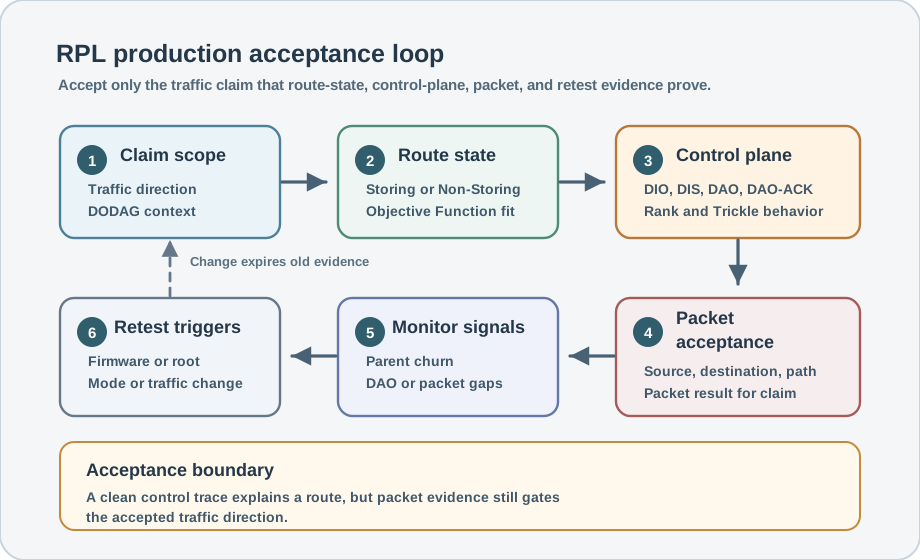
  • The framework does not need to predict every future fault.
  • It needs to state when the old evidence no longer proves the current claim.
RPL production acceptance loop linking claim scope, route-state review, control-plane evidence, packet acceptance, monitoring signals, and retest triggers.
iotclass.org

Major section

Summary

An RPL production framework is an evidence structure, not a deployment guarantee.

  • Mode choice is about route-state placement and tested traffic directions.
  • Objective Function choice must match the parent-selection evidence the design can collect.
  • DIO, DIS, DAO, DAO-ACK, Trickle, Rank, and packet traces support different claims.
  • Downward and peer traffic require separate route-state and packet evidence.
iotclass.org

Deck summary

Key takeaways

RPL means the routing method used by low-power and lossy device networks.

  • This runway does not certify field life, recovery time, or every traffic pattern.
  • An RPL production framework is not a promise that a network will work in the field.
  • Production review starts with the traffic claim, not with a preferred mode.
  • The framework should turn a broad deployment statement into testable routing claims. "RPL is configured" is too weak.
iotclass.org

Retrieval practice

Recall check 1 of 3

Packet Pete says: answer from memory, then check your reasoning.

Q1A framework record accepts an RPL design using only a diagram and default settings. What should the review do?

AAccept it because defaults prove production readiness
BRequire claim-specific control-plane, packet, monitoring, and retest evidence
CIgnore packet tests because diagrams are easier to audit
DTreat firmware and topology changes as irrelevant to retesting
Show answer

Answer: B An RPL production framework is a review structure, not a promise that a diagram will work in the field.

iotclass.org

Retrieval practice

Recall check 2 of 3

Packet Pete says: answer from memory, then check your reasoning.

Q2A review record shows compatible DIO messages, a selected preferred parent, and successful node-to-root telemetry packets. The same record also claims that the root can command every node. What is missing before the downward-command claim should be accepted?

ADAO or route-state evidence plus root-to-node packet tests for the command path
BOnly a DODAG diagram, because the selected parent proves both directions
COnly a lower Rank value, because lower Rank confirms command delivery
DOnly a longer Trickle interval, because stable DIO timing proves application health
Show answer

Answer: A Downward-command claims require routing-mode evidence, DAO or route-state evidence, and packet tests in the downward direction.

iotclass.org

Retrieval practice

Recall check 3 of 3

Packet Pete says: answer from memory, then check your reasoning.

Q3A production RPL review shows stable DIO timing, a preferred parent, and successful upward telemetry. It also approves root-to-node commands without DAO or route-state evidence. What should the reviewer do?

AReject the downward-command claim until route-state evidence and root-to-node packet tests are added.
BAccept the claim because low DIO traffic proves the whole routing system is healthy.
CAccept the claim because a preferred parent proves both upward and downward delivery.
DRemove retest triggers because the trace was stable once.
Show answer

Answer: A Production RPL acceptance must keep formation, route-state, packet-direction, and retest evidence separate.

iotclass.org

Print reference

Answers

Answer key.

  1. B · An RPL production framework is a review structure, not a promise that a diagram will work in the field.
  2. A · Downward-command claims require routing-mode evidence, DAO or route-state evidence, and packet tests in the downward direction.
  3. A · Production RPL acceptance must keep formation, route-state, packet-direction, and retest evidence separate.
iotclass.org