Routing & RPL · Study deck

Why RPL Exists

Picture an orchard node that wakes, measures frost risk, and sends one numbered reading through two neighbours.

Packet Pete is your guide for this deck.

ipv6routingdodag
iotclass.org

After studying this chapter

Learning objectives

You will be able to:

  • review RPL by its assumptions rather than treating it as a drop-in infrastructure-routing replacement
  • explain why upward and downward traffic each need their own proof
  • Explain: The map may show a path while the node has chosen a stale parent or only one traffic direction works.
  • Explain: The structure establishes the intended constrained path, not successful application delivery.
iotclass.org

Major section

Start With the Mesh That Has Limits

The map may show a path while the node has chosen a stale parent or only one traffic direction works.

  • A directed acyclic graph is a set of one-way links with no route that loops back to its start.
  • A DODAG is that shape aimed at one destination root.
  • IPv6 means the newer Internet addressing system used by the nodes.
  • Telemetry means measurements and status sent from remote devices for review.

Key terms

RPL
RPL is not just a mesh label.
iotclass.org

Major section

Overview: RPL Solves a Constrained Routing Problem
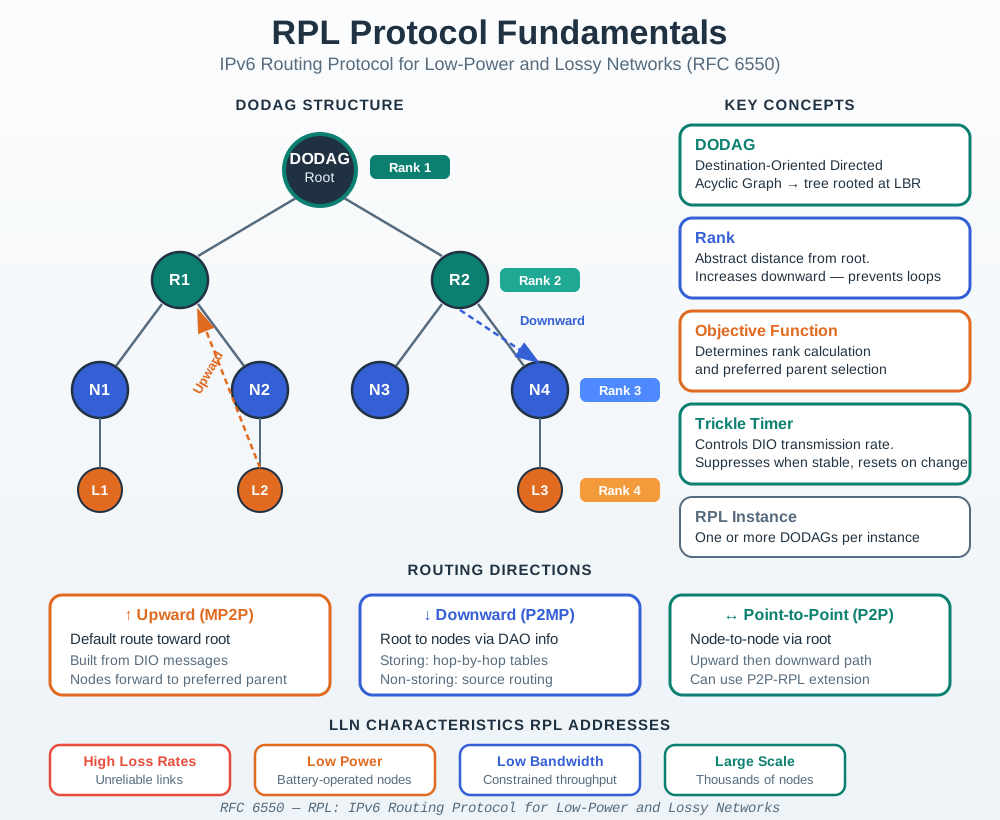
The structure establishes the intended constrained path, not successful application delivery.

  • Those fields make later repair and downward-routing claims testable from a defined baseline.
RPL Protocol Fundamentals
iotclass.org

Major section

Practitioner: Review RPL By Its Assumptions
The worked example separates rootward parent links, DIO advertisements, and the storing-mode DAO exchange needed to build downward routing state.

  • The 256-unit increments follow the stated Objective Function Zero settings; Rank is not generally a hop count.
  • C and D cannot use each other as parents at their equal Rank.
A worked RPL preferred-parent tree and DIO/DAO sequence distinguish upward formation from storing-mode downward route advertisement.
iotclass.org

Major section

Under the Hood: Direction Determines the Proof
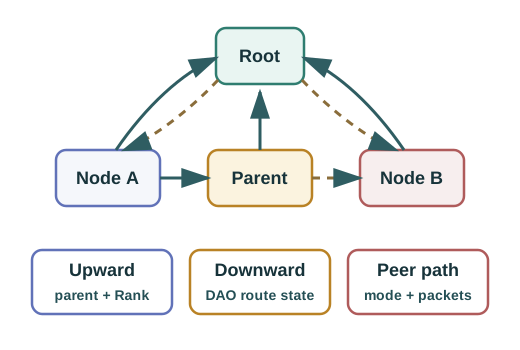
This diagram tests Under the Hood: Direction Determines the Proof.

  • Those elements explain how review the traffic direction before deciding which RPL evidence is sufficient within Under the Hood: Direction Determines the Proof.
Review the traffic direction before deciding which RPL evidence is sufficient.
iotclass.org

Deck summary

Key takeaways

The map may show a path while the node has chosen a stale parent or only one traffic direction works.

  • The structure establishes the intended constrained path, not successful application delivery.
  • The worked example separates rootward parent links, DIO advertisements, and the storing-mode DAO exchange needed to build downward routing state.
  • This diagram tests Under the Hood: Direction Determines the Proof.
iotclass.org

Retrieval practice

Recall check 1 of 3

Packet Pete says: answer from memory, then check your reasoning.

Q1Why does RPL exist for many constrained IPv6 sensor networks?

ALLN routers have lossy links, limited state, duty cycles, and root-oriented traffic
BRPL replaces IPv6 addressing so constrained nodes do not need network-layer routes
CRPL proves packet delivery as soon as a DODAG diagram is drawn
DThe upstream enterprise network needs fast convergence and a complete link-state topology map
Show answer

Answer: A RPL exists because constrained IPv6 networks need a routing model that can be reviewed through local parent choice, Rank, objective functions, and control-message evidence.

iotclass.org

Retrieval practice

Recall check 2 of 3

Packet Pete says: answer from memory, then check your reasoning.

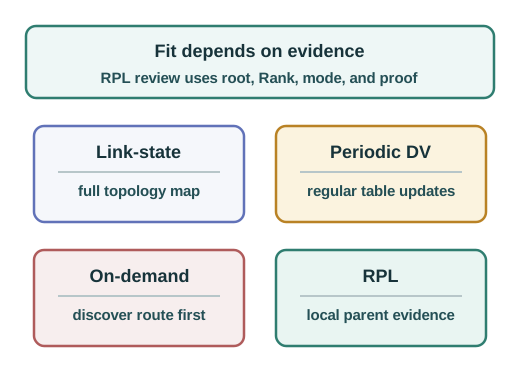
Q2A lab shows nodes sending telemetry toward one border router and claims RPL is a better fit than a link-state design. Which evidence best supports the limited design-fit claim?

AThe static DODAG picture proves every downward command route exists for every node in the lab
BIPv6 LLN, node-to-root traffic, and RPL parent choice from DIO, Rank, and an Objective Function
CThe smallest visible hop count is always the preferred parent, regardless of Objective Function
DThe Trickle timer alone proves the application packets are delivered during the telemetry run
Show answer

Answer: B A practitioner review separates design fit from reachability, delivery, and performance claims.

iotclass.org

Retrieval practice

Recall check 3 of 3

Packet Pete says: answer from memory, then check your reasoning.

Q3Which statement keeps an RPL traffic-direction claim evidence-safe?

ADIO reception proves downward commands, peer traffic, and telemetry all follow working routes
BDAO messages are optional labels and do not affect root-to-node reachability evidence
CReview upward, downward, and peer flows separately; a DODAG does not prove every direction
DA low Rank always means the path has the fewest hops and best packet delivery
Show answer

Answer: C Traffic direction determines whether parent, DAO, route-state, or packet evidence is needed.

iotclass.org

Print reference

Answers

Answer key.

  1. A · RPL exists because constrained IPv6 networks need a routing model that can be reviewed through local parent choice, Rank, objective functions, and control-message evidence.
  2. B · A practitioner review separates design fit from reachability, delivery, and performance claims.
  3. C · Traffic direction determines whether parent, DAO, route-state, or packet evidence is needed.
iotclass.org