Routing & RPL · Study deck

Worked Example: Rank and Parent Choice

A new low-power node hears advertisements from two possible RPL parents and must choose a route toward the root.

Packet Pete is your guide for this deck.

dodagworked-examplerank
Packet Pete, the module guide, in a scene from this chapter.
iotclass.org

After studying this chapter

Learning objectives

You will be able to:

  • Explain: It lays out how the example topology gives each node a small set of candidate parents and link-cost labels for hand calculation, so the next decision can be tied to an observable state or transition.
  • Explain: This ordered reading connects the second-hop choice discussion to the chapter's running argument: a routing decision is credible only when its control state, forwarding result, failure response, and retest trigger can be checked together.
  • Explain: This matters because a routing label or formed topology alone cannot prove that the required traffic path works or recovers at its boundaries.
iotclass.org

Major section

Calculate the Parent Before Drawing the Tree
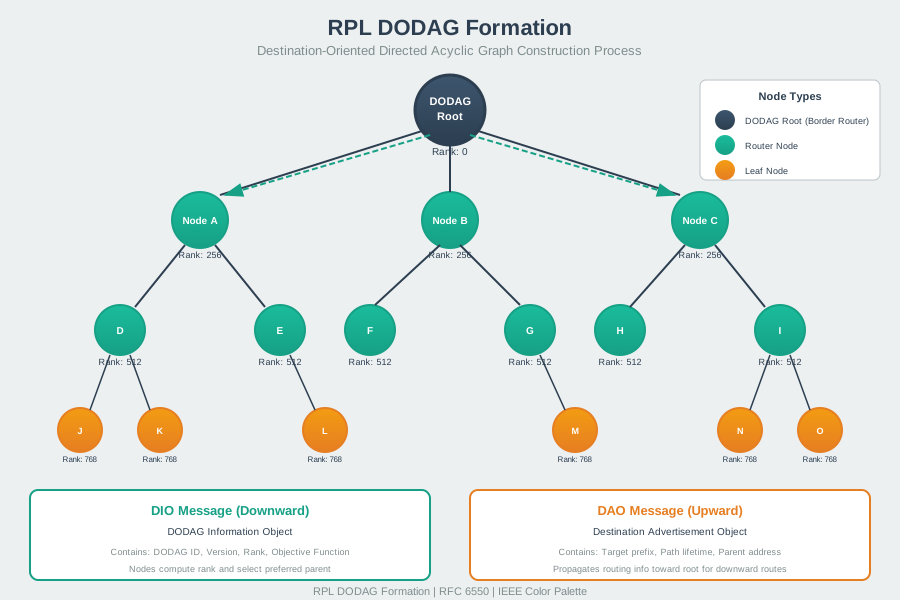
The direction of rank is a loop-avoidance constraint, not a geographic distance.

  • Parent A has path cost 40 and N measures link cost 18 to A, giving (40+18=58).
  • Parent B has path cost 32 but link cost 31, giving (32+31=63).

Why it matters

Under this additive example, N selects A because 58 is lower than 63.

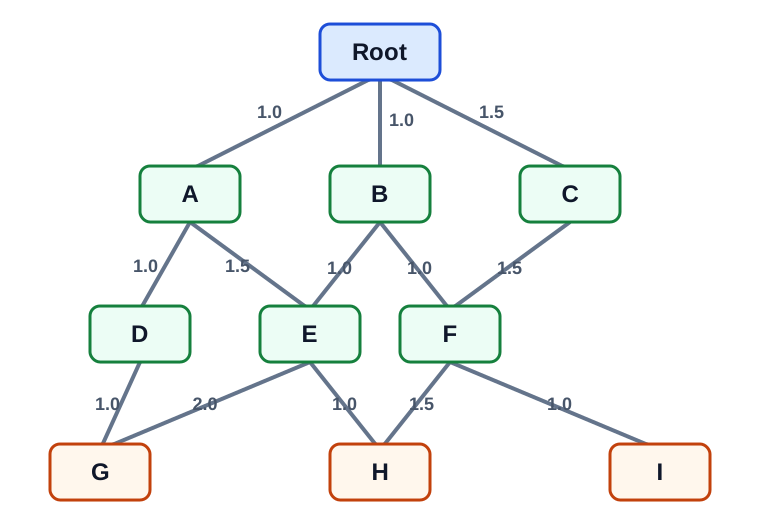
The example topology gives each node a small set of candidate parents and link-cost labels for hand calculation.
iotclass.org

Major section

Calculate the Parent Before Drawing the Tree (continued)

The apparently better upstream cost at B is outweighed by N's weaker local link.

  • If B later reaches 49, the improvement is 9 and crosses the margin, so a switch is allowed.
  • After choosing A, N advertises a rank that is greater than A's according to the configured minimum increment and objective function.
  • It must reject a neighbour whose advertised relation would violate the upward direction.
iotclass.org

Major section

Start With the Node That Must Join

The route with the lower rank may change after a weak link or restart, so the final receiver result must stay attached to the route evidence.

  • RPL means the routing method used by low-power and lossy device networks.
  • A DODAG means the root-oriented, loop-free route shape that its nodes build.
  • Latency means the elapsed time from a stated start event to a stated finish event.
iotclass.org

Major section

Start With the Node That Must Join (continued)

This runway does not predict every field route or delay.

  • A worked DODAG example becomes real when one node has to join a network already in motion.
  • It hears candidate parents, compares Rank and metrics, avoids loops, and chooses a place in the graph that affects every later packet.
  • The important result is not only the final diagram, but the evidence trail: why one parent was selected, why another was rejected, and how the resulting path supports the traffic direction being tested.
iotclass.org

Major section

Overview: Parent Choice Is a Calculation, Not a Guess

It lays out how the example topology gives each node a small set of candidate parents and link-cost labels for hand calculation, so the next decision can be tied to an observable state or transition.

  • This diagram tests Overview: Parent Choice Is a Calculation, Not a Guess.

Why it matters

This matters because a routing label or formed topology alone cannot prove that the required traffic path works or recovers at its boundaries.

The example topology gives each node a small set of candidate parents and link-cost labels for hand calculation.
iotclass.org

Major section

Practitioner: Calculate Every Candidate Before Choosing
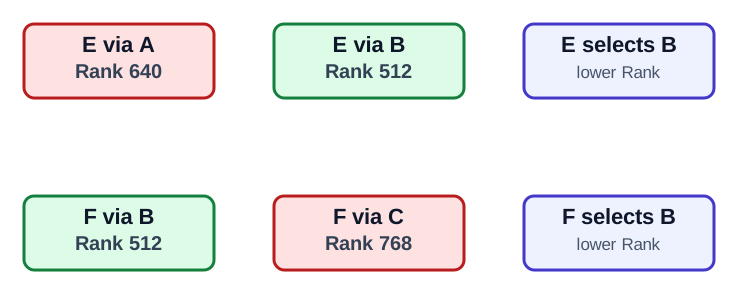
This matters because a routing label or formed topology alone cannot prove that the required traffic path works or recovers at its boundaries.

  • This ordered reading connects the second-hop choice discussion to the chapter's running argument: a routing decision is credible only when its control state, forwarding result, failure response, and retest trigger can be checked together.
E and F both choose B in this teaching model because B gives the lower resulting candidate Rank.
iotclass.org

Deck summary

Key takeaways

The direction of rank is a loop-avoidance constraint, not a geographic distance.

  • The apparently better upstream cost at B is outweighed by N's weaker local link.
  • The route with the lower rank may change after a weak link or restart, so the final receiver result must stay attached to the route evidence.
  • This runway does not predict every field route or delay.
  • It lays out how the example topology gives each node a small set of candidate parents and link-cost labels for hand calculation, so the next decision can be tied to an observable state or transition.
iotclass.org

Retrieval practice

Recall check 1 of 3

Packet Pete says: answer from memory, then check your reasoning.

Q1What is the safest claim after a worked example calculates the preferred parent for every node?

AThe upward parent choices are explained under the stated Rank model
BRoot-to-node command delivery is proven without DAO route-state evidence
CThe node with the fewest hops must always be selected
DEvery visible neighbor is automatically a valid backup parent
Show answer

Answer: A Parent calculations explain upward choices under the stated model.

iotclass.org

Retrieval practice

Recall check 2 of 3

Packet Pete says: answer from memory, then check your reasoning.

Q2Node F can choose B with parent Rank 256 and link cost 1.0, or C with parent Rank 384 and link cost 1.5. Using candidate_rank = parent_rank + round(256 x link_cost), which parent should F select?

AB, because 256 + round(256 x 1.0) = 512
BC, because C is also directly connected to the root
CC, because distributing child traffic could reduce congestion at B
DEither parent, because both candidates are already in the DODAG
Show answer

Answer: A Through B, F gets candidate Rank 512.

iotclass.org

Retrieval practice

Recall check 3 of 3

Packet Pete says: answer from memory, then check your reasoning.

Q3After B fails, E, F, H, and I recalculate their Rank values. What evidence is still needed before claiming root-to-H command delivery works?

AFresh DAO or route-state evidence for H's downward reachability after repair
BOnly the fact that H still has a lower-Rank path toward the root
CThe original parent diagram, since it already identifies H's path through the network
DNo extra evidence, because Rank values also prove DAO behavior
Show answer

Answer: A Repaired upward parents do not automatically prove that downward route state has been refreshed.

iotclass.org

Print reference

Answers

Answer key.

  1. A · Parent calculations explain upward choices under the stated model.
  2. A · Through B, F gets candidate Rank 512.
  3. A · Repaired upward parents do not automatically prove that downward route state has been refreshed.
iotclass.org