Routing & RPL · Study deck

RPL Control Messages: DIO, DIS, DAO

Picture a new node that hears a route message and must decide where to join.

Packet Pete is your guide for this deck.

dodagmessage-flowdao-ack
iotclass.org

After studying this chapter

Learning objectives

You will be able to:

  • separate discovery (DIO/DIS) from reachability (DAO) in RPL message flow
  • build a reviewable message-flow record for a DODAG
  • explain why DAO meaning depends on the routing mode in use
  • Explain: One packet can start that choice, but it cannot prove the whole path.
iotclass.org

Major section

Start With One Control Packet

One packet can start that choice, but it cannot prove the whole path.

  • A route may look healthy while an old message or a lost reply hides a break.
  • More control traffic can aid repair, but it also costs airtime and power.
  • The message records later in the chapter show those exact bounds.
iotclass.org

Major section

Overview: RPL Message Flow Separates Discovery From Reachability

That discovery can support telemetry toward the root, but it does not establish a return path.

  • The evidence boundary for Overview: RPL Message Flow Separates Discovery From Reachability is visible in Figure: DIO.
  • This matters because a routing label or formed topology alone cannot prove that the required traffic path works or recovers at its boundaries.
RPL root, router, and new-node lifelines exchange DIO, DIS, DAO, forwarded DAO, and DAO-ACK messages.
iotclass.org

Major section

Practitioner: Build a Reviewable Message-Flow Record
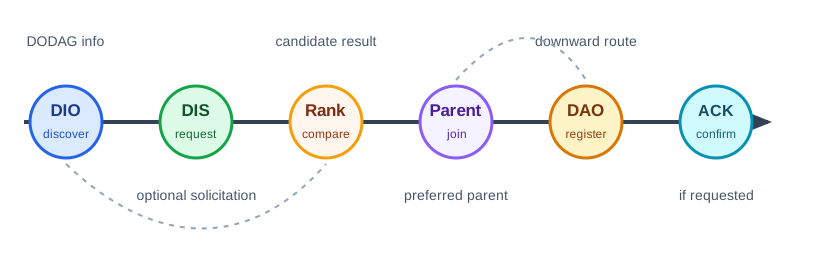
A useful trace does not just list packets.

  • Parent A advertises Rank 256 and the local link adds 384.
  • Parent B advertises Rank 512 and the local link adds 128.
A clean join record follows discovery, Rank calculation, parent selection, route registration, and ongoing maintenance.
iotclass.org

Major section

Under the Hood: DAO Meaning Depends on Routing Mode
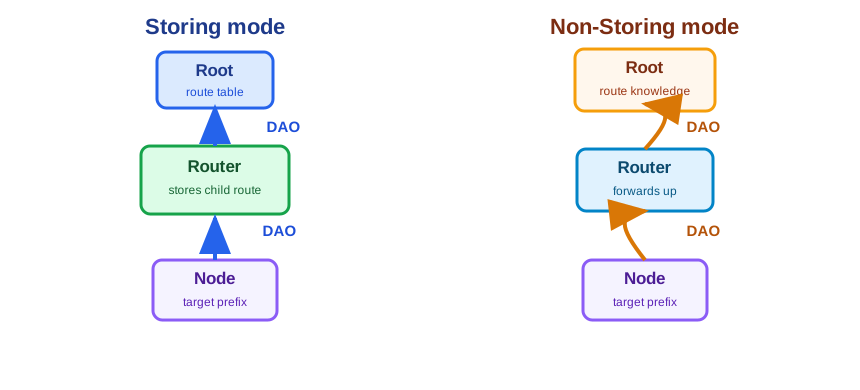
To distinguish the responsibilities inside Under the Hood: DAO Meaning Depends on Routing Mode, turn to Figure: DAO evidence must be interpreted against the selected.

  • In Storing mode, intermediate routers can store descendant route entries.
  • DAO is the message family most often misread in RPL reviews because its operational meaning depends on routing mode.
DAO evidence must be interpreted against the selected RPL mode and the expected location of downward route state.
iotclass.org

Major section

Trickle: Timing RPL Messages

A mesh that stays quiet after a route change has the opposite fault because new information does not spread.

  • A protocol means the shared rules for a message exchange.
  • RPL means Routing Protocol for Low Power and Lossy Networks.
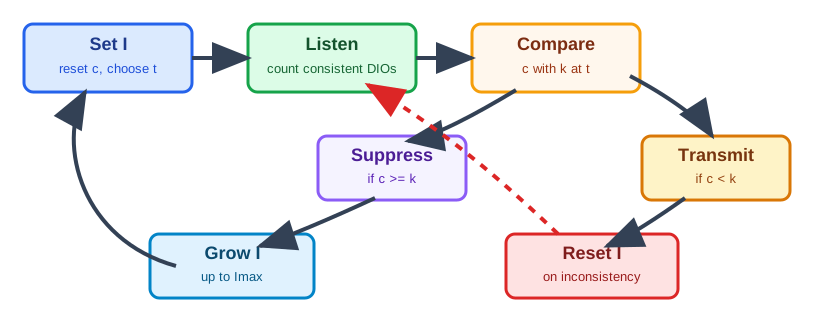
A Trickle interval starts by setting the timer and counter, listens for consistent DIOs, then either transmits, suppresses, grows, or resets.
iotclass.org

Deck summary

Key takeaways

One packet can start that choice, but it cannot prove the whole path.

  • That discovery can support telemetry toward the root, but it does not establish a return path.
  • A useful trace does not just list packets.
  • To distinguish the responsibilities inside Under the Hood: DAO Meaning Depends on Routing Mode, turn to Figure: DAO evidence must be interpreted against the selected.
  • A mesh that stays quiet after a route change has the opposite fault because new information does not spread.
iotclass.org

Retrieval practice

Recall check 1 of 6

Packet Pete says: answer from memory, then check your reasoning.

Q1A node has selected a preferred parent after hearing compatible DIO messages. Which extra RPL evidence matters when gateway-to-node commands are part of the claim?

ADAO evidence, DAO-ACK when requested, and packet proof for the downward path.
BOnly another DIO from the same parent, because DIO proves both route directions.
COnly DIS messages, because DIS installs route state for commands.
DOnly application payload size, because RPL control messages cannot affect command delivery.
Show answer

Answer: A RPL message-flow review separates discovery, parent selection, downward route registration, and packet proof.

iotclass.org

Retrieval practice

Recall check 2 of 6

Packet Pete says: answer from memory, then check your reasoning.

Q2Two candidate parents produce the same calculated Rank for a joining node. What should the reviewer record before accepting the selected parent?

ATie-break or hysteresis rule, previous parent, selected parent, and stability evidence.
BOnly the first DIO observed, because the first advertisement always wins.
COnly the parent with the larger advertised Rank, because larger Rank is always closer to the root.
DNo extra evidence, because equal Rank proves that either path will be stable.
Show answer

Answer: A An RPL parent record should preserve the compatible DIOs, Rank inputs, Objective Function, tie-break or hysteresis rule, selected parent, and stability evidence.

iotclass.org

Retrieval practice

Recall check 3 of 6

Packet Pete says: answer from memory, then check your reasoning.

Q3What does Trickle directly control in RPL?

AThe timing and suppression of DIO control messages
BThe final proof that application packets are delivered
CThe storage location for downward DAO routes
DThe encryption policy for the LLN
Show answer

Answer: A Trickle is scoped to DIO timing, suppression, and reset behavior.

iotclass.org

Retrieval practice

Recall check 4 of 6

Packet Pete says: answer from memory, then check your reasoning.

Q4A node has k = 4. In the current interval it hears three consistent DIO messages and no conflicting DODAG information. What should happen at the scheduled transmit time?

ATransmit a DIO because c is less than k
BSuppress the DIO because three messages is close to k
CReset the interval because c is less than k
DSend a DAO because Trickle controls downward route registration
Show answer

Answer: A Trickle transmits when c < k and suppresses when c >= k unless inconsistent DODAG evidence resets the interval.

iotclass.org

Retrieval practice

Recall check 5 of 6

Packet Pete says: answer from memory, then check your reasoning.

Q5A trace shows a node joining and later receiving a command. Which record best explains the RPL message flow?

AName each sender and message, the parent change, DAO route state, and the command packet result as separate evidence.
BKeep only the final DODAG drawing and call the command delivered.
CKeep only the first DIO and treat it as proof of return traffic.
DKeep only the command result and infer every control exchange from it.
Show answer

Answer: A A reviewable flow ties message identity and sender to changed routing state and directional packet proof.

iotclass.org

Retrieval practice

Recall check 6 of 6

Packet Pete says: answer from memory, then check your reasoning.

Q6A reviewer sees a DAO in a packet capture. Where should they check the resulting downward route state?

AAt relevant ancestor routers for Storing mode, or at the root for Non-Storing mode; then test a downward packet.
BOnly on the joining leaf for every mode.
COnly in the DIO timer because DAO is a Trickle message.
DNowhere; observing DAO proves the application command arrived.
Show answer

Answer: A Interpret DAO against the configured route-state location and verify the claimed traffic direction.

iotclass.org

Print reference

Answers 1 of 2

Answer key.

  1. A · RPL message-flow review separates discovery, parent selection, downward route registration, and packet proof.
  2. A · An RPL parent record should preserve the compatible DIOs, Rank inputs, Objective Function, tie-break or hysteresis rule, selected parent, and stability evidence.
  3. A · Trickle is scoped to DIO timing, suppression, and reset behavior.
  4. A · Trickle transmits when c < k and suppresses when c >= k unless inconsistent DODAG evidence resets the interval.
iotclass.org

Print reference

Answers 2 of 2

Answer key.

  1. A · A reviewable flow ties message identity and sender to changed routing state and directional packet proof.
  2. A · Interpret DAO against the configured route-state location and verify the claimed traffic direction.
iotclass.org