Routing & RPL · Study deck

How a DODAG Forms

An RPL root begins by announcing a routing instance, and nearby low-power nodes choose parents before advertising farther outward.

Packet Pete is your guide for this deck.

dodagconstructionrank
Packet Pete, the module guide, in a scene from this chapter.
iotclass.org

After studying this chapter

Learning objectives

You will be able to:

  • Explain: Each node that hears the announcement must decide whether it belongs, how far it is from the root, and which parent makes the graph safer or cheaper to use.
  • Explain: Node C hears A with link cost 20 and B with link cost 35, so its additive candidates differ by 15 even though parent ranks match.
  • Explain: HOPS, QUALITY, and LOOP RULE show why the same topology can produce different Rank values while still requiring a parent with lower Rank.
  • Explain: The deeper sections explain announcements, rank, joining, repair, and the evidence needed to accept the graph.
iotclass.org

Major section

Watch the DODAG Grow One Advertisement at a Time

A DODAG can contain several candidate links even though each node selects a preferred parent.

  • Node C hears A with link cost 20 and B with link cost 35, so its additive candidates differ by 15 even though parent ranks match.

Why it matters

The constraint prevents a node from selecting a parent that is farther down its own directed path.

Generic multi-root directed acyclic graph contrasted with a single-root RPL destination-oriented DAG and increasing Rank.
iotclass.org

Major section

Watch the DODAG Grow One Advertisement at a Time (continued)

It selects A and advertises a rank greater than 512 under the configured objective function.

  • If A disappears, C should age or invalidate that route, compare remaining candidates, choose B when acceptable, and advertise the changed state.
  • Downward traffic also needs DAO handling according to storing or non-storing mode.
  • A successful upward ping does not prove that the root can route a command back to C.
iotclass.org

Major section

Start With the Root Announcement

Each device needs a next step, but the strongest neighbour now may fail after rain or battery loss.

  • The route must change without forming a loop or hiding lost data.
  • Internet Protocol means the addressing rules used to move network packets.
  • IPv6 means version 6 of those rules.
  • A map must show no path when none exists.

Key terms

Telemetry
Telemetry means readings and status sent by a remote device.
iotclass.org

Major section

Start With the Root Announcement (continued)

Routing Protocol for Low-Power and Lossy Networks (RPL) means rules for choosing paths in such a network.

  • A directed acyclic graph means one-way paths without a loop back to the start.
  • A destination-oriented version leads toward one root and is called a DODAG.
  • Telemetry means readings and status sent by a remote device.
iotclass.org

Major section

Start With the Root Announcement (continued)
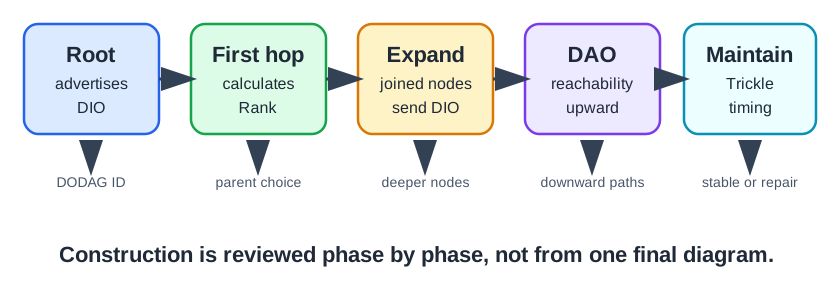
This runway does not prove the best parent rule or network scale.

  • The deeper sections explain announcements, rank, joining, repair, and the evidence needed to accept the graph.
  • A DODAG starts to form when the root announces a graph that other nodes can evaluate.
  • Each node that hears the announcement must decide whether it belongs, how far it is from the root, and which parent makes the graph safer or cheaper to use.
iotclass.org

Major section

Practitioner: Record The Parent Decision, Not Just The Final Tree
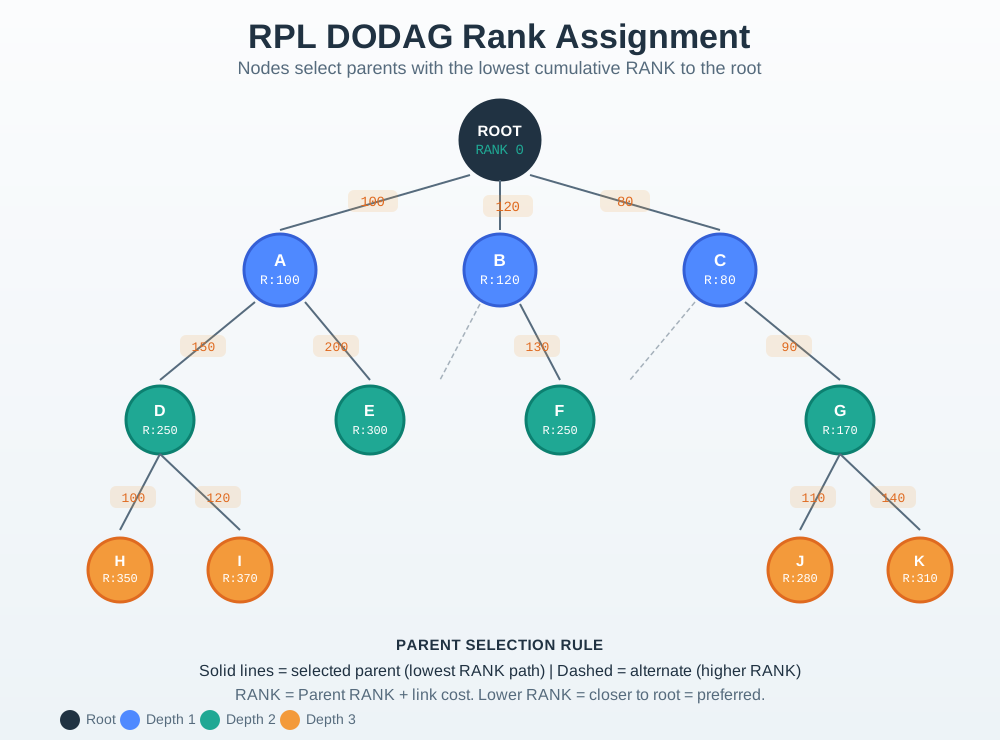
Its labeled path shows how RPL DODAG Rank Assignment, which makes this section's next operational choice explicit.

  • The final tree can also hide an asymmetric link.
RPL DODAG Rank Assignment
iotclass.org

Major section

Under The Hood: DAO, Trickle, And Repair Are Separate Evidence Layers
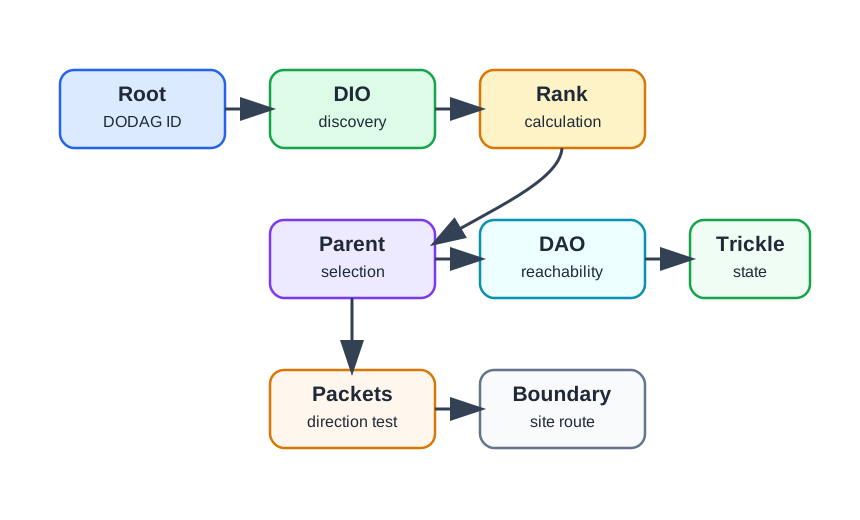
The result gives Under The Hood: DAO, Trickle, And Repair Are Separate Evidence Layers an observable meaning.

  • HOPS, QUALITY, and LOOP RULE show why the same topology can produce different Rank values while still requiring a parent with lower Rank.
The evidence map keeps discovery, parent choice, route state, timing, repair, and packet confirmation as distinct review claims.
iotclass.org

Deck summary

Key takeaways

A DODAG can contain several candidate links even though each node selects a preferred parent.

  • It selects A and advertises a rank greater than 512 under the configured objective function.
  • Each device needs a next step, but the strongest neighbour now may fail after rain or battery loss.
  • Routing Protocol for Low-Power and Lossy Networks (RPL) means rules for choosing paths in such a network.
  • This runway does not prove the best parent rule or network scale.
iotclass.org

Retrieval practice

Recall check 1 of 3

Packet Pete says: answer from memory, then check your reasoning.

Q1What is the best overview description of RPL DODAG construction?

AA root advertises DIO information, nodes choose parents and Rank, joined nodes advertise onward, and DAO state is added when downward reachability is needed.
BA node joins after one strong signal sample, without checking DIO compatibility, candidate Rank, Objective Function policy, DAO state, or packet direction.
CDAO messages start the DODAG and DIO messages are only used after the graph is stable.
DTrickle replaces parent selection by calculating every node route centrally at the root.
Show answer

Answer: A RPL DODAG construction should be reviewed as root advertisement, compatible DIO reception, candidate parent and Rank evaluation, onward DIO propagation, optional DAO route state, and maintenance.

iotclass.org

Retrieval practice

Recall check 2 of 3

Packet Pete says: answer from memory, then check your reasoning.

Q2A joining node hears Parent A with advertised Rank 256 and local link increase 384, and Parent B with advertised Rank 512 and local link increase 128. What is the safest review conclusion?

ABoth candidates produce Rank 640, so the final parent choice needs policy or stability evidence.
BParent A must win because its advertised Rank is lower.
CParent B must win because the local link increase is lower.
DBoth parents must be rejected after seeing equal candidate Rank, without applying the tie, hysteresis, or stability rule.
Show answer

Answer: A A practitioner review should calculate candidate Rank from parent Rank plus the local increase, then record the policy or stability evidence used to break ties.

iotclass.org

Retrieval practice

Recall check 3 of 3

Packet Pete says: answer from memory, then check your reasoning.

Q3Which review statement keeps RPL construction evidence fail-closed?

AOnce a DIO is captured, DAO state and packet delivery can be assumed for both directions.
BA Trickle reset proves the application is healthy because it increases DIO activity.
CA root-triggered reconstruction and a local parent switch should be recorded as the same repair event.
DTreat DIO discovery, parent choice, DAO state, Trickle timing, repair, and packet delivery as separate claims.
Show answer

Answer: D Under-the-hood review keeps each RPL construction layer tied to the evidence that actually proves it, especially for downward routing and repair behavior.

iotclass.org

Print reference

Answers

Answer key.

  1. A · RPL DODAG construction should be reviewed as root advertisement, compatible DIO reception, candidate parent and Rank evaluation, onward DIO propagation, optional DAO route state, and maintenance.
  2. A · A practitioner review should calculate candidate Rank from parent Rank plus the local increase, then record the policy or stability evidence used to break ties.
  3. D · Under-the-hood review keeps each RPL construction layer tied to the evidence that actually proves it, especially for downward routing and repair behavior.
iotclass.org