Routing & RPL · Study deck

The RPL Routing Model

An orchard leaf hears two neighbours that can forward toward the root.

Packet Pete is your guide for this deck.

dodagranktrickle
Packet Pete, the module guide, in a scene from this chapter.
iotclass.org

After studying this chapter

Learning objectives

You will be able to:

  • explain how RPL turns local parent-choice evidence into a DODAG
  • build an RPL evidence record covering rank, mode, and control messages
  • separate rank comparison, mode choice, and failure boundaries as distinct review items
  • Explain: One is close but nearly full; the other is farther away but has a steadier path.
iotclass.org

Major section

Start With One Parent Choice

One is close but nearly full; the other is farther away but has a steadier path.

  • The useful record explains which parent it chose and why that choice still leads upward.
  • A protocol means agreed rules for exchanging messages.
  • IPv6 is an addressing system for networked devices.
  • This one choice does not prove the whole network.

Why it matters

DODAG identity, Rank, metrics, control messages, and routing mode all matter because they explain why the node joined the graph in that place and what traffic the resulting route state can support.

iotclass.org

Major section

Start With One Parent Choice (continued)

The Routing Protocol for Low-Power and Lossy Networks (RPL) builds routes for constrained links.

  • A directed acyclic graph is a set of paths with no loops.
  • RPL aims this graph at one root; that form is called a Destination-Oriented Directed Acyclic Graph (DODAG).
  • RPL becomes concrete when one node must choose a parent.
iotclass.org

Major section

Change the Orchard Parent without Confusing Rank with Distance

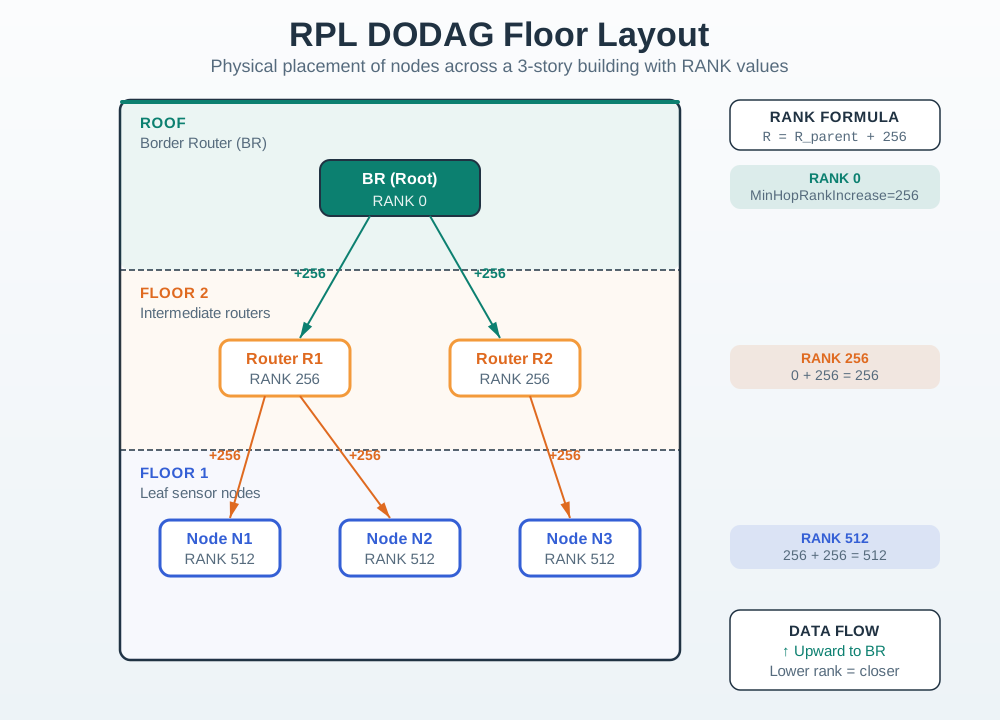
The leaf-to-parent difference is 256.

  • Those values show Rank increasing away from the root in this teaching model; they do not mean the leaf is 512 metres away or that all real objective functions add the same amount per hop.
  • It may turn at that ancestor rather than visiting the root.

Why it matters

The earlier shortcut is no longer proven simply because the upward parents remain unchanged.

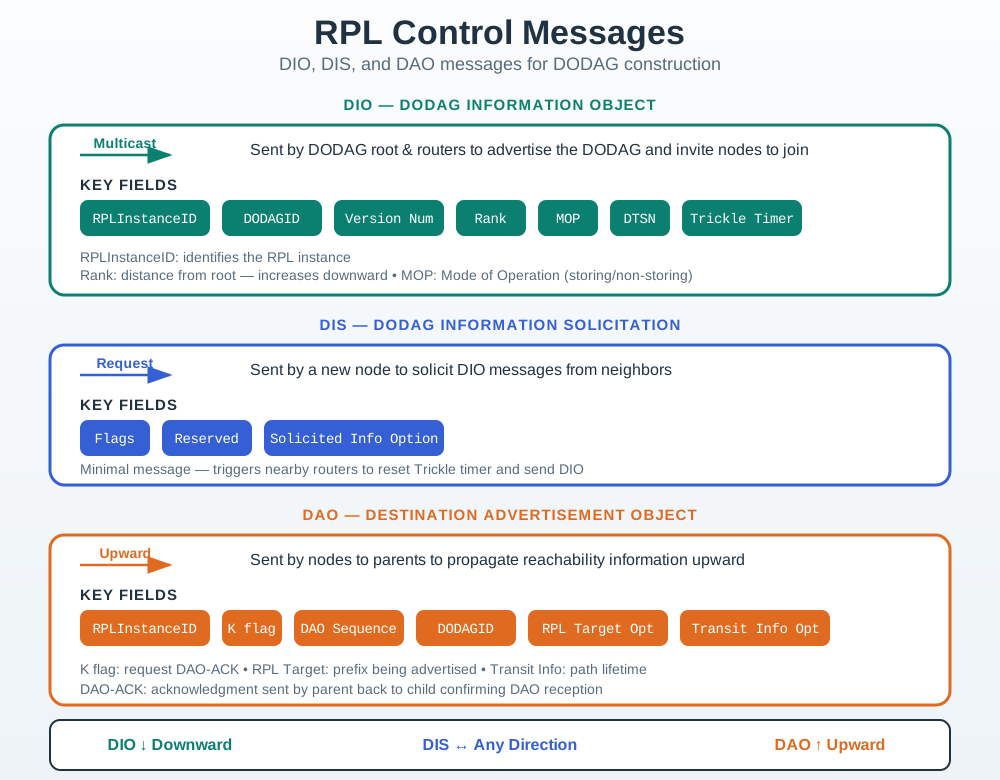
Six-step RPL sequence from a candidate DAG through DIO, parent scoring, rank, DAO, and data forwarding.
iotclass.org

Major section

Change the Orchard Parent without Confusing Rank with Distance (continued)

A radio signal alone cannot establish that the neighbour offers a safe upward path.

  • The subsequent data trace must show that packets actually follow the selected parent.
  • A leaf can send upward through its parent while the downward route remains missing or stale.
  • For an illustrative recovery clock, remove the parent at 0 s, select the alternative at 4 s and observe the first accepted reading at 7 s.
iotclass.org

Major section

Change the Orchard Parent without Confusing Rank with Distance (continued)

The routing-state change takes 4 s, while useful delivery resumes after 7 s.

  • If the alarm deadline was 5 s, the new parent selection alone does not make the service pass.
  • This module uses the rooted graph to connect local decisions with complete traffic paths.
  • That evidence explains why a node joined where it did and what must be re-established after a neighbour disappears.
iotclass.org

Deck summary

Key takeaways

One is close but nearly full; the other is farther away but has a steadier path.

  • The Routing Protocol for Low-Power and Lossy Networks (RPL) builds routes for constrained links.
  • The leaf-to-parent difference is 256.
  • A radio signal alone cannot establish that the neighbour offers a safe upward path.
  • The routing-state change takes 4 s, while useful delivery resumes after 7 s.
iotclass.org

Retrieval practice

Recall check 1 of 3

Packet Pete says: answer from memory, then check your reasoning.

Q1A sensor node hears DODAG information from several neighbors. Which RPL review conclusion is safest before accepting its route?

AAccept the first DIO, parent label, RSSI sample, and topology drawing as enough proof for the route.
BCheck DODAG compatibility, Objective Function, parents, Rank direction, and a packet test.
CChoose the neighbor with highest Rank, strongest RSSI, and largest route table before packet testing.
DSkip packet tests when DIO and DAO messages appear because control traffic proves application delivery.
Show answer

Answer: B RPL review ties DODAG compatibility, Objective Function, Rank direction, parent choice, and packet evidence together.

iotclass.org

Retrieval practice

Recall check 2 of 3

Packet Pete says: answer from memory, then check your reasoning.

Q2A greenhouse RPL mesh proves soil-sensor telemetry reaches the border router, then claims the gateway can also push valve-schedule updates back to one sensor. What evidence is still missing?

AA second DODAG drawing, fresh upward telemetry sample, and root-to-sensor arrows for every greenhouse node.
BA larger IPv6 prefix, fresh sensor labels, and a subnet inventory showing every valve controller.
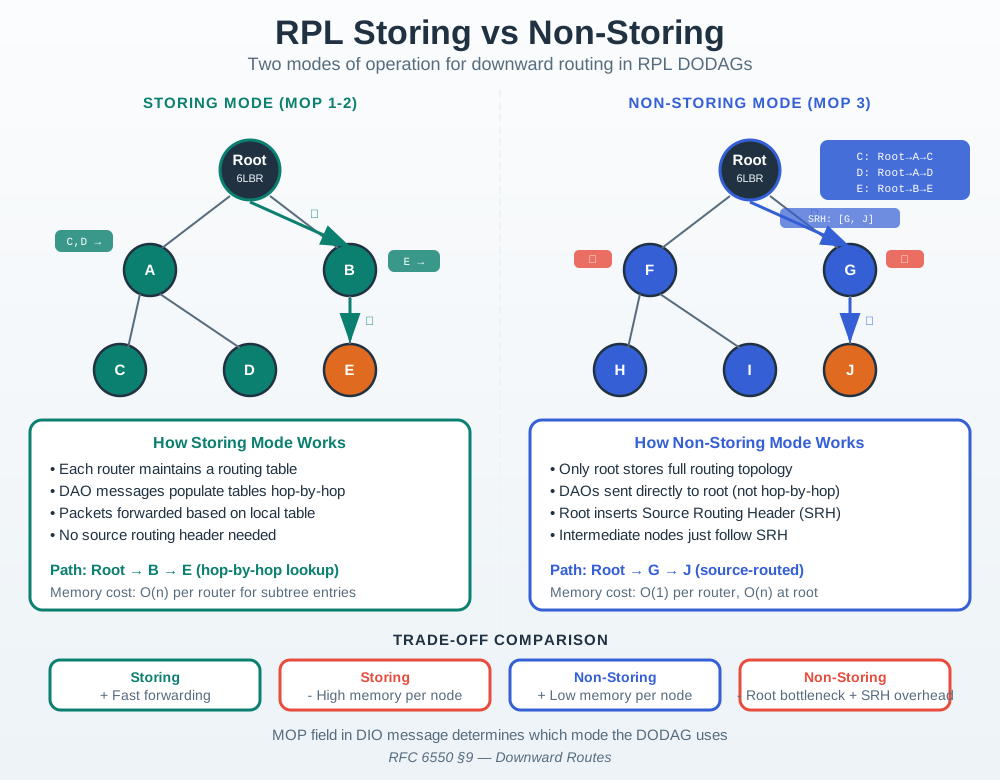
CMode choice, route state for the sensor, and a gateway-to-node packet trace.
DA statement that all RPL meshes use the same downward mode and do not need command-path evidence.
Show answer

Answer: C RPL evidence has to match the traffic direction.

iotclass.org

Retrieval practice

Recall check 3 of 3

Packet Pete says: answer from memory, then check your reasoning.

Q3A node at Rank 768 forwards upward through a neighbor advertising Rank 900. What is the strongest review response?

ATreat it as loop risk; recheck DODAG compatibility, Objective Function, parents, and packets.
BAccept it after seeing one strong RSSI sample from the neighbor, without checking whether it is a compatible lower-Rank parent.
CIgnore Rank because DAO messages choose all RPL parents.
DAssume the route is valid if the topology figure has no visible cycle.
Show answer

Answer: A RPL loop avoidance relies on upward forwarding toward lower Rank, interpreted through DODAG compatibility and Objective Function rules.

iotclass.org

Print reference

Answers

Answer key.

  1. B · RPL review ties DODAG compatibility, Objective Function, Rank direction, parent choice, and packet evidence together.
  2. C · RPL evidence has to match the traffic direction.
  3. A · RPL loop avoidance relies on upward forwarding toward lower Rank, interpreted through DODAG compatibility and Objective Function rules.
iotclass.org