Wireless and Optical Sensing for IoT · Study deck
Detecting Hidden Cameras and Rogue Devices
Radio Remi is checking a rented meeting room before a private discussion.
Radio Remi is your guide for this deck.
After studying this chapter
Learning objectives
You will be able to:
- Distinguish device discovery, type classification, localisation, and proof of recording.
- Extract bounded timing and packet-size features from supplied synthetic metadata.
- Compare RF, lens-reflection, and phone ToF methods by blind spots, false positives, and lawful use.
- Explain: Radio Remi is checking a rented meeting room before a private discussion.
Major section
Start With the Story
Radio Remi is checking a rented meeting room before a private discussion.
- A phone app lists several nearby radios, but none says “hidden camera.” A shiny screw reflects a torch, while a smart television sends steady network bursts.
- Remi does not touch, disable, or join unknown equipment.
- Instead, the team records candidates, compares several safe clues, asks the venue owner to inspect, and treats uncertainty as part of the result.
Major section
Read traffic without reading content
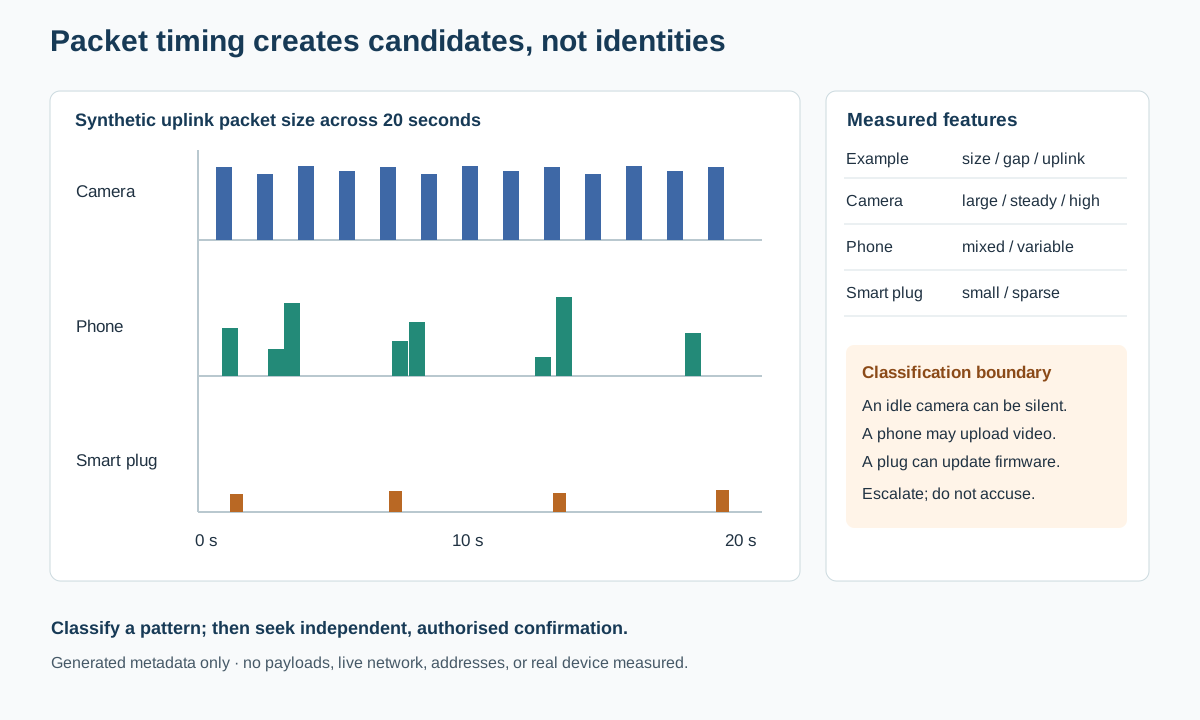
A streaming camera often sends sustained uplink data with regular bursts, while a phone may alternate short interactive bursts and idle periods.
- A smart plug may send small, sparse status messages.
- Firmware updates, cloud retries, video buffering, background sync, and network congestion can imitate another class.
- The chapter lab uses generated metadata with no payloads, addresses, live capture, exploit, or target network.
Major section
Compare three synthetic traces
The final uncertainty note matters most because a new firmware state or an idle camera can fall outside these examples.
- The camera fixture has repeated large uplink bursts, the phone fixture mixes directions and gaps, and the smart-plug fixture sends small periodic messages.
Major section
Sweep the spectrum with limits
An RF spectrum sweep can reveal energy by frequency and time without decoding traffic.
- It may find an unexpected transmitter, but it cannot prove the device is a camera.
- A detector also needs a local noise baseline and calibrated antenna response; a bright peak on an uncalibrated display is not a location.
- RSSI gathered along a known walk can narrow a transmitting candidate, but reflections and body blocking distort the path-loss model.
Major section
Look for a lens, not every shiny point
Camera lenses can return a bright retro-reflection when illumination and viewing geometry align.
- The lens may expose only a tiny opening, the useful reflection has a limited angle, and metal, glass, decorations, and other optics can look similar.
- A thorough scan needs overlapping viewpoints and still produces candidates for authorised inspection.
- Phone lidar or ToF hardware differs by model, field of view, resolution, and access API.
Deck summary
Key takeaways
Radio Remi is checking a rented meeting room before a private discussion.
- A streaming camera often sends sustained uplink data with regular bursts, while a phone may alternate short interactive bursts and idle periods.
- The final uncertainty note matters most because a new firmware state or an idle camera can fall outside these examples.
- An RF spectrum sweep can reveal energy by frequency and time without decoding traffic.
- Camera lenses can return a bright retro-reflection when illumination and viewing geometry align.
Retrieval practice
Recall check

Radio Remi says: answer from memory, then check your reasoning.
Q1What does a camera-like traffic classification establish?
Show answer
Answer: A A traffic model labels similarity to its examples; confirmation needs independent, lawful evidence.
Q2Why combine RF and optical checks during an authorised inspection?
Show answer
Answer: A Methods with different failure modes can narrow a candidate, but authorised physical confirmation remains separate.
Print reference
Answers
Answer key.
- A · A traffic model labels similarity to its examples; confirmation needs independent, lawful evidence.
- A · Methods with different failure modes can narrow a candidate, but authorised physical confirmation remains separate.