Mobile Robotics · Study deck
Classical Control Architectures for Mobile Robots
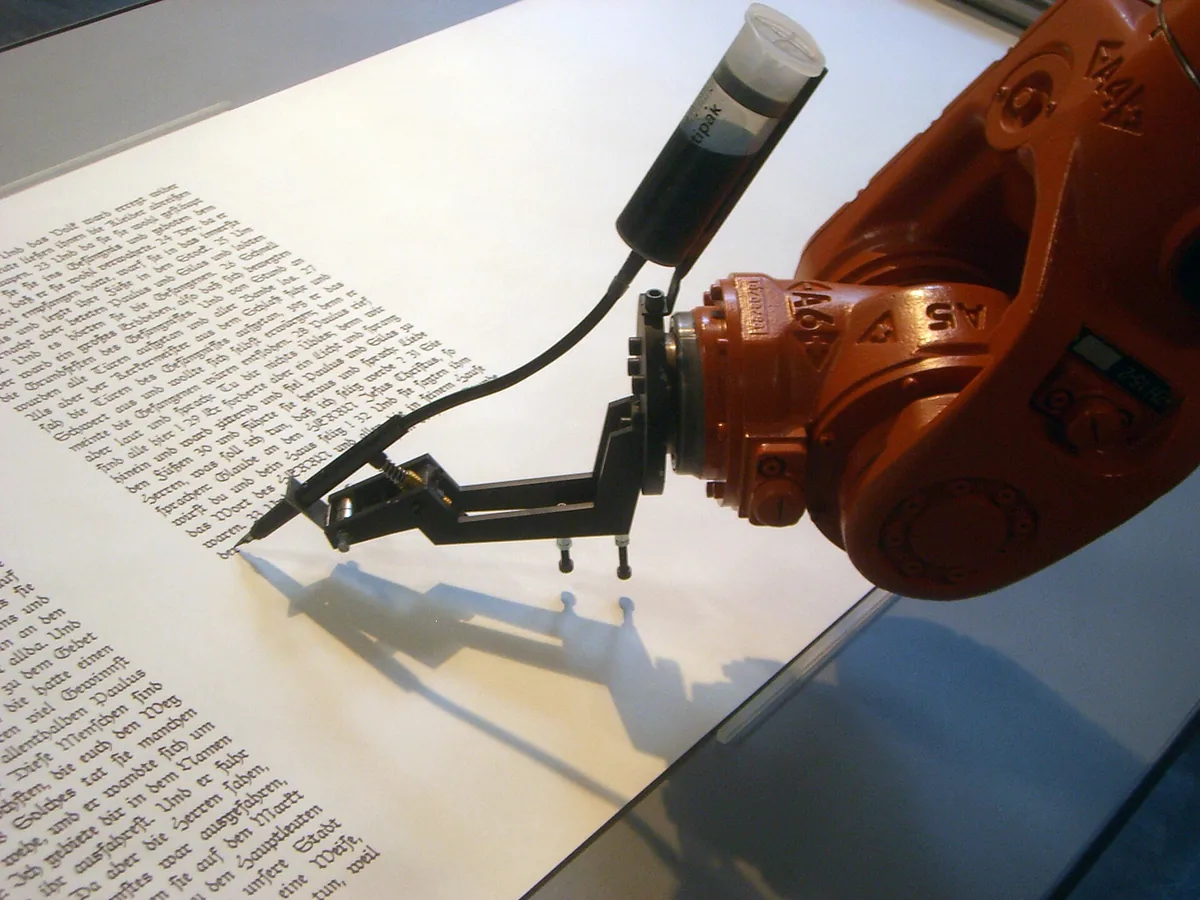
Before using the specification, look at the real industrial robot shown below.
Motor Max is your guide for this deck.

After studying this chapter
Learning objectives
You will be able to:
- Classify a robot controller along proximal-distal and reactive-deliberative axes
- Trace sensor values through a small neural or rule-based reactive controller
- Compare potential fields, motor schemas, and subsumption by composition and failure mode
- Select an architecture from latency, observability, planning, and safety requirements
Major section
Overview: Put Every Controller on Two Axes
Its package, terminals, scale, and place of use all count as engineering evidence.
- This chapter does not re-teach that mature treatment.
- A planner selects and sequences behaviors using a model of possible future states.
Major section
Practitioner: Build Behaviors, Then Define Their Arbitration
Production rules need explicit priority, mutual exclusion, timeouts, and a safe default.
- The method is compact and naturally reactive.
- Its characteristic failure is a local minimum: forces can cancel at a point that is not the goal.
- Narrow passages can also make repulsion dominate the useful forward component.
- The stack makes priority visible.
Major section
Practitioner: Build Behaviors, Then Define Their Arbitration (continued)
Otherwise source order becomes accidental arbitration.
- A defensible implementation records a stuck detector and an escape policy instead of treating the summed vector as guaranteed progress.
- Composition can be weighted, gated, or priority based.
- Whatever the mechanism, the weights and overrides are part of the safety argument.
Major section
Practitioner: Build Behaviors, Then Define Their Arbitration (continued)
A silent numeric sum is not an operational policy until you can explain which behavior wins and why.
- Subsumption architecture, associated with Brooks (1986), stacks behaviors so a higher layer can suppress or inhibit a lower layer while preserving the lower layer as a working fallback.
- ExploreSelect new space to visit when lower-level safety and motion remain available.
- Maintain motion safetyStop or limit actuators when perception is stale, drivers saturate, or a hard limit opens.
Major section
Lab: Interrupt-To-Actuator Feedback Loop
Every fault must produce the declared safe state without depending on the dashboard, network, or a future sensor update.
- A digital sensor interrupt records an edge and timestamp.
- The interrupt handler does not drive the motor; it places a compact event in a bounded handoff slot.
- The lab passes only when normal feedback is observable and every injected fault reaches the same bounded failsafe.
Try it: Lab: Interrupt-To-Actuator Feedback Loop in the chapter
Major section
Under the Hood: From Weighted Neurons to Safe Arbitration
The source example uses f(x)=tanh(x) and connects eight sensor inputs to two motor outputs.
- The transfer function bounds each neuron output, but it does not by itself bound the physical command.
- Rule basedNamed sensor conditions select turn or stop actions.
- Architecture selection is therefore an observability decision too.
Major section
Summary
The comparison also exposes the real trade: fast local response, inspectable composition, predictive capability, and safe arbitration must fit the same physical timing envelope.
- Neural and Braitenberg controllers can create fast proximal reactions, while rules and motor schemas expose named behaviors.
- Potential fields compose attractive and repulsive vectors but can become trapped in local minima.
- Subsumption makes behavioral priority explicit through suppression and inhibition between layers.
- Every architecture needs a physical command envelope, observable arbitration, and tested failure recovery.
Deck summary
Key takeaways
Its package, terminals, scale, and place of use all count as engineering evidence.
- Production rules need explicit priority, mutual exclusion, timeouts, and a safe default.
- Otherwise source order becomes accidental arbitration.
- A silent numeric sum is not an operational policy until you can explain which behavior wins and why.
- Every fault must produce the declared safe state without depending on the dashboard, network, or a future sensor update.
Retrieval practice
Recall check 1 of 3

Motor Max says: answer from memory, then check your reasoning.
Q1A controller evaluates named avoid-obstacle and move-to-goal behaviors every cycle, combines their outputs, and does not simulate future trajectories. How should it be classified?
Show answer
Answer: D Classify sensing abstraction and planning horizon separately.
Retrieval practice
Recall check 2 of 3
Motor Max says: answer from memory, then check your reasoning.
Q2A potential-field robot stops between two obstacles even though the goal is still ahead. What is the best diagnosis and response?
Show answer
Answer: C Potential fields turn local geometry into a vector command, but summed forces can cancel away from the goal.
Retrieval practice
Recall check 3 of 3
Motor Max says: answer from memory, then check your reasoning.
Q3A tanh neural controller always emits values between -1 and 1. Why is a separate actuator safety envelope still required?
Show answer
Answer: D Control safety lives at the physical interface.
Print reference
Answers
Answer key.
- D · Classify sensing abstraction and planning horizon separately.
- C · Potential fields turn local geometry into a vector command, but summed forces can cancel away from the goal.
- D · Control safety lives at the physical interface.