RFID, NFC & UWB · Study deck

RFID Read Troubleshooting

Picture a tagged tool that is read on the bench but missed whenever it enters a metal cabinet.

Radio Remi is your guide for this deck.

diagnosticsmiddlewareread-zones
Radio Remi, the module guide, in a scene from this chapter.
iotclass.org

After studying this chapter

Learning objectives

You will be able to:

  • Explain: UHF RFID around 900 MHz has a free-space wavelength near 300,000,000 / 900,000,000 = 0.33 m, so a quarter wavelength is about 0.33 / 4 = 0.0825 m, or 8.25 cm.
  • Explain: A useful first record might say: during 50 carton passes, 38 produced accepted receiving events, 8 produced raw reads that middleware filtered out, 4 produced no raw reads, and 3 neighboring staged cartons were also observed.
  • Explain: The same tag and reader may work in free air and fail on a particular carton, metal tool, liquid container, or presentation angle.
iotclass.org

Major section

Start With the Story

Radio frequency means the part of the spectrum used to carry the tag signal.

  • Radio frequency identification (RFID) means identifying an object from data carried by that tag.
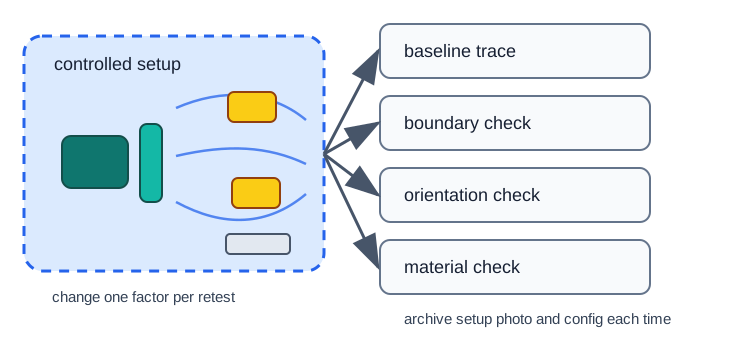
  • Reproduce the miss, then change one factor at a time and include a nearby cross-read test.
  • An RFID failure rarely arrives as a neat error message.
iotclass.org

Major section

Eddie's Math Bridge: Turn VSWR Into a Range Screen · Start With the Failure Pattern

The mathematical gist.: At VSWR 10:1, the reflection magnitude is 0.818, only 33.1% of available power reaches the chip, and mismatch costs 4.81 dB.

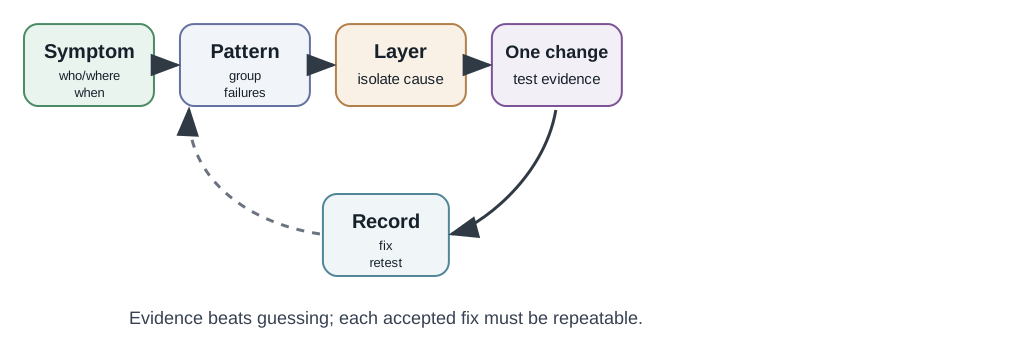
  • Most RFID failures are not random.
  • The pattern usually points to the layer that needs attention.

Numbers to remember

4.81 dBand mismatch costs 4.81 dB.
RFID troubleshooting diagnostic flow from symptom capture through pattern, layer isolation, controlled change, and fix record
iotclass.org

Major section

Turn the Complaint Into Counts

When tags stop reading, the instinct is to blame the reader or the software.

  • The tell is that the failures are position-specific or material-specific.
  • The same tag and reader may work in free air and fail on a particular carton, metal tool, liquid container, or presentation angle.
  • Each problem needs a different first test.

Why it matters

This pattern-first habit prevents harmful fixes.

iotclass.org

Major section

Turn the Complaint Into Counts (continued)

This pattern-first habit prevents harmful fixes.

  • A useful first record might say: during 50 carton passes, 38 produced accepted receiving events, 8 produced raw reads that middleware filtered out, 4 produced no raw reads, and 3 neighboring staged cartons were also observed.
  • If the 4 no-read cases are all foil-lined cartons, object material is a better first suspect than reader firmware.
  • Replacing all tags may hide a bad antenna port.
iotclass.org

Major section

Turn the Complaint Into Counts (continued)

If they all pass antenna 2, the cable, port, antenna angle, or local reflections are better suspects.

  • If every carton has raw reads but only 38 events appear, middleware timing and duplicate rules are the first boundary to inspect.
  • Increasing power may turn the 4 misses into reads, but it may also raise wrong-zone reads from 3 to 12.
  • Editing middleware may make a physical blind spot look like a clean event stream.
iotclass.org

Major section

Pattern Map

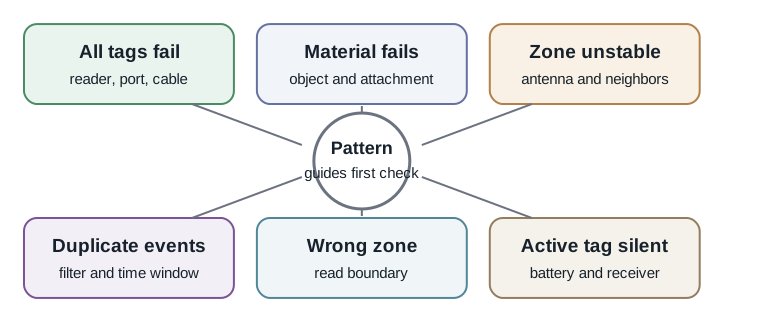
Success at: All tags fail cannot prove the filter and time window boundary.

  • The first diagnostic question is not "What is the best tag?" It is "What does this failure pattern make unlikely?".
RFID troubleshooting pattern map connecting failure patterns to likely first checks
iotclass.org

Major section

Material, Orientation, and Event Evidence

Two material families break RFID in different ways, and the fix depends on band and mounting.

  • The unifying idea is detuning: a tag antenna is resonant at the operating frequency, and mounting it on metal, liquid, or certain plastics can shift that resonance off band.
  • Placement around: RFID-RC522 marking still needs testing.

Key terms

Troubleshooting
Troubleshooting is complete only when the physical record and event record agree.
This reader module's own coil is the counterpart in every row of the table above: the tag has to stay resonant with a field like this one, and edge-on presentation or a metal or liquid backing is what pushes that resonance -- and the read -- off band. Photo: JrawX, CC0
iotclass.org

Major section

Material, Orientation, and Event Evidence (continued)
A tag sitting in a portal for 4 seconds may produce dozens of raw observations.

  • A tag that reads on the bench and dies on the product is often being detuned by the product.
  • Middleware tests need their own counts.
  • If 75 raw observations become one receiving event, duplicate suppression is working.
iotclass.org

Major section

Material, Orientation, and Event Evidence (continued)

For a metal tool checkout problem, test the same identifier in four states: free air, taped flat to the tool, mounted on a spacer, and mounted with an on-metal tag.

  • If the same 75 observations become 12 receiving events, the duplicate window or event key is wrong.
  • If 75 observations become no event, the read may be filtered by an unexpected antenna, direction, unknown-tag, retired-tag, or confidence rule.
  • Troubleshooting is complete only when the physical record and event record agree.
iotclass.org

Major section

Controlled Change Test

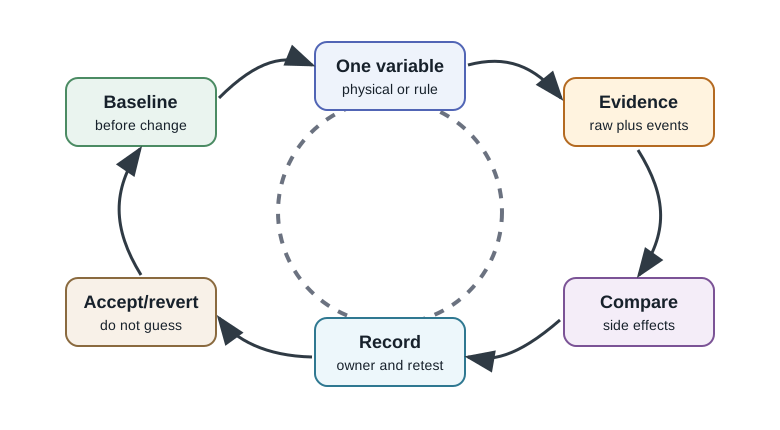
A controlled change makes the fix reproducible.

  • To ground controlled change test, compare before change with side effects in it. Do not guess makes the purpose concrete.
  • Combining before change with side effects hides accountability.
  • Reopen controlled change test whenever side effects changes.
  • The conclusion depends on archive setup photo and config each time.
RFID controlled troubleshooting test loop showing baseline, one change, evidence capture, compare, accept, and retest trigger
iotclass.org

Major section

Nulls, Polarization, and Link Budget

A tag can fail right next to the antenna, which rules out a simple "not enough range" diagnosis.

  • Second, polarization mismatch can cut the link.
  • A linear reader antenna and a linear tag antenna at 90 degrees can lose most of the coupling regardless of distance.
  • Underneath both effects is a two-way link budget.

Numbers to remember

0.0825 mso a quarter wavelength is about 0.33 / 4 = 0.0825 m

Why it matters

Detuning, absorption, nulls, and cross-polarization each reduce one or both links.

iotclass.org

Major section

Nulls, Polarization, and Link Budget (continued)

A passive read works only if the forward link delivers enough power to wake the tag and the reverse backscatter link is strong enough for the reader to decode.

  • A few numbers make the diagnosis less mysterious.
  • Reader power also needs units.
  • A dense-tag miss may be an inventory timing problem, not a tag defect.
iotclass.org

Major section

Nulls, Polarization, and Link Budget (continued)

UHF RFID around 900 MHz has a free-space wavelength near 300,000,000 / 900,000,000 = 0.33 m, so a quarter wavelength is about 0.33 / 4 = 0.0825 m, or 8.25 cm.

  • Reflections from shelves, frames, and carts can therefore move a strong-read spot or a null by only a few centimeters.
  • If a tag changes from unreadable to reliable after moving it 6 cm, that is consistent with a field-pattern problem.
  • Raising conducted power from 27 dBm to 30 dBm is a 3 dB increase, roughly double the conducted power before antenna and regulatory limits.
iotclass.org

Major section

Nulls, Polarization, and Link Budget (continued)

Doubling power can help marginal wake-up cases, but it also expands the field into nearby shelves and staging areas.

  • If the reader cycles four antennas evenly, each antenna has roughly 2.0 / 4 = 0.5 seconds before the geometry changes.
  • Good troubleshooting asks whether the selected power, antenna sequence, inventory behavior, duplicate window, and event rules all fit inside the actual motion of the workflow.
  • Detuning, absorption, nulls, and cross-polarization each reduce one or both links.
iotclass.org

Major section

Evidence Packet

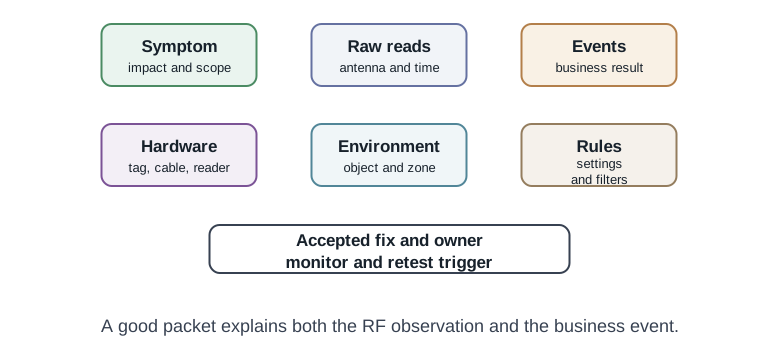
A troubleshooting packet makes the fix auditable.

  • To make evidence packet reviewable, set impact and scope against object and zone with it. Monitor and retest trigger limits the claim.
RFID troubleshooting evidence packet with symptom, scope, hardware, environment, reader settings, middleware, decision, and retest trigger
iotclass.org

Major section

Common Mistakes · Review Checklist

Changing reader power first: This may increase cross-reads and hide the root cause.

  • Testing only a loose tag: The real object, material, and attachment can change behavior.
  • Ignoring middleware: A physical read may be filtered out, duplicated, or mapped to the wrong event.
  • Fixing one zone without checking neighbors: Antenna changes can create new wrong-zone reads.
iotclass.org

Deck summary

Key takeaways

Radio frequency means the part of the spectrum used to carry the tag signal.

  • The mathematical gist.: At VSWR 10:1, the reflection magnitude is 0.818, only 33.1% of available power reaches the chip, and mismatch costs 4.81 dB.
  • When tags stop reading, the instinct is to blame the reader or the software.
  • This pattern-first habit prevents harmful fixes.
  • If they all pass antenna 2, the cable, port, antenna angle, or local reflections are better suspects.
iotclass.org

Retrieval practice

Recall check 1 of 3

Radio Remi says: answer from memory, then check your reasoning.

Q1What is the first step in the structured RFID troubleshooting workflow?

ADescribe which tags fail, where, when, and what changed.
BImmediately turn up the reader's transmit power to its maximum setting.
CReplace every tag in the whole deployment before diagnosing anything.
DSwap the reader for a different vendor's model as the very first step.
Show answer

Answer: A Structured RFID troubleshooting starts by describing the failure pattern before isolating layers or changing settings.

iotclass.org

Retrieval practice

Recall check 2 of 3

Radio Remi says: answer from memory, then check your reasoning.

Q2A UHF tag reads perfectly in free air but fails when placed flat on a stainless-steel shelf, even directly in front of the antenna. What is the most likely cause and fix?

AThe reader lost power; keep increasing transmit power until it reads through the metal.
BThe EPC was physically erased by contact with the metal; rewrite the tag.
CThe LLRP host session dropped; restart the host software and reconnect it.
DMetal detunes the tag; use an on-metal tag or standoff spacer.
Show answer

Answer: D Metal can detune the tag antenna off-band and create surface nulls, so a free-air tag may fail on steel.

iotclass.org

Retrieval practice

Recall check 3 of 3

Radio Remi says: answer from memory, then check your reasoning.

Q3A doorway reader correctly sees tagged cases crossing the door, but it also sees cases parked in a nearby staging area. What is the best first troubleshooting action?

AIncrease the reader's transmit power so that the doorway reads come through stronger.
BDelete all the duplicate events afterward inside the business application layer.
CReplace every tag in the area with an active tag.
DCapture raw reads by antenna while moving a known case through both areas.
Show answer

Answer: D Wrong-zone reads should be diagnosed by mapping raw reads to antenna identity and physical position.

iotclass.org

Print reference

Answers

Answer key.

  1. A · Structured RFID troubleshooting starts by describing the failure pattern before isolating layers or changing settings.
  2. D · Metal can detune the tag antenna off-band and create surface nulls, so a free-air tag may fail on steel.
  3. D · Wrong-zone reads should be diagnosed by mapping raw reads to antenna identity and physical position.
iotclass.org