RFID, NFC & UWB · Study deck
RFID Standards and Protocols
Picture a warehouse tag that one reader sees but another cannot decode.
Radio Remi is your guide for this deck.

After studying this chapter
Learning objectives
You will be able to:
- Separate air-interface standards from reader-control protocols and event-data standards.
- Choose between ISO 14443, ISO 15693, EPC Gen2, NFC Forum, and active RFID families based on workflow evidence.
- Explain why EPC Gen2 anti-collision needs a tuned inventory round instead of only higher reader power.
- Describe how EPC identifiers become useful business events through middleware, EPCIS, and common vocabularies.
Major section
Start With the Story
Both boxes say they support tags, yet the air link, reader control, and event record may follow different contracts.
- Near field communication, or NFC, is a short-range radio method for nearby exchanges.
- Radio frequency means the rate of a radio wave.
- Radio frequency identification, or RFID, uses radio to identify a tag.
Major section
Start With the Story (continued)
Standards divide that work into layers that must not be confused.
- Swap one reader and reject any event whose meaning changes.
- This runway does not make one standards family fit every workflow.
- A working RFID system has several contracts at once.
- This chapter separates those contracts so design reviews do not mix them together.
Major section
Why Standards Matter
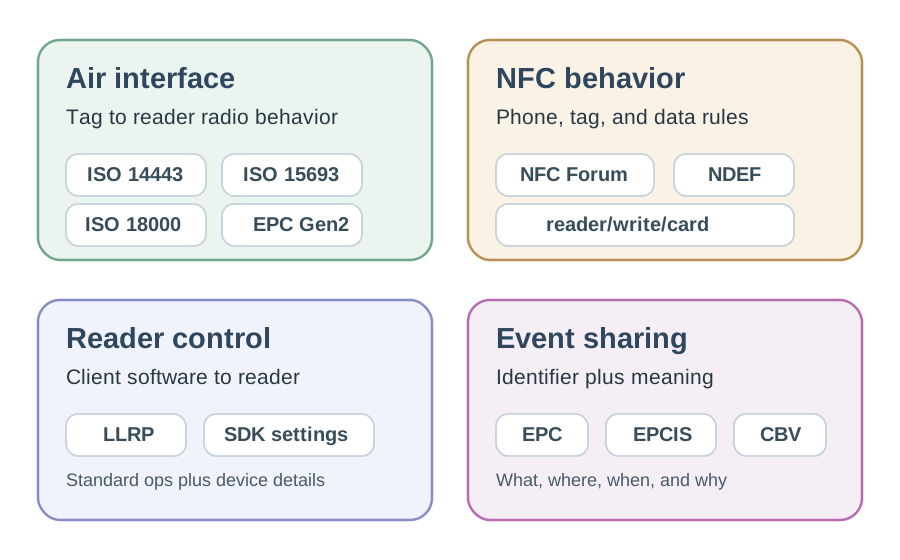
EPC, EPCIS, and the GS1 Core Business Vocabulary describe how identifiers and read events are represented for supply-chain visibility.
- The conclusion in why standards matter now has a named boundary.
Major section
Event-Data Standards
The Electronic Product Code gives physical things a structured identifier.
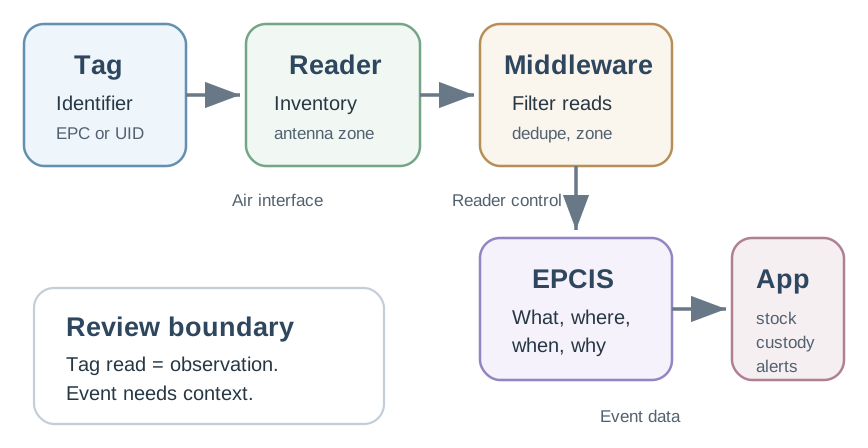
- EPCIS and the Core Business Vocabulary help turn observations into shareable events such as what was observed, where it was observed, when it happened, and why it matters to the business process.
- This distinction is important.
- The event layer needs business context and reviewable evidence.
Major section
EPC Gen2 Dominates UHF Supply-Chain RFID
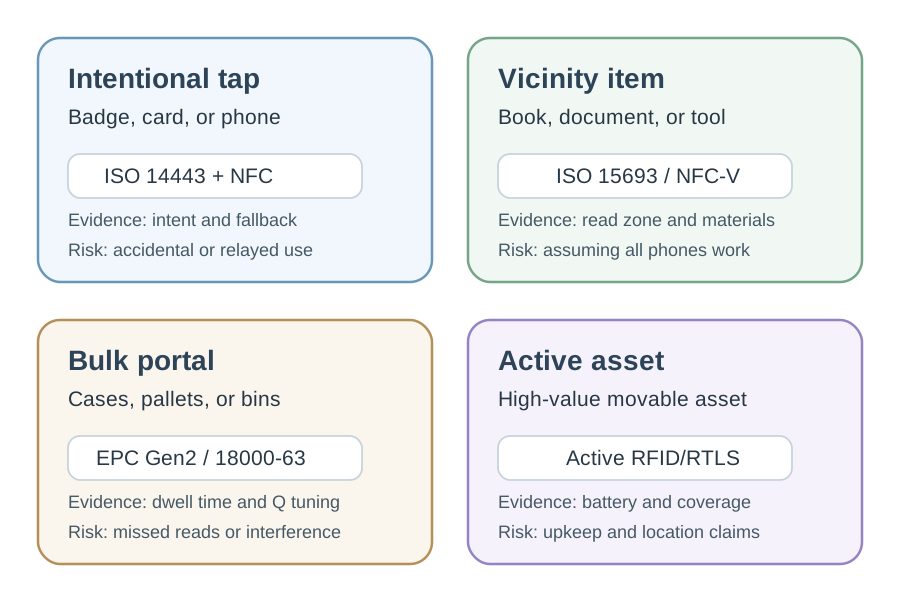
Picking a standard is really picking a band, range class, interaction pattern, and evidence model together.
- It defines radio behavior between reader and tag plus the tag data conventions that let a Gen2 reader from one vendor inventory Gen2 tags from another.
- The other standards fill in the interaction patterns Gen2 does not cover.
- The important design habit is to keep the standards family tied to the interaction that must be proven.
Major section
EPC Gen2 Dominates UHF Supply-Chain RFID (continued)
ISO/IEC 14443 supports proximity behavior at 13.56 MHz HF,: ISO/IEC 15693 supports vicinity behavior at 13.56 MHz HF, and: ISO 11784/11785 covers LF animal identification around 125-134 kHz.
- A medicine cabinet badge tap is not the same problem as a dock-door carton portal.
- In the cabinet case, the review evidence may say: staff presents a badge within a few centimeters, the cabinet logs one deliberate access event, and a missed read sends the nurse to a manual identity check.
- That points toward EPC Gen2 UHF because bulk inventory and anti-collision are the central mechanisms.
Major section
EPC Gen2 Anti-Collision
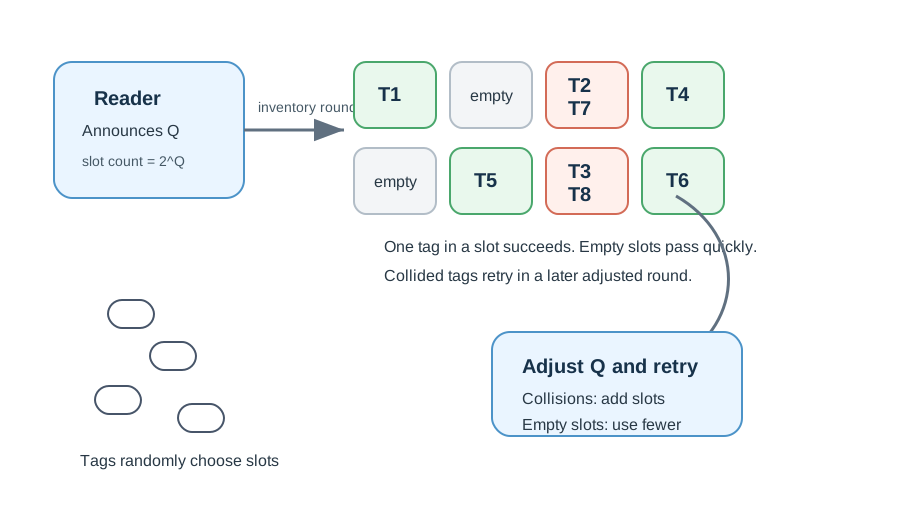
When many passive tags are energized at the same time, they cannot all answer at once.
- EPC Gen2 uses a slotted process where the reader announces a Q value, tags choose slots, and collided tags retry in later rounds.
- To test epc gen2 anti-collision, keep both: Announces Q and: T1 visible in it.: T7 supplies the consequence.
Major section
Q Value As A Planning Heuristic
A larger Q reduces collisions but lengthens a round.
- The slot count is 2^Q.
- That estimate is only a starting point.
- A smaller Q shortens a round but increases collisions.
- The best setting depends on dwell time, tag count, antenna sequence, reader firmware, and the materials in the read zone.
Major section
The Select, Query, And ACK Handshake
If it starts at Q = 9, there are 512 slots, so the round can waste time stepping through mostly empty slots.
- Getting Q close to the population size is what separates a fast inventory from a stalled one.
- If a dock-door reader expects about 48 tags in the field, ceil(log2(48)) = 6, so Q = 6 gives 2^6 = 64 slots.
- Both extremes can lose reads when the pallet is moving.
Major section
From Identifier To Business Event
A standards-compliant read is still just an observation.
- The system becomes useful when the observation is filtered, associated with business context, and shared in a form that other systems can interpret.
- Reopen from identifier to business event whenever custody changes.
Major section
Gen2 Memory Banks Are Separate Evidence Fields
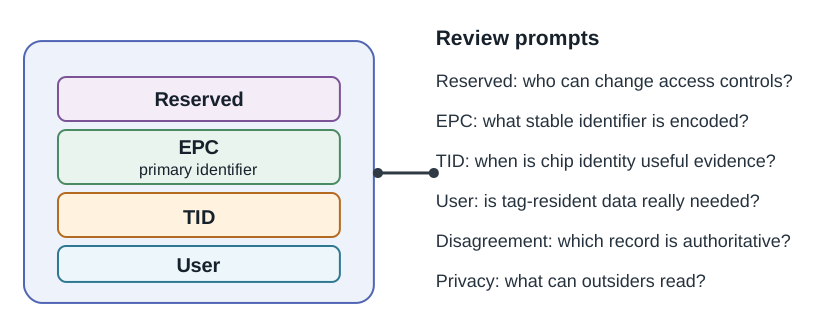
Reading a Gen2 tag well means knowing where its data lives.
- To place gen2 memory banks are separate evidence fields on firm evidence, follow the change from primary identifier to: TID: when is chip identity useful evidence? On it.: Privacy: what can outsiders read? Limits the claim.
Major section
Gen2 Memory Banks Are Separate Evidence Fields (continued)
Work through it with primary identifier as one fact,: TID: when is chip identity useful evidence? As another, and: Privacy: what can outsiders read? As the closeout.
- Both primary identifier and: TID: when is chip identity useful evidence? Need evidence.
- Second, the passwords in Bank 00 are only 32 bits and are sent with light cover-coding, so classic Gen2 security is weak by design.
- The business system should parse the EPC payload according to the encoding scheme the organization actually owns, then store the reader, antenna, timestamp, and event reason beside the observation.
Major section
Concept Relationships
Frequency-band knowledge explains why LF, HF, UHF, and active systems behave differently.
- Tag-type knowledge explains why passive, battery-assisted, and active tags fit different workflows.
- RFID security knowledge explains why range, identity, and event sharing create privacy and misuse risks.
- Deployment knowledge explains how antenna placement, reader scheduling, and exception handling affect the final outcome.
Deck summary
Key takeaways
Both boxes say they support tags, yet the air link, reader control, and event record may follow different contracts.
- Standards divide that work into layers that must not be confused.
- EPC, EPCIS, and the GS1 Core Business Vocabulary describe how identifiers and read events are represented for supply-chain visibility.
- The Electronic Product Code gives physical things a structured identifier.
- Picking a standard is really picking a band, range class, interaction pattern, and evidence model together.
Retrieval practice
Recall check 1 of 3

Radio Remi says: answer from memory, then check your reasoning.
Q1A team is choosing an RFID or NFC standards family early in design. Which evidence packet is strong enough to make the choice reviewable?
Show answer
Answer: B A reviewable RFID standards choice ties the workflow, object, interaction range, environment, standards family, reader-control layer, event-data layer, pilot evidence, privacy and operations risks, and retest trigger together.
Retrieval practice
Recall check 2 of 3

Radio Remi says: answer from memory, then check your reasoning.
Q2A hospital wants staff to intentionally tap a badge at a medication cabinet, while the same hospital also wants bulk inventory reads of tagged supply cases at a receiving doorway. What is the best standards decision?
Show answer
Answer: B Standards choices should follow the workflow.
Retrieval practice
Recall check 3 of 3

Radio Remi says: answer from memory, then check your reasoning.
Q3A brand-protection application checks for copied EPC identifiers on UHF tags. Which Gen2 memory should it compare with the EPC, and why?
Show answer
Answer: C Gen2 defines Reserved, EPC, TID, and User banks.
Print reference
Answers
Answer key.
- B · A reviewable RFID standards choice ties the workflow, object, interaction range, environment, standards family, reader-control layer, event-data layer, pilot evidence, privacy and operations risks, and retest trigger together.
- B · Standards choices should follow the workflow.
- C · Gen2 defines Reserved, EPC, TID, and User banks.