RFID, NFC & UWB · Study deck

RFID Integration: Reader and Protocol Interfaces

An RFID reader must move tag events to a host without hiding time or status.

Radio Remi is your guide for this deck.

appshardwareintegration
Radio Remi, the module guide, in a scene from this chapter.
iotclass.org

After studying this chapter

Learning objectives

You will be able to:

  • Define the boundary between RFID tag observation, reader hardware, host interface, middleware normalization, application policy, and release evidence.
  • Choose reader interfaces such as GPIO, serial, USB, Ethernet, or fieldbus based on event contract, supervision, timing tolerance, and maintenance needs.
  • Review antenna placement, shielding, cable routing, mounting surface, and power quality as first-class integration risks.
  • Build validation traces that separate raw reader output, deduplication, filtering, business event creation, fallback, and audit fields.
iotclass.org

Major section

Start With the Story

General purpose input output, or GPIO, means a configurable pin on a small computer board.

  • Radio frequency means the rate of a radio wave.
  • Radio frequency identification, or RFID, uses radio to identify a tag.
  • The host interface carries reader events into software.
  • This runway does not prove every antenna or site.
iotclass.org

Major section

Eddie's Math Bridge: Shape a Portal Antenna Zone

The mathematical gist.: Holding the chapter's 35 dBm EIRP fixed, a 6 dBi panel needs 29 dBm or 0.794 W conducted and concentrates ideal full-strength radiation into 25.1% of a sphere.

  • A 9 dBi panel needs 26 dBm or 0.398 W and narrows that fraction to 12.6%.

Numbers to remember

29 dBma 6 dBi panel needs 29 dBm or 0.794 W conducted
0.794 Wa 6 dBi panel needs 29 dBm or 0.794 W conducted
26 dBmA 9 dBi panel needs 26 dBm or 0.398 W
iotclass.org

Major section

Integration Boundary
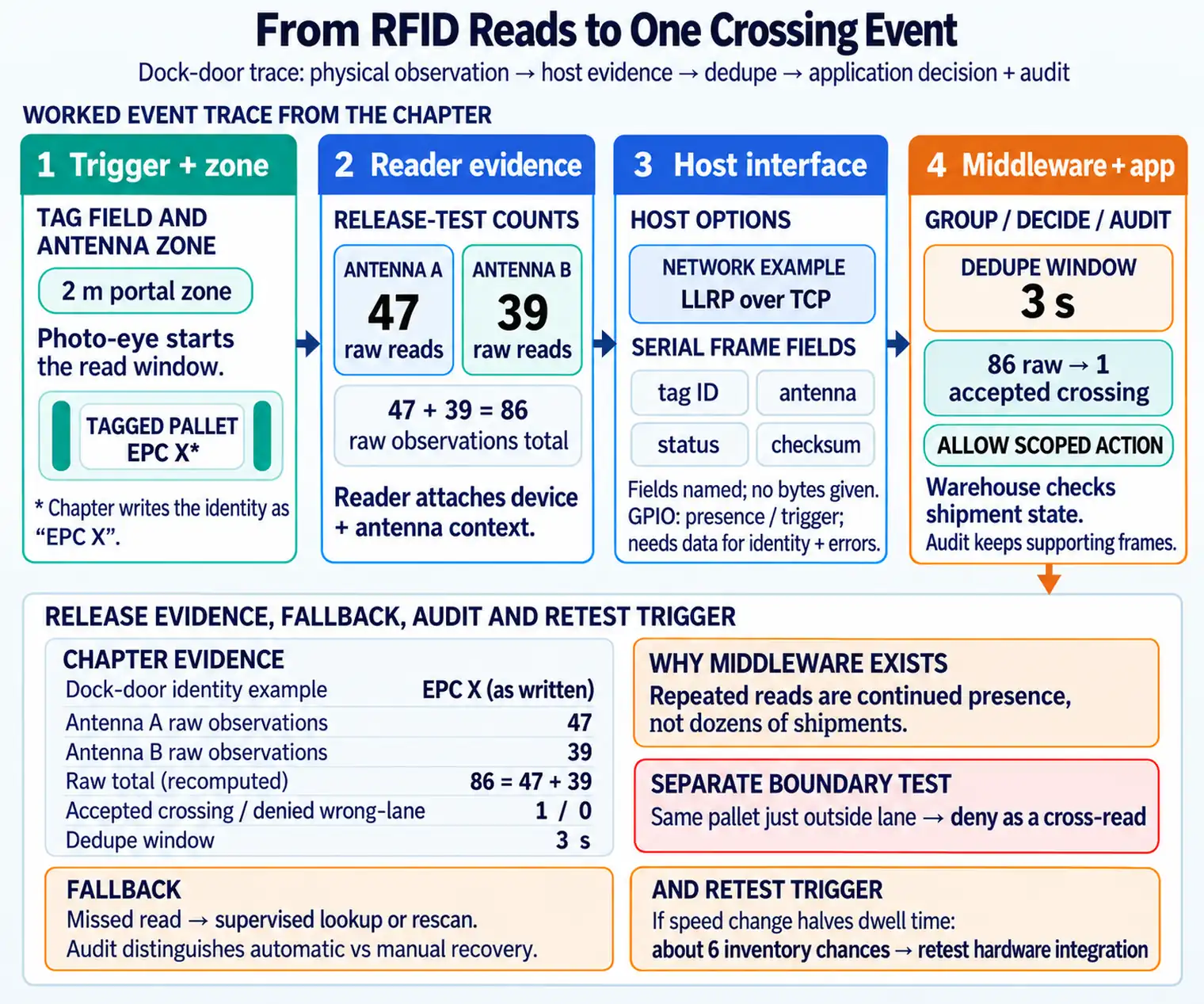
The remaining question is and retest trigger.

  • Locate its roles by locating: Tag field and antenna zone, assigning: Allow scoped action, and ending at and retest trigger.
  • The tag field and antenna determine which observations are physically possible; the reader then attaches device and antenna context before the host link carries those observations to middleware.

Why it matters

Locate its roles by locating : Tag field and antenna zone, assigning : Allow scoped action, and ending at and retest trigger.

RFID hardware integration boundary showing tag field, antenna, reader, GPIO or serial host link, middleware, application decision, fallback, audit, and release evidence.
iotclass.org

Major section

Integration Boundary (continued)

This end-to-end boundary is the running contract for every hardware choice that follows.

  • RF field: Tag orientation, material nearby, tag density, and antenna geometry decide whether the reader sees the intended tag or a neighboring tag.
  • Reader edge: The reader reports observations, health, and errors.
  • It should not silently turn every read into an approved application action.
iotclass.org

Major section

Minimum Viable Understanding

A read is evidence, not a decision.: The reader saw a tag value under specific conditions.

  • Middleware and application policy decide what that observation means.
  • Antennas are part of the system contract.: Placement, polarization, shielding, cable strain, and nearby metal or liquid can change the read zone after a bench test passes.
  • Interfaces need supervision.: A serial or network event stream should expose reader health, queue state, reconnect behavior, and duplicate suppression, not just tag IDs.
iotclass.org

Major section

Reader Has Air and Host Contracts

Integrating an RFID reader means wiring up two different conversations.

  • Confusing the two is the usual integration mistake.
  • Business logic, read windows, reports, deduplication, and audit fields live on the other.
  • If a pallet pauses in the doorway, the reader may report the same EPC dozens of times.
iotclass.org

Major section

Air-Interface Encoding Shapes Read Reliability
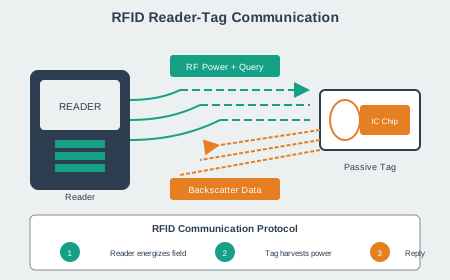
It separates the energy-bearing reader transmission from the much weaker response that the reader must recover.

  • A passive tag first harvests enough energy to operate, its IC interprets the command, and then it changes its antenna load so that a modulated reflection returns to the reader.

Key terms

Slower Miller subcarriers
Slower Miller subcarriers are more robust and better in dense-reader or noisy environments.

Why it matters

The two air-interface directions use deliberately different schemes because the tag has almost no power budget.

RFID reader-tag communication showing RF power and query from the reader, passive tag energy harvest, IC chip response, and backscatter data returning to the reader.
iotclass.org

Major section

Air-Interface Encoding Shapes Read Reliability (continued)

The outgoing carrier is therefore both power source and command path, whereas the return is a faint backscatter signal.

  • That asymmetry explains why encoding, dwell time, antenna placement, and receiver conditions jointly determine whether a read becomes usable evidence.
  • Slower Miller subcarriers are more robust and better in dense-reader or noisy environments.
  • So the reliability-versus-speed tradeoff is partly an encoding setting pushed from the host, not a fixed property of the reader.
iotclass.org

Major section

Air-Interface Encoding Shapes Read Reliability (continued)

If a forklift moves at 1.2 m/s through a 2 m read zone, the pallet is visible for about 2 / 1.2 = 1.67 s.

  • If the reader configuration completes one useful inventory cycle every 120 ms after trigger and settling time, the portal has about 1.67 / 0.12 = 13 chances to see each tag.
  • That may be enough for a sparse pallet, but a dense pallet, poor tag orientation, or slower robust encoding can consume those chances quickly.
  • The release test should therefore store both the raw read count and the accepted event.
iotclass.org

Major section

Reader Interface Choices

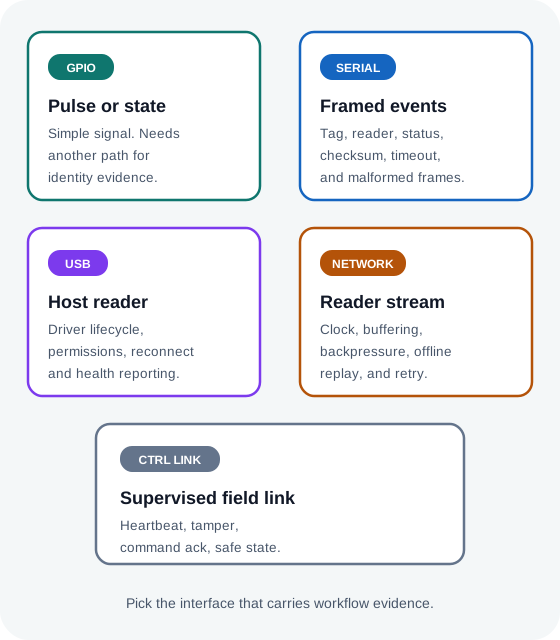
Network readers can carry multi-antenna event streams and buffered reports, but they also introduce clock, queue, and replay behavior.

  • A supervised controller link adds explicit heartbeat and acknowledgement where the safe state matters.
  • The correct interface is the least complex one that still carries the evidence and failure semantics required by the integration boundary.
RFID reader interface choices comparing GPIO pulses, serial frames, a USB host reader, a network reader stream, and a supervised controller link by data richness, supervision, and integration ownership.
iotclass.org

Major section

Reader Interface Choices (continued)

Pair it with a separate data channel or it becomes hard to audit tag identity and reader errors.

  • Serial frame: Useful for embedded controllers that need tag ID, antenna, status, and checksum fields.
  • Ethernet reader: Useful when multiple antennas or lanes send events to middleware.
  • Reader SDK: Useful when the reader exposes filtering and antenna controls.
iotclass.org

Deck summary

Key takeaways

General purpose input output, or GPIO, means a configurable pin on a small computer board.

  • The mathematical gist.: Holding the chapter's 35 dBm EIRP fixed, a 6 dBi panel needs 29 dBm or 0.794 W conducted and concentrates ideal full-strength radiation into 25.1% of a sphere.
  • The remaining question is and retest trigger.
  • This end-to-end boundary is the running contract for every hardware choice that follows.
  • A read is evidence, not a decision.: The reader saw a tag value under specific conditions.
iotclass.org

Retrieval practice

Recall check

Radio Remi says: answer from memory, then check your reasoning.

Q1Why does this chapter frame RFID hardware integration as a release problem, not just a wiring problem?

ABecause RFID readers are unusually difficult to physically wire and cable up on a real site.
BThe reader, antenna, mounting, and middleware must stop noisy reads becoming trusted events.
CBecause antenna connector and cable-loss checks provide the evidence needed to release the workflow.
DBecause the reader power supply must meet its load before the workflow can be released.
Show answer

Answer: B RFID integration is a release problem because reader, antenna, mounting, and middleware must keep noisy reads from becoming trusted events.

iotclass.org

Print reference

Answers

Answer key.

  1. B · RFID integration is a release problem because reader, antenna, mounting, and middleware must keep noisy reads from becoming trusted events.
iotclass.org