RFID, NFC & UWB · Study deck
RFID Lab Check: Placement and Read Analysis
Moving an antenna a few centimetres can change which tags are seen.
Radio Remi is your guide for this deck.
After studying this chapter
Learning objectives
You will be able to:
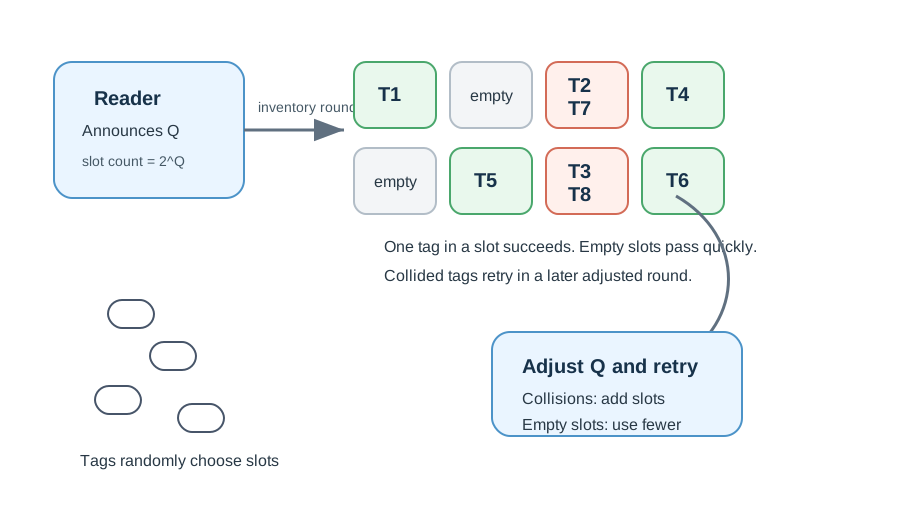
- Explain: With 64 nearby tags and Q=4, the reader has only 2^4 = 16 slots, so the average load is 64 / 16 = 4 tags per slot.
- Explain: Under a simple slotted ALOHA model, the expected useful singletons are roughly N * e^-G, where G is the average tags per slot.
- Explain: Changing too many variables at once:: If antenna aim, reader power, and tag placement change together, the trace cannot explain which change mattered.
- Explain: That gives about 64 * e^-4 = 1.2 successful tag replies per frame, so the trace will be dominated by collisions.
Major section
Lab 3: Antenna Placement Tests
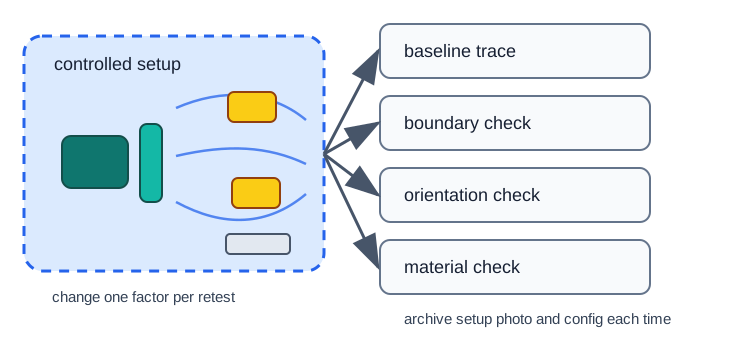
Antenna placement is a test variable, not a decoration.
- When a placement improves one scenario but creates stray reads in another, record both effects.
- Both controlled setup and boundary check need evidence.
- The conclusion in lab 3: antenna placement tests now has a named boundary.
Try it: Lab 3: Antenna Placement Tests in the chapter
Major section
Dense Inventories and Q Scaling
Reopen dense inventories and q scaling whenever: T3 changes.
- The arithmetic explains a common lab surprise.
- With 64 nearby tags and Q=4, the reader has only 2^4 = 16 slots, so the average load is 64 / 16 = 4 tags per slot.
Major section
Dense Inventories and Q Scaling (continued)
Under a simple slotted ALOHA model, the expected useful singletons are roughly N * e^-G, where G is the average tags per slot.
- That gives about 64 * e^-4 = 1.2 successful tag replies per frame, so the trace will be dominated by collisions.
- With Q=6, the frame has 64 slots and G = 1, giving about 64 / e = 23.5 useful singletons per frame.
- It still takes multiple rounds to see every tag, but the trace is no longer thrashing.
- The consequence for assessment is concrete: a release record must separate RF inventory performance from application logic.
Major section
Assessment Rubric
A strong submission can be reproduced by another team member using the record alone.
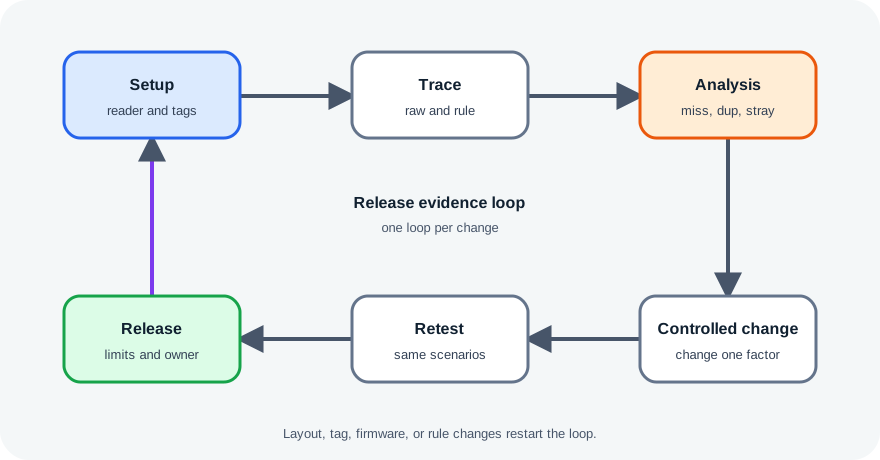
- Setup control: The reader, antenna, tag set, object materials, mounting method, and scenarios are recorded before testing.
- Failure analysis: Missed, duplicate, and stray reads are classified with plausible causes and retest evidence after changes.
- Middleware review: The event logic is visible enough to explain de-duplication, zone ownership, exception handling, offline behavior, and application handoff.
Major section
Release and Retest Record
It should be short enough to maintain and precise enough to retest.
- Retest after a reader firmware change, antenna move, tag type change, packaging change, middleware rule change, layout change, or incident report.
- If the workflow depends on a physical read zone, physical changes are software changes for assessment purposes.
Major section
Common Pitfalls
Counting raw reads as inventory events:: A raw read is an observation.
- Changing too many variables at once:: If antenna aim, reader power, and tag placement change together, the trace cannot explain which change mattered.
- Testing only happy paths:: Expected tags alone do not prove a read zone.
- Inventory state needs middleware rules for dwell time, de-duplication, and departure.
Deck summary
Key takeaways
Antenna placement is a test variable, not a decoration.
- Reopen dense inventories and q scaling whenever: T3 changes.
- Under a simple slotted ALOHA model, the expected useful singletons are roughly N * e^-G, where G is the average tags per slot.
- A strong submission can be reproduced by another team member using the record alone.
- It should be short enough to maintain and precise enough to retest.
Retrieval practice
Recall check 1 of 2

Radio Remi says: answer from memory, then check your reasoning.
Q1In a dense RFID lab, an inventory trace shows mostly collision slots and a low read rate. What should happen to Q, and what limit remains even after it converges?
Show answer
Answer: D The Q algorithm raises Q when collisions dominate and lowers it when slots are mostly empty.
Retrieval practice
Recall check 2 of 2

Radio Remi says: answer from memory, then check your reasoning.
Q2A lab team moves an RFID antenna, sees fewer missed reads, and wants to release the setup immediately. What evidence is still needed before the result is release-ready?
Show answer
Answer: C RFID release evidence must show controlled retesting, boundary behavior, failure handling, middleware decisions, and fallback readiness after physical or configuration changes.
Print reference
Answers
Answer key.
- D · The Q algorithm raises Q when collisions dominate and lowers it when slots are mostly empty.
- C · RFID release evidence must show controlled retesting, boundary behavior, failure handling, middleware decisions, and fallback readiness after physical or configuration changes.