RFID, NFC & UWB · Study deck
RFID Lab Check: Inventory and Trace Evidence
RFID identifies tagged items by radio.
Radio Remi is your guide for this deck.
After studying this chapter
Learning objectives
You will be able to:
- Define a read-zone test plan with controlled tag set, reader position, antenna orientation, reader settings, and pass or fail criteria.
- Capture inventory traces that preserve tag IDs, timestamps, antenna IDs, RSSI or equivalent signal indicators, event state, and middleware decisions.
- Diagnose missed reads, duplicate reads, stray reads, orientation sensitivity, and material effects without relying on unsupported range claims.
- Record privacy, safety, fallback, and retest evidence before releasing an RFID workflow.
Major section
Start With the Decision
RFID identifies tagged items by radio.
- A tag carries the identity on an item.
- A read is one reader event; an inventory trace is the saved series of those events.
- An RFID inventory trace can hide missed tags behind a good total count.
- The lab records each read before hardware is changed.
Major section
Start With the Story
A reader beep cannot show whether the workflow made the right inventory decision.
- Radio frequency means the part of the radio spectrum used to carry a signal.
- RFID means radio frequency identification, a way to identify tagged items with radio signals.
- A single good read is less useful than a repeatable evidence record.
Major section
Eddie's Math Bridge: Screen the Read-Zone Beam
The mathematical gist: Treating gain as ideal directivity, 6 dBi gives a 101.8° square-beam screen and 9 dBi gives 72.1°; the ideal solid angle halves.
- At a fixed 36 dBm EIRP ceiling, the 9 dBi panel needs 27 dBm conducted power, while a 10 cm shift at 1 m changes the look angle by 5.71°.
Major section
Lab Scope
The equipment can be classroom hardware or production-style readers, but the evidence expectations are the same.
- Inventory trace: The raw or normalized event stream that shows each observed tag and the context of the observation.
- The release record should name both zone boundaries and the rule version.
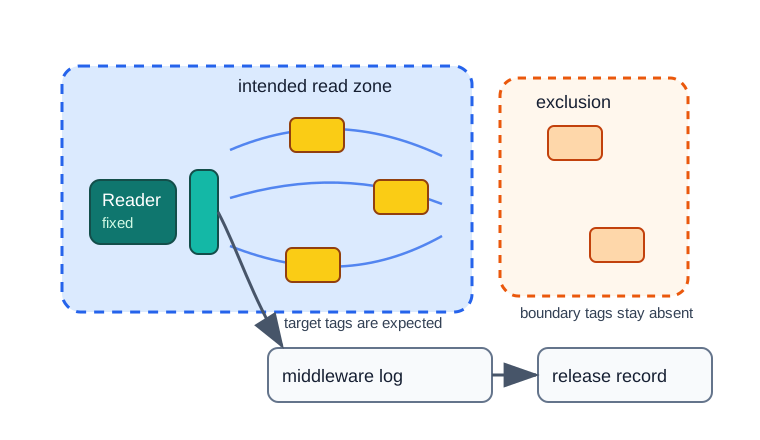
Try it: Lab Scope in the chapter
Major section
A Lab Result Is a Controlled Evidence Set
The release note should preserve both the physical setup and the trace summary.
- The useful question in an RFID application lab is not "did any tag read?" but "did the workflow produce the right application event under controlled conditions?" A small shelf lab can show the difference.
- If the raw trace contains 54 reader observations, that is not automatically 54 inventory events.
- That reproducibility is the difference between an activity and an assessment.
Try it: A Lab Result Is a Controlled Evidence Set in the chapter
Major section
Lab 1: Read-Zone Setup
The plan prevents the common mistake of moving the reader, tag set, and acceptance criteria during the same test.
- The first setup should be conservative.
- Lower power, reduce antenna spillover, and add shielding or physical separation before increasing coverage.
- A lab that reads everything everywhere is not controlled; it is only noisy.
Try it: Lab 1: Read-Zone Setup in the chapter
Major section
Lab 2: Tag Inventory Trace
The point is to preserve how a raw observation was classified, not merely to count how many lines the reader emitted.
- Raw reads explain RF behavior; middleware output explains what the application actually sees.
- The reader observes asset-014 and asset-021, then sees asset-021 again.
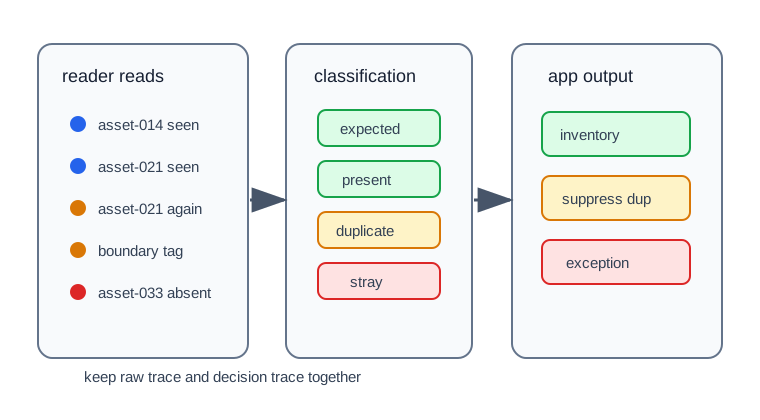
Try it: Lab 2: Tag Inventory Trace in the chapter
Major section
Replay the Trace Before Changing Hardware
In the shelf example, a defensible replay table has one row per expected item and one row per boundary item.
- The important comparison is not highest signal; it is whether the middleware decision matches the scenario label.
- If 12 target tags were expected and 11 became present, the target acceptance rate is 11 / 12 = 91.7%.
- None of those numbers is a universal pass threshold; the pass threshold is the one the lab wrote before testing.
Deck summary
Key takeaways
RFID identifies tagged items by radio.
- A reader beep cannot show whether the workflow made the right inventory decision.
- The mathematical gist: Treating gain as ideal directivity, 6 dBi gives a 101.8° square-beam screen and 9 dBi gives 72.1°; the ideal solid angle halves.
- The equipment can be classroom hardware or production-style readers, but the evidence expectations are the same.
- The release note should preserve both the physical setup and the trace summary.
Retrieval practice
Recall check 1 of 3
Radio Remi says: answer from memory, then check your reasoning.
Q1What is the goal of an RFID application lab beyond making a reader beep once on a bench?
Show answer
Answer: C An RFID lab should show selective, repeatable identification with evidence that another team can retest.
Retrieval practice
Recall check 2 of 3
Radio Remi says: answer from memory, then check your reasoning.
Q2A portal reads a tag repeatedly. What should the lab compare before creating an inventory event?
Show answer
Answer: D Repeated RF observations may map to a deduplicated business event.
Retrieval practice
Recall check 3 of 3
Radio Remi says: answer from memory, then check your reasoning.
Q3A portal reports an inventory event but cannot explain which reads formed it. What trace is needed?
Show answer
Answer: C Those fields let a reviewer replay the event decision.
Print reference
Answers
Answer key.
- C · An RFID lab should show selective, repeatable identification with evidence that another team can retest.
- D · Repeated RF observations may map to a deduplicated business event.
- C · Those fields let a reviewer replay the event decision.