RFID, NFC & UWB · Study deck
How RFID Identifies Objects
RFID connects radio observations to object identities through tag physics, controlled read zones, and explicit event rules.
Radio Remi is your guide for this deck.

After studying this chapter
Learning objectives
An RFID review must connect a decoded identity with the intended physical event.
- Tag power and radio coupling describe different parts of identification.Passive tags harvest reader energy, while active tags use a battery to transmit their identity.
- An inventory event needs identity, physics, zone, and application evidence.A tag decoded near the tool cabinet still needs a correct object association and a rule for accepting a return.
- Time inside the read zone limits inventory opportunities.The chapter’s 2.4 m portal at 1.6 m/s provides 1.5 s to observe the passing cartons.
- The review record makes filtering and exceptions repeatable.A new carton material, reader position, or firmware can change the evidence and require another portal test.
Major section
Inductive and backscatter return paths (1/2)
The panels compare RFID coupling; start with the coil path, then cross to the UHF return path.
- The inductive panel shows reader energy entering the tag coil.Its paired load-modulation path returns data, so both coil alignment and detuning matter to a successful read.
- Coil size and alignment can change the near-field reading zone.Evidence from a bench arrangement cannot establish the same performance after a tag is attached to metal or moved.
Major section
Inductive and backscatter return paths (2/2)
- The radiative panel shows an incoming wave and backscatter return.The UHF tag changes its reflection to send data rather than using the coil-coupled return shown in the other panel.
- UHF reception depends on the installed antenna and surrounding materials.Antenna angle, liquids, metal, and multipath can change the observed range, so another installation needs its own evidence.
Major section
Tag power and passage direction (1/2)
Repeated observations need direction and zone rules before becoming a passage event.
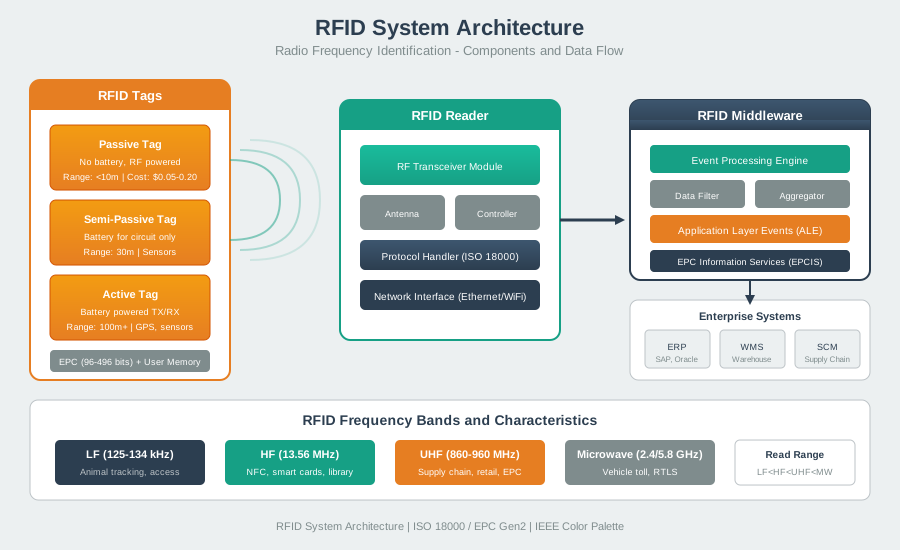
- Passive and battery-assisted tags use different sources of operating energy.A passive tag harvests the reader field; a battery-assisted tag can power its chip while retaining reader interaction.
- An active tag uses its own battery to transmit an identity.The power model changes lifetime, maintenance, cost, and measurement possibilities rather than merely labelling a tag as stronger.
Major section
Tag power and passage direction (2/2)
- Antenna order can support an entry inference for T91.Upstream-before-downstream observations give direction evidence when middleware combines seven reads into one candidate passage event.
- Reversed or simultaneous observations need an explicit event rule.The portal must distinguish an exit from uncertainty instead of treating every decoded identifier as a confirmed entry.
Major section
Dwell time and missed cartons (1/2)
A moving carton’s time inside the zone limits the available inventory opportunities.
- The 2.4 m zone provides 1.5 s at 1.6 m/s.Dividing zone length by travel speed gives the time available before the cartons leave the reader’s accepted area.
- A 200 ms inventory round permits about 7.5 rounds.Dividing 1.5 s by 0.2 s estimates opportunities; it does not guarantee successful identification of every passing carton.
Major section
Dwell time and missed cartons (2/2)
- Observing 29 of 32 cartons leaves three unexplained misses.Orientation, material shielding, anti-collision timing, antenna aim, or middleware timeout could explain the incomplete portal result.
- Unique expected identities reveal misses hidden by repeated messages.The chapter’s 100-message example could include duplicates, so message totals cannot establish 100 correctly identified cartons.
Activity 1 · Work it out
✎ Estimate the portal opportunity

I want you to count reading opportunities before trusting a fast-moving portal.
For 32 cartons, divide a 2.4 m read zone by a speed of 1.6 m/s. Then divide that dwell time by a 200 ms inventory round. Does observing 29 cartons prove full identification?
3 minutes · Pen and paper · Answer: Activity 1
Major section
Start With the Story (1/2)
Define the inventory event before installing the reader and antennas.
- A raw read establishes an observation under particular radio conditions.The cabinet’s 63 observations do not mean 63 tools; repeated messages must map to the expected physical identities.
- The cabinet rule must accept intended tools and exclude nearby tools.The chapter’s target is 18 / 18 cabinet tools accepted and 0 / 3 bench tools accepted.
Major section
Start With the Story (2/2)
- Duplicate filtering connects repeated reads to one inventory event per tool.The cabinet-close rule supplies the event boundary that a list of decoded identifiers cannot establish alone.
- Installation tests need the conditions that can fool the cabinet.Metal, liquid, crowded placement, damaged tags, restarts, and zone-edge tools can produce missing reads or false inventory events.
Major section
Object binding and false returns (1/2)
Preserve evidence at each handoff so a false event has a diagnosable cause.
- Commissioning must bind a scanned tag to a confirmed physical object.The record also names who made the association, so a readable identifier can be traced to the intended tool.
- A replacement label requires retirement of the old identifier.Accepting a new association without retiring the damaged label leaves the object’s identity record ambiguous.
Major section
Object binding and false returns (2/2)
- A false return after reliable decoding points toward event rules.The chapter’s return-desk case needs zone, filtering, reader identity, timing, and mapping evidence before a radio redesign.
- Uncertain inventory must remain visible to the people using the system.A weak read cannot safely become a confident present-or-absent result, and urgent safety checks need an independent basis.
Major section
Overview: What an RFID Claim Means
Anti-collision and repeated inventory rounds can produce more observations than there are tools.
- Middleware filters those reads before the application decides which tools are present or missing under a business rule.
- In the worked cabinet, 18 tagged tools and 63 observations are different quantities; the event must explain how repeats were handled.
Major section
Summary (1/2)
Approve the observed workflow under its tested conditions.
- Tag power, coupling, orientation, and material determine physical read plausibility.A tag that works before attachment can fail on metal, liquid, or stacked cartons in the installed arrangement.
- Antennas, motion, dwell time, and neighboring tags can change the reading zone.The moving portal needs its speed and inventory timing recorded alongside misses and unwanted reads from nearby objects.
Major section
Summary (2/2)
- Filtering and application rules give each observation its event meaning.The same decoded identifier may support received, returned, counted, or rejected only through the reviewed workflow rule.
- Installation and workflow changes can invalidate earlier approval evidence.New packaging, reader relocation, firmware, or operating procedures require review against the original dock-door conditions.
Deck summary
Key takeaways
A trustworthy RFID event needs a trace from the physical object to application state.
- A decoded tag needs a correct object association and event rule.A wrench seen near the return desk has not necessarily been returned, even when its identifier is decoded reliably.
- A wider reading zone can create false inventory events.Nearby bench tools may be accepted accidentally when the cabinet’s read zone extends beyond its intended objects.
- Separate counts can reveal misses, stray reads, and duplicate observations.Expected unique identities reveal whether repeated messages have hidden missing cartons or included unwanted nearby tags.
- An owner and exception path keep the reviewed workflow supportable.Privacy limits, replacement rules, and retest triggers identify who responds when later changes undermine the accepted evidence.
Retrieval practice
Recall check 1 of 4
Radio Remi says: answer from memory, then check your reasoning.
Q1A battery helps a tag power its chip, yet the reader still misses its reply. Which limit now matters?
Show answer
Answer: A Local battery power can remove wake limits while reply strength remains bounded.
Retrieval practice
Recall check 2 of 4
Radio Remi says: answer from memory, then check your reasoning.
Q2A team says an RFID workflow is ready because one tagged item was read on a bench. What should the review say?
Show answer
Answer: D One bench read proves decode only; object mapping, tag type, frequency fit, read-zone behavior, filtering, exception handling, privacy, and retest evidence all still need boundaries.
Retrieval practice
Recall check 3 of 4
Radio Remi says: answer from memory, then check your reasoning.
Q3A portal reads most cartons during a pilot, but some reads are duplicated and a few nearby pallets are detected. What evidence is missing before approval?
Show answer
Answer: A The gap is a read-zone and event-filter record: antenna settings, boundary control, duplicate window, missed-read rule, extra-read handling, owner, and retest triggers.
Retrieval practice
Recall check 4 of 4
Radio Remi says: answer from memory, then check your reasoning.
Q4Where should the false return event be investigated after a reliable tag read?
Show answer
Answer: C A reliable decode but a wrong 'returned' state points to the reader-to-middleware and middleware-to-application boundary: zone rule, duplicate filter, accepted reader, timing, and event mapping.
Print reference
Answers 1 of 2
Answer key.
- A · Local battery power can remove wake limits while reply strength remains bounded.
- D · One bench read proves decode only; object mapping, tag type, frequency fit, read-zone behavior, filtering, exception handling, privacy, and retest evidence all still need boundaries.
- A · The gap is a read-zone and event-filter record: antenna settings, boundary control, duplicate window, missed-read rule, extra-read handling, owner, and retest triggers.
Print reference
Answers 2 of 2
Answer key.
- C · A reliable decode but a wrong 'returned' state points to the reader-to-middleware and middleware-to-application boundary: zone rule, duplicate filter, accepted reader, timing, and event mapping.
Print reference
Activity 1 answer
Model answer.
Work it out: Dwell time is 2.4 / 1.6 = 1.5 s. Inventory opportunities are 1.5 / 0.2 = 7.5 rounds. Observing 29 of 32 leaves three misses; investigate orientation, shielding, timing, antenna aim, or middleware timeout before release.