RFID, NFC & UWB · Study deck
RFID Frequency Bands
A livestock ear tag, library book, and warehouse pallet all use RFID, yet their coils, antennas, range, and response to water or metal differ.
Radio Remi is your guide for this deck.

After studying this chapter
Learning objectives
You will be able to:
- Distinguish LF and HF/NFC near-field coupling from UHF far-field backscatter, and their differing sensitivity to metal, liquid, and orientation
- Calculate dwell time for a moving tag population through a UHF read zone and connect it to antenna gain and coverage-angle trade-offs
- Build a frequency-selection evidence record naming workflow fit, material and mounting, read-zone design, and standards and operations evidence
- Explain: The figures compare regimes; they do not promise one exact read distance.
Major section
Cross From Coupling to Propagation
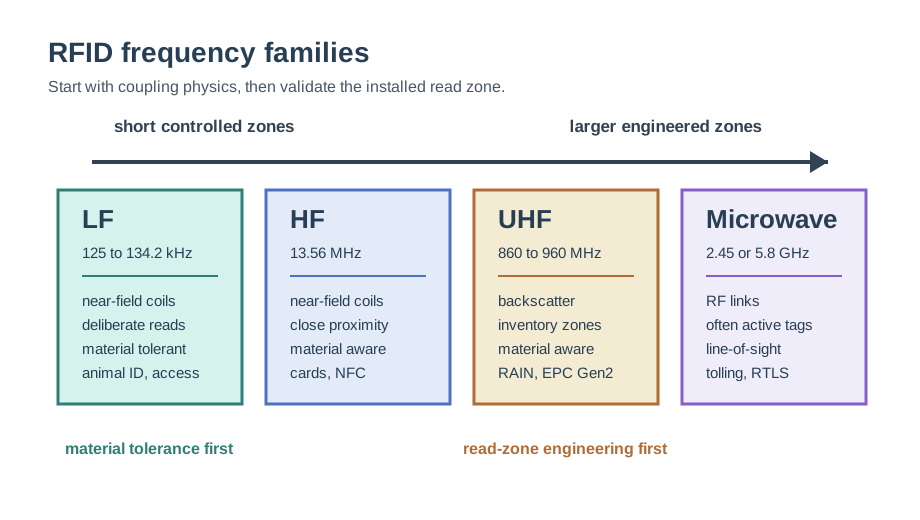
The figures compare regimes; they do not promise one exact read distance.
- The reader coil creates a changing magnetic field for inductive coupling, and a nearby tag coil receives energy and exchanges data.
- In the UHF view, the reader antenna launches an electromagnetic wave and the tag changes its reflection through backscatter.
Major section
Cross From Coupling to Propagation (continued)
The approximate near-field boundary is (r\approx\lambda/(2\pi)), where (lambda=c/f).
- At 13.56 MHz, wavelength is about (3.0\times10^8/13.56\times10^6=22.1\ \mathrm{m}), giving (r\approx3.52\ \mathrm{m}).
- This boundary separates field behavior; it is not an HF tag read-range prediction.
- At 915 MHz, wavelength is about 0.328 m and (lambda/(2\pi)\approx0.052\ \mathrm{m}).
Major section
Start With the Story
Radio frequency means energy carried by radio waves.
- Radio Frequency Identification, or RFID, uses that energy to observe an identity stored on a tag.
- The team does not need the greatest possible distance.
- It needs every tray inside the doorway, no tray in the next room, and a clear result around metal carts and people.
Major section
Start With the Story (continued)
Include an object just outside the zone and nearby radio use.
- A catalog range or one open-room trial is not proof of the installed zone.
- This opening does not say that one band is always best.
- Under the Hood examines near and far fields, coupling, wake power, reply strength, detuning, orientation, and why range changes after installation.
Major section
Eddie's Math Bridge: Cross the Near-Field Boundary
The mathematical gist.: At 125 kHz, wavelength is 2,400 m and the near-field boundary is 382 m, about 1,273 times a 0.3 m LF read.
- At 13.56 MHz the boundary is 3.52 m, about 35 times a 0.1 m HF tap.
Major section
Overview: Frequency Choice Is a Read-Zone Decision
At the decision point in overview: frequency choice is a read-zone decision, find the boundary between: RFID frequency families and larger engineered zones on it. Near-field coils supplies the consequence.
- For overview: frequency choice is a read-zone decision, attach the next action to near-field coils.
Major section
Under the Hood: Coupling, Detuning, and Evidence Drift
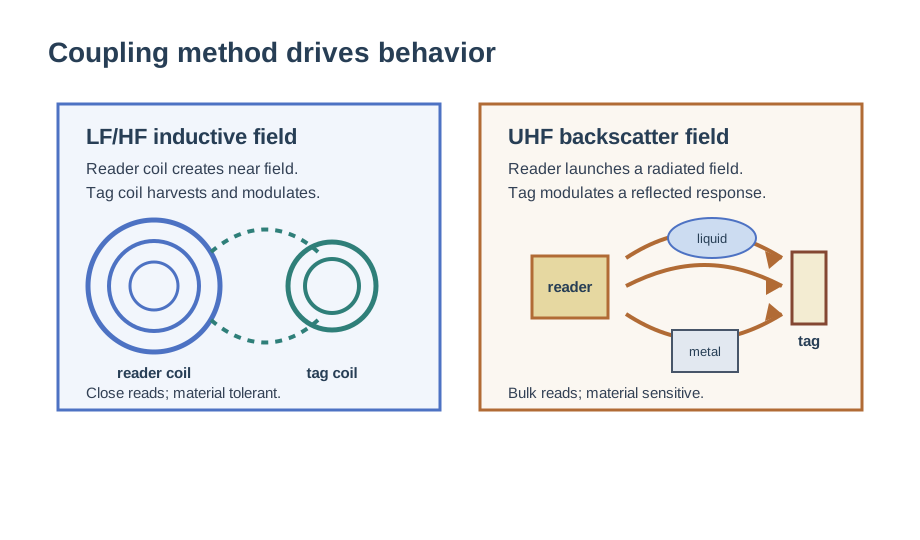
The hand-off to: Bulk reads; material sensitive needs an assigned owner.
- The conclusion in under the hood: coupling, detuning, and evidence drift now has a named boundary.
Major section
Summary
RFID frequency selection is a coupling and read-zone decision, not a simple range contest.
- LF and HF are strongest for close, controlled reads where material tolerance, deliberate presentation, or NFC behavior matters.
- UHF is strongest for engineered passive inventory zones when tags, materials, antennas, region settings, and filtering are validated together.
- Microwave and active systems need explicit power, maintenance, protocol, privacy, and support evidence.
Deck summary
Key takeaways
The figures compare regimes; they do not promise one exact read distance.
- The approximate near-field boundary is (r\approx\lambda/(2\pi)), where (lambda=c/f).
- Radio frequency means energy carried by radio waves.
- Include an object just outside the zone and nearby radio use.
- The mathematical gist.: At 125 kHz, wavelength is 2,400 m and the near-field boundary is 382 m, about 1,273 times a 0.3 m LF read.
Retrieval practice
Recall check 1 of 3

Radio Remi says: answer from memory, then check your reasoning.
Q1A team asks which RFID band has the longest range before describing the object or workflow. What should the review ask first?
Show answer
Answer: C Before naming a band, ask what read decision is needed, what materials and mounting are involved, where reads must and must not happen, and what evidence will release the workflow.
Retrieval practice
Recall check 2 of 3

Radio Remi says: answer from memory, then check your reasoning.
Q2A warehouse team wants passive RFID for cases moving through one dock door. Which frequency-selection record is strongest?
Show answer
Answer: D The strongest record ties the UHF candidate to the doorway workflow, tag placement, materials, antenna layout, regional settings, duplicate filtering, missed-read handling, and retest triggers.
Retrieval practice
Recall check 3 of 3

Radio Remi says: answer from memory, then check your reasoning.
Q3A UHF portal worked in pilot, but after a packaging change some liquid-filled products are missed and nearby pallets are still read. What review action is strongest?
Show answer
Answer: B Liquids absorb UHF, so retest the installed evidence: packaging, tag mounting, antenna placement, reader settings, material effects, duplicate and extra-read handling, and the affected workflow claims.
Print reference
Answers
Answer key.
- C · Before naming a band, ask what read decision is needed, what materials and mounting are involved, where reads must and must not happen, and what evidence will release the workflow.
- D · The strongest record ties the UHF candidate to the doorway workflow, tag placement, materials, antenna layout, regional settings, duplicate filtering, missed-read handling, and retest triggers.
- B · Liquids absorb UHF, so retest the installed evidence: packaging, tag mounting, antenna placement, reader settings, material effects, duplicate and extra-read handling, and the affected workflow claims.