RFID, NFC & UWB · Study deck

RFID Industry Applications

Picture a pallet counted twice because two doors heard the same tag.

Radio Remi is your guide for this deck.

appsindustry
Radio Remi, the module guide, in a scene from this chapter.
iotclass.org

After studying this chapter

Learning objectives

You will be able to:

  • Compare RFID application patterns across retail, manufacturing, logistics, healthcare, access, cold-chain, and maintenance workflows.
  • Select LF, HF, UHF, or active location approaches based on read zone, item material, mobility, and evidence needs.
  • Explain how reader placement and middleware filtering turn raw tag reads into useful business events.
  • Identify privacy, safety, and access boundaries before tag reads trigger operational decisions.
iotclass.org

Major section

Start With the Story · In 60 Seconds

Each application has its own denominator for success.

  • A reader event is not yet proof of the business event the operator cares about.
  • Radio-frequency identification uses radio tags and readers to identify marked items; it is shortened to RFID.
  • Industry RFID applications are not one generic tracking problem.
iotclass.org

Major section

Application Pattern Map
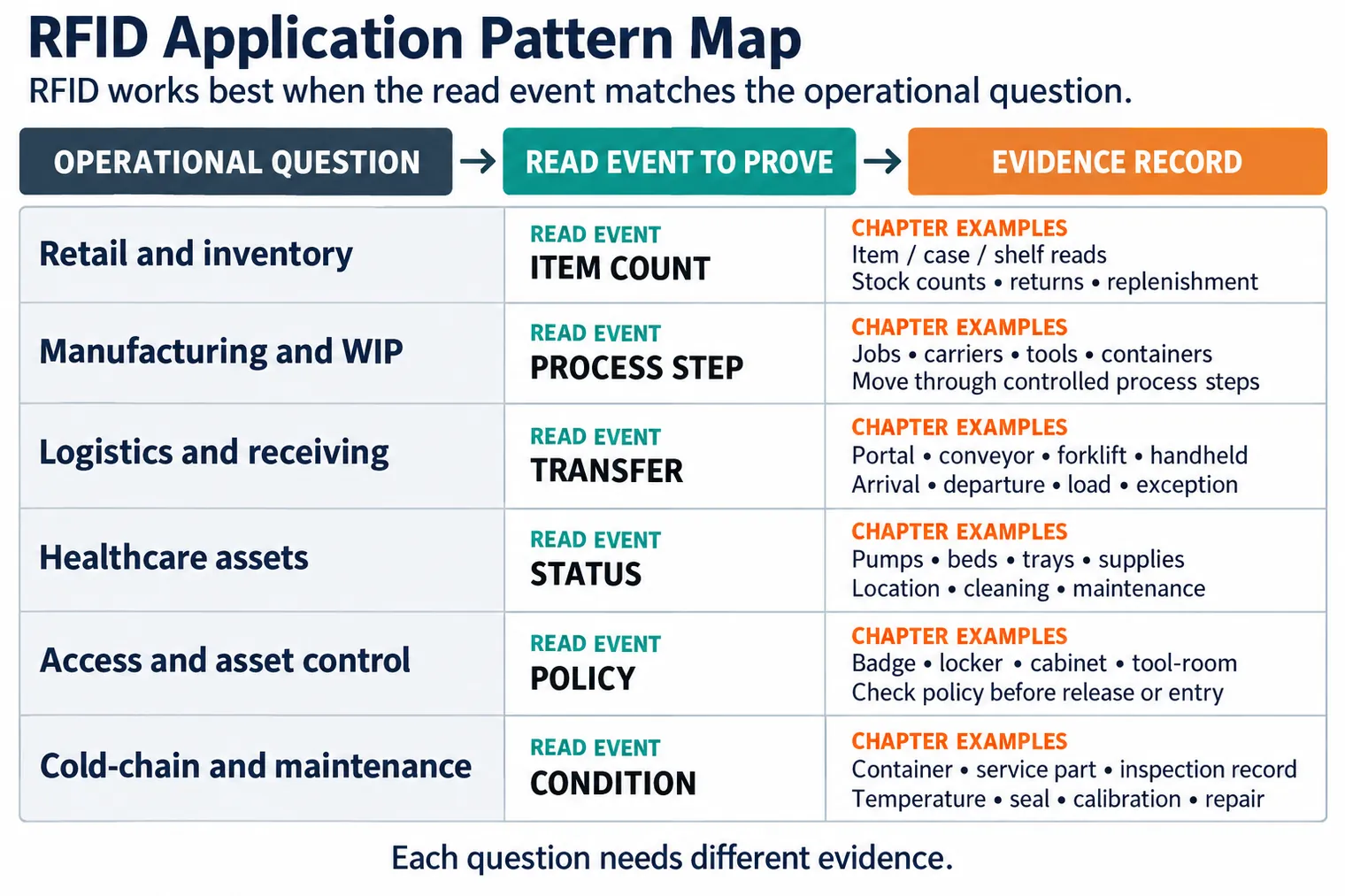
RFID works best when the read event matches the operational question.

  • A dock door asks "which shipment crossed this threshold?" A workcell asks "which job is here now?" A hospital storeroom asks "which asset was last seen in this zone?" Each question needs different evidence.
RFID industry application pattern map comparing retail, manufacturing, logistics, healthcare, access, cold-chain, and maintenance workflows by read event and evidence record.
iotclass.org

Major section

Application Pattern Map (continued)

To place application pattern map on firm evidence, inspect how: Item count relates to: Transfer in it.: Condition identifies the later check.

  • Retail and inventory: Item, case, or shelf reads support stock counts, misplaced item detection, returns, and replenishment workflows.
  • Healthcare assets: Tags on pumps, beds, trays, specimens, or supplies support location, status, cleaning, maintenance, and chain-of-custody review.
  • Access and asset control: Badge, locker, cabinet, or tool-room reads should be checked against policy before release or entry.
  • Cold-chain and maintenance: RFID can bind a container, service part, or inspection record to temperature, seal, calibration, or repair evidence.
iotclass.org

Major section

Match the Pattern to the Read Zone · Frequency and Tag Fit
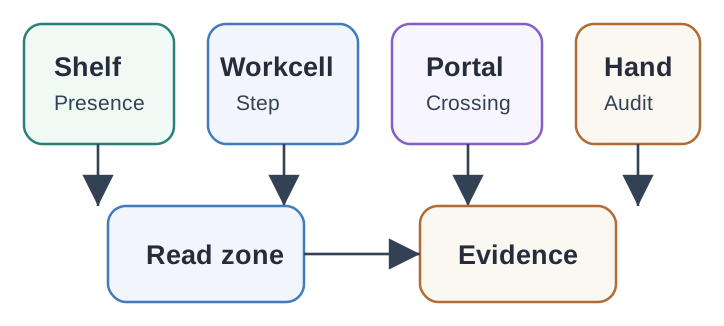
Shelf or bin read.: Useful for item presence and replenishment, but it needs shielding, zone tuning, and rules for nearby items.

  • Workcell read.: Useful for WIP state transitions, but the event should be tied to operator, station, route, and quality state.
  • The same industry may use more than one approach.
RFID reader placement map showing shelf, workcell, portal, handheld, cabinet, and mobile-zone read patterns.
iotclass.org

Major section

Evidence Records · Identity and Event Visibility
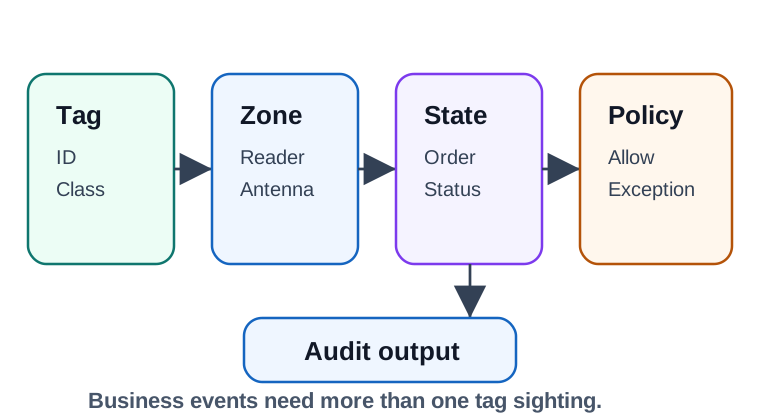
Raw reads are noisy.

  • Useful systems create an evidence record that explains why a business event was accepted, denied, or sent to exception handling.
  • The remaining question is: Business events need more than one tag sighting.
  • Tag evidence.: Capture the tag identifier, expected item class, encoding format, and whether the tag was expected in this workflow.

Key terms

Serialization
Serialization is what lets a system follow one unit through packing, receiving, movement, sale, quarantine, or return.
RFID industry evidence record showing tag identity, read zone, antenna evidence, object state, policy decision, exception path, and audit output.
iotclass.org

Major section

EPC Identity Schemes and Where They Fit · EPCIS Events for Provenance and Recall
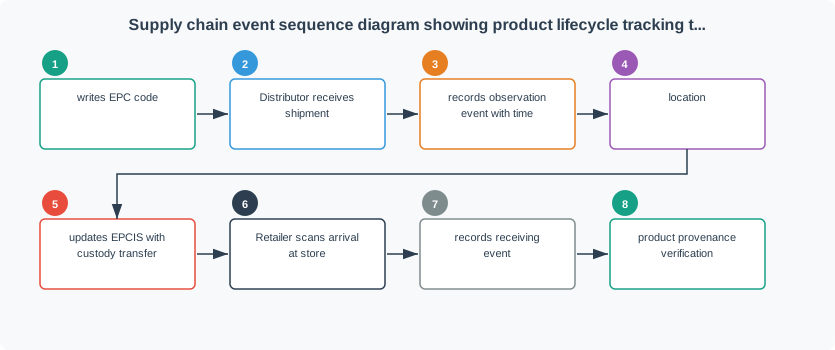
Choosing the scheme is choosing what the tag means.

  • The pallet or mixed load should use an SSCC because it is a logistics unit.
  • A reusable insulated tote should use a GRAI or GIAI-style asset identity because it is tracked across trips.

Key terms

If the pallet
If the pallet is broken down, a new aggregation or disaggregation event records which cases left the pallet.

Why it matters

In the distributor example, a case tag should use an SGTIN because the case is a trade item.

RFID supply-chain EPCIS event sequence from EPC writing through custody transfer to retailer provenance check
iotclass.org

Major section

Logistics, Receiving, and Shipping · Healthcare and Life-Science Workflows

Asset location is different from patient care authorization.

  • Logistics deployments use dock portals, conveyor readers, forklift readers, handheld audits, and sometimes vehicle-mounted readers.
  • The hard part is not seeing a tag once; it is deciding which business event the read proves.
  • A cabinet read is different from medication administration approval.
iotclass.org

Major section

Library and Media

Library and media workflows use RFID to make checkout, return, shelf audit, and anti-theft review faster, but the tag read still needs circulation state.

  • Returned items may be damaged, reserved, or routed to another branch.
  • Shelf scans may see nearby carts or patron-handled items.
  • A reviewable design records item identity, station type, return routing, anti-theft state, damaged-item handling, and privacy-retention rules before it updates a catalog or audit record.
iotclass.org

Major section

Access, Cabinets, and Controlled Assets · Cold-Chain, Field Service, and Maintenance

Access cards, cabinets, tool cribs, and controlled storage use RFID as an identity or object-selection input.

  • The tag read should be checked against user role, item status, time, location, supervisor rules, and return requirements.
  • For sensitive assets, a UID or static tag value is not enough authority by itself.
  • The controller should decide what can be opened, removed, issued, returned, or denied.
iotclass.org

Major section

Review Record · Review Decision

The dashboard can be shared, but the evidence model should not be identical for every industry pattern.

  • Receiving can accept a portal event only after zone and direction checks.
  • WIP should require route and quality state.
  • Healthcare assets need cleaning, maintenance, and patient-safety boundaries.
  • Tool control needs issue and return policy.
iotclass.org

Major section

Rollout Validation · Common Pitfalls

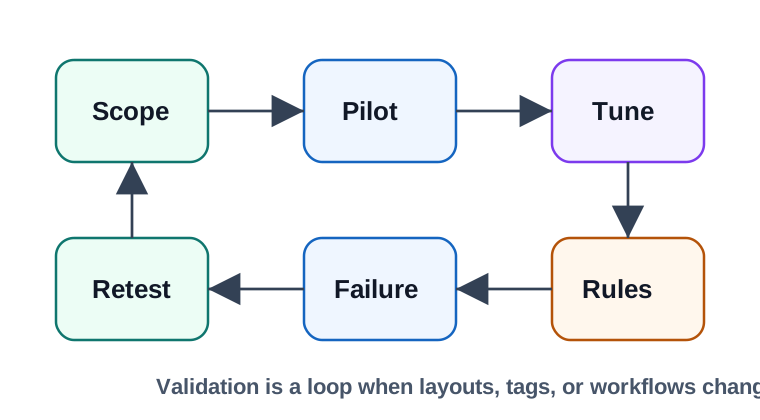
Scope the event.: Define exactly what each read is allowed to prove and what it cannot prove.

  • Validate middleware.: Test duplicate filtering, direction logic, expected-state validation, exception routing, and reconciliation reports.
  • Counting reads as truth too early.: Raw tag sightings need zone, state, and duplicate filtering before they become inventory, movement, or custody events.
RFID industry rollout validation loop showing scope, pilot, RF tuning, middleware rules, exception rehearsal, evidence review, and retest.
iotclass.org

Major section

Summary · Key Takeaway

RFID industry applications differ by event, read zone, material, workflow state, and evidence requirement.

  • Retail, manufacturing, logistics, healthcare, access, cold-chain, and maintenance patterns need different tag and reader choices.
  • Middleware should filter duplicates, validate zones, check expected state, and route exceptions before updating systems of record.
  • Privacy, safety, fallback, rollout validation, and retest triggers are part of the design, not afterthoughts.
iotclass.org

Deck summary

Key takeaways

Each application has its own denominator for success.

  • RFID works best when the read event matches the operational question.
  • To place application pattern map on firm evidence, inspect how: Item count relates to: Transfer in it.: Condition identifies the later check.
  • Shelf or bin read.: Useful for item presence and replenishment, but it needs shielding, zone tuning, and rules for nearby items.
  • Raw reads are noisy.
iotclass.org

Retrieval practice

Recall check 1 of 3

Radio Remi says: answer from memory, then check your reasoning.

Q1Why is 'RFID industry applications' not one generic tracking problem?

ABecause each industry is legally required to use a completely different radio band.
BBecause RFID tags are prohibited outright in most of these industries.
CBecause reader coordination sets a separate schedule for each industry's tags.
DEach industry needs different read zones and exception paths.
Show answer

Answer: D RFID applications differ by domain: read zones, tag forms, and exception paths vary across retail, logistics, healthcare, and cold-chain.

iotclass.org

Retrieval practice

Recall check 2 of 3

Radio Remi says: answer from memory, then check your reasoning.

Q2A retailer wants to trace an individual contaminated unit back through distribution for a recall. Why is an RFID EPC SGTIN with EPCIS events decisive where a barcode GTIN is not?

ASGTIN serializes each unit; EPCIS records what, when, where, and why per EPC.
BThe barcode GTIN already uniquely identifies each physical unit, so RFID only adds read speed.
CEPCIS stores the raw RSSI of every read, which is what actually enables tracing.
DThe TID bank holds the full recall history directly on the tag itself.
Show answer

Answer: A SGTIN serializes each item beyond the class-level GTIN, and EPCIS captures what, when, where, and why events per EPC, enabling precise per-unit track-and-trace and recalls.

iotclass.org

Retrieval practice

Recall check 3 of 3

Radio Remi says: answer from memory, then check your reasoning.

Q3A receiving dock portal reads a UHF tag on a case as a forklift passes nearby. Which design keeps the industry application boundary correct?

AMatch the tag ID to an expected shipment and mark it received when the portal reports it.
BCombine tag ID with zone, direction, expected state, duplicate filtering, and exceptions.
CUse only handheld reads, because fixed dock portals cannot produce reliable evidence.
DWrite the received status directly to the tag so backend systems need no reconciliation.
Show answer

Answer: B RFID industry deployments succeed when a raw read is validated against zone, direction, expected state, policy, and exception handling before it becomes an operational event.

iotclass.org

Print reference

Answers

Answer key.

  1. D · RFID applications differ by domain: read zones, tag forms, and exception paths vary across retail, logistics, healthcare, and cold-chain.
  2. A · SGTIN serializes each item beyond the class-level GTIN, and EPCIS captures what, when, where, and why events per EPC, enabling precise per-unit track-and-trace and recalls.
  3. B · RFID industry deployments succeed when a raw read is validated against zone, direction, expected state, policy, and exception handling before it becomes an operational event.
iotclass.org