RFID, NFC & UWB · Study deck
RFID Integration: Antennas and Event Pipelines
LLRP is a protocol by which a host sets up an RFID reader and receives its tag reports.
Radio Remi is your guide for this deck.

After studying this chapter
Learning objectives
You will be able to:
- Use LLRP operations and reports in a reader design.
- Assess antenna, power, and event-pipeline risks.
- Explain: The host installs a ROSpec, or reader operation spec, that describes which antennas to use, at what power, with what air-interface settings and start/stop triggers.
- Explain: Its worked 915 MHz point gives about 41.2 dB free-space path loss at 3 m and about −6.2 dBm at an isotropic receive point before material and orientation loss.
Major section
LLRP Carries Reader Operations and Reports
The host installs a ROSpec, or reader operation spec, that describes which antennas to use, at what power, with what air-interface settings and start/stop triggers.
- A GPIO trigger such as a photo-eye can start a read cycle so the reader only powers the field when there is something to inspect.
- That separation matters: declarative specs go down to the reader, tag reports come back up, and middleware decides which raw observations become business events.
- LLRP helps only if the integration preserves the evidence.
Major section
Antenna, Power, and Mounting
Its worked 915 MHz point gives about 41.2 dB free-space path loss at 3 m and about −6.2 dBm at an isotropic receive point before material and orientation loss.
- That estimate is a starting condition, not a pass result for the installed portal.
- The site record must show both intended reads and excluded reads.
Major section
Antenna, Power, and Mounting (continued)
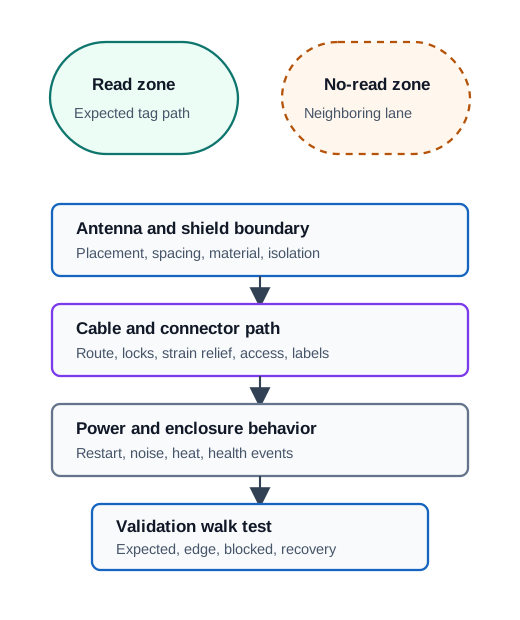
The field must cover intended tags while excluding neighbouring objects; the cable and power path must preserve that approved behaviour; and shielding, mounting surface, and enclosure determine whether the bench geometry survives installation.
- This order turns a vague “reader problem” into a controlled search across physical causes before software rules are changed.
- Cable and connector path: Capture cable length class, strain relief, connector locking, ground routing, and whether service access can disturb tuning or orientation.
- Shielding and mounting: Use shielding, spacers, or mounting changes when the read zone crosses a wall, shelf, lane, or neighboring enclosure.
Major section
Antenna, Power, and Mounting (continued)
Service replacement: Label antenna ports, reader identity, firmware/config version, and mounting orientation so a field replacement can reproduce the approved setup.
- The schematic still needs an installed reality check. Figure: A real portal-style RFID installation shows the kind of doorway hardware whose height, aim, cable route, and service access must match the recorded configuration.
- The installed portal in Figure: A real portal-style RFID installation shows how doorway antennas and cabling become one site boundary.
- The reader antennas sit on the doorway frame, while cables run to a wall-mounted enclosure.

Major section
Antenna, Power, and Mounting (continued)
RFID failures often look like software defects because the event stream is the first place the problem becomes visible.
- That placement creates an expected tag path through the opening and a neighboring area where an unintended read could occur.
- Cable locks, strain relief, labels, and service access affect whether the setup can be maintained after a fault.
- The photo shows a real installation form; its read accuracy and isolation must be measured at the site.
Major section
RF Margin and Self-Jamming Are Installed Risks
A monostatic UHF reader transmits and receives at the same time on the same frequency, so it is always listening through its own carrier.
- It uses a circulator or directional coupler to isolate the strong outgoing transmit path from the faint incoming backscatter, plus receiver cancellation to subtract its own leakage.
- A simple RF budget explains why an installation can pass on the bench and fail after mounting.
- At 3 m, free-space path loss is approximately 32.44 + 20log10(915) + 20log10(0.003) = 41.2 dB.
- The return path is harder because passive backscatter is a weak reflection.
Major section
Middleware Event Pipeline
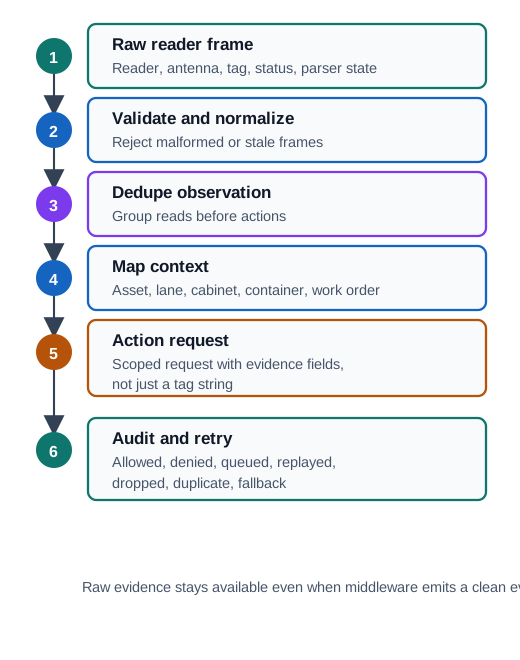
The next step keeps a repeat observation from causing a repeat act.
- Antenna context adds the zone, while the work map adds the asset or task.
- The path shows the chapter's core rule: a tag read becomes a decision only through clear handoffs that a reviewer can inspect.
Major section
Middleware Event Pipeline (continued)
Validation: Reject malformed frames, unknown readers, unexpected antenna ports, stale timestamps, and tag formats that do not match the workflow.
- A tag staying in the field should not create an unbounded stream of business events.
- Business mapping: Map tag references to assets, people, containers, or work orders only after the reader and antenna context is accepted.
- Action request: Send the application a scoped request with evidence fields, not only a tag string.
Major section
Validation and Release Evidence
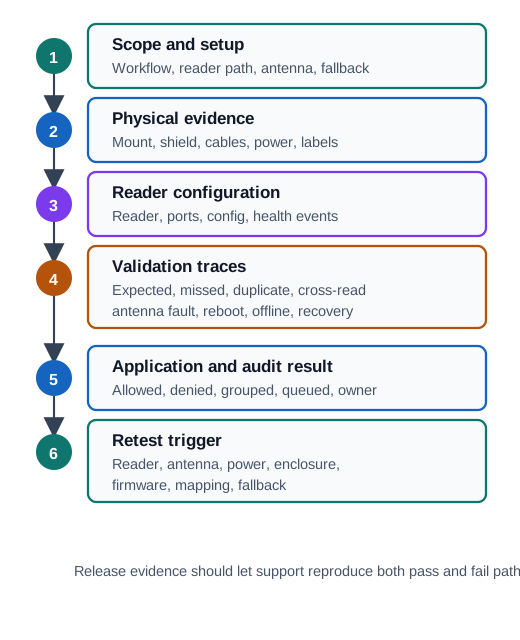
Finish with evidence that a second reviewer can reproduce.
- Scope states the work that the system must support.
- Site setup and reader settings make the RF test repeatable.
- Traces and fault tests show how a read became a result.
- Fallback and a named audit owner keep the service safe after release.
Major section
Common Pitfalls
Bench success treated as deployment success: A reader that works on a desk can fail after mounting, shielding, cable routing, or tag orientation changes.
- Letting duplicate reads create duplicate actions: Middleware should group repeated observations, and applications should make side effects idempotent.
- Ignoring reader health: A silent antenna disconnect, reboot, or host-link outage can look like normal low traffic unless health events are part of the contract.
- Skipping retest triggers: Reader replacement, antenna moves, firmware/config changes, middleware mappings, power changes, and enclosure changes can invalidate earlier evidence.
Major section
Checkpoint: Summary
RFID hardware integration should prove the whole chain from RF read to application action, not only that a tag can be scanned.
- Antenna placement, shielding, mounting, cable routing, and power behavior are part of the event contract.
- GPIO, serial, USB, Ethernet, and controller links differ in how much evidence and supervision they can carry.
- Middleware should preserve raw frames while producing deduplicated, auditable, scoped application events.
Deck summary
Key takeaways
The host installs a ROSpec, or reader operation spec, that describes which antennas to use, at what power, with what air-interface settings and start/stop triggers.
- Its worked 915 MHz point gives about 41.2 dB free-space path loss at 3 m and about −6.2 dBm at an isotropic receive point before material and orientation loss.
- The field must cover intended tags while excluding neighbouring objects; the cable and power path must preserve that approved behaviour; and shielding, mounting surface, and enclosure determine whether the bench geometry survives installation.
- The next step keeps a repeat observation from causing a repeat act.
Retrieval practice
Recall check 1 of 2

Radio Remi says: answer from memory, then check your reasoning.
Q1An RFID portal reports the same pallet tag several times while the pallet pauses in the read zone. What should the integration do before creating business actions?
Show answer
Answer: B RFID integrations should distinguish raw observations from business events.
Retrieval practice
Recall check 2 of 2
Radio Remi says: answer from memory, then check your reasoning.
Q2A UHF reader in a warehouse reports fewer tags as ambient RF noise rises. An integrator wants to trade some throughput for robustness. Which change targets the right layer?
Show answer
Answer: B Air-interface encoding governs read robustness versus speed, while LLRP is the separate host control and reporting plane.
Print reference
Answers
Answer key.
- B · RFID integrations should distinguish raw observations from business events.
- B · Air-interface encoding governs read robustness versus speed, while LLRP is the separate host control and reporting plane.