Wireless and Optical Sensing for IoT · Study deck
RF Localisation with RSSI, Time, Angle, UWB, and Sensor Fusion
Radio Remi must find a medicine cart on a busy hospital floor.
Radio Remi is your guide for this deck.
After studying this chapter
Learning objectives
You will be able to:
- Compare RSSI, fingerprinting, ToF, TDoA, AoA, and UWB by their measurement assumptions.
- Fuse a fixed RSSI training map with motion evidence and score held-out positions.
- Use median and p90 error to make a bounded deployment choice.
- Explain: The centre card applies a path-loss fit, fingerprint match, geometric solver, or fusion update.
Major section
Read the localisation evidence map
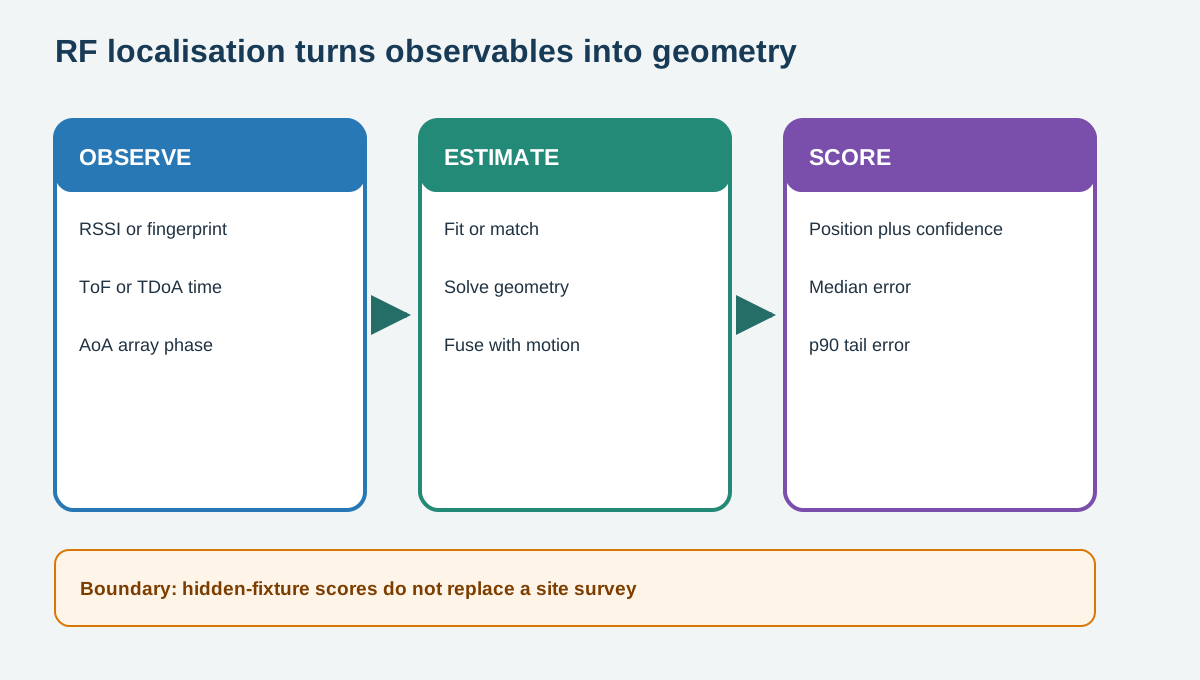
The centre card applies a path-loss fit, fingerprint match, geometric solver, or fusion update.
- The right card reports a position with confidence and error percentiles.
- The red boundary under the cards reminds us that a map and a notebook do not prove performance in another building.
Major section
Fuse without hiding drift
A motion estimate can predict where a handset moved between radio observations.
- Fusion works only when coordinate frames, timestamps, units, and uncertainty agree.
- A smooth track may still be wrong if both inputs share a bias.
- A measurement update should shrink uncertainty only as far as its calibrated error model allows.
Major section
Score a hidden path
Euclidean position error is the distance between a predicted point and its held-out reference.
- The median describes a typical test point, while p90 exposes the long tail that affects alarms and hand-offs.
- A fixed training set and a separate deterministic test path prevent the learner from tuning directly on every answer.
- These scores validate the supplied fixture only; a site survey must repeat them with measured anchors and real movement.
Major section
Plan the anchor geometry
Anchor placement determines which directions and distances the measurements can constrain.
- A survey record should preserve anchor coordinates, mounting height, clock role, antenna orientation, and any blocked region.
- Coverage also needs redundant observations where the system makes an important hand-off or alarm.
- Maintenance checks must detect a moved anchor before its bias silently shifts every reported position.
Major section
Summary
Fusion can reduce gaps, but it cannot erase shared bias or missing calibration.
- The useful result is a location estimate whose frame, calibration, and tail error remain attached.
- Those details make the estimate reproducible and reveal whether a method works across the whole test area or only near favourable anchors.
- Median and p90 error on a held-out path are stronger evidence than one best-case fix.
Deck summary
Key takeaways
The centre card applies a path-loss fit, fingerprint match, geometric solver, or fusion update.
- A motion estimate can predict where a handset moved between radio observations.
- Euclidean position error is the distance between a predicted point and its held-out reference.
- Anchor placement determines which directions and distances the measurements can constrain.
- Fusion can reduce gaps, but it cannot erase shared bias or missing calibration.
Retrieval practice
Recall check

Radio Remi says: answer from memory, then check your reasoning.
Q1Why report p90 position error beside the median?
Show answer
Answer: A It exposes the worse tail that a typical error can hide.
Q2Which method most directly depends on synchronized anchor clocks?
Show answer
Answer: A Time difference of arrival.
Print reference
Answers
Answer key.
- A · It exposes the worse tail that a typical error can hide.
- A · Time difference of arrival.