Transport Protocols · Study deck
Transport Error Handling
Picture a remote pump that receives a start command just as its link drops.
Packet Pete is your guide for this deck.

After studying this chapter
Learning objectives
You will be able to:
- Explain: A weak record only says "duplicate." A stronger record shows the previous accepted state, whether the duplicate changed state, whether an acknowledgement was sent, and what condition would reopen sequence-handling review.
- Explain: This order matters because a retry or reset is not itself success; the loop closes only when the system exposes what state remains and what change would invalidate the conclusion.
- Explain: Keeping those fields together prevents a timeout counter or reset log from masquerading as complete recovery proof and connects the practitioner record to the chapter's state-machine contract.
Major section
Start With One Error State
The control screen retries, but the operator cannot tell whether the first command ran.
- A blind retry could start the pump twice, while silence could leave it stopped.
- An actuator is a part that turns a command into physical action.
- A gateway is the device that joins the pump network to another network.
Major section
Start With One Error State (continued)
This first exercise does not remove every source of failure.
- Devices and links can fail in combinations.
- The deeper sections show how detection, backoff, duplicate control, checks, and recovery records support a defensible error-handling plan.
- Once the state is named, recovery can be reviewed as a bounded contract with evidence, owner, and retest trigger.
Major section
Overview: Reliable Error Handling Leaves a Bounded State
Transport reliability is not the absence of errors.
- Links drop frames, acknowledgements are missed, duplicate messages arrive, checksums fail, sessions expire, and gateways restart.
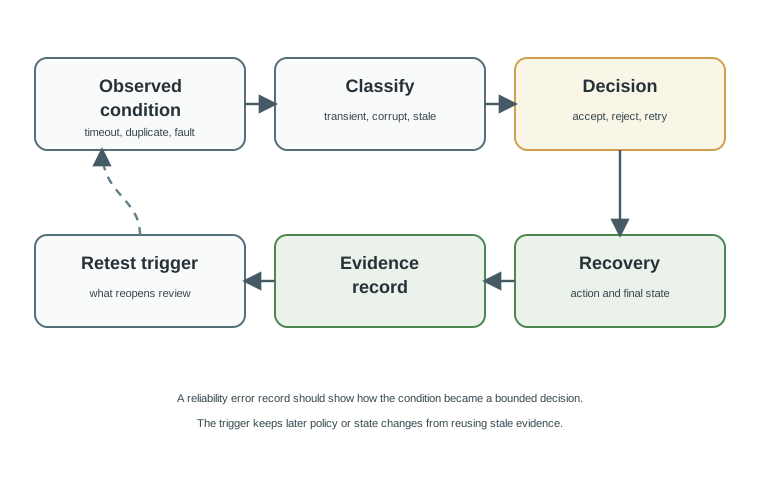
- Reliable handling means the system detects the condition, classifies it, takes a bounded action, and leaves evidence of the final state.
- The same record should also state the non-claim.
Major section
Overview: Reliable Error Handling Leaves a Bounded State (continued)
For example, gateway-west sends close command C-841 to actuator-17 and expects an acknowledgement before the command window closes.
- If the first response is missing, the record should show whether the gateway retried, how long it waited, and what happened after the final attempt.
- The system may accept, reject, retry, hold, reset, reconnect, report, or fail safe.
- Timeout value, retry count, final state, and escalation or fail-safe rule.
Major section
Overview: Reliable Error Handling Leaves a Bounded State (continued)
A bounded outcome might be: two retries with backoff, command marked unresolved, valve state left at last-confirmed open, operator alarm raised, and later duplicate acknowledgements ignored unless they match the active command id.
- This order matters because a retry or reset is not itself success; the loop closes only when the system exposes what state remains and what change would invalidate the conclusion.
- BoundName the stopping condition, final state, owner, and retest trigger so recovery behavior does not become an unbounded loop.
- Discarding duplicates without proving state was not changed.
Major section
Practitioner: Build a Decision Record for Each Error Path
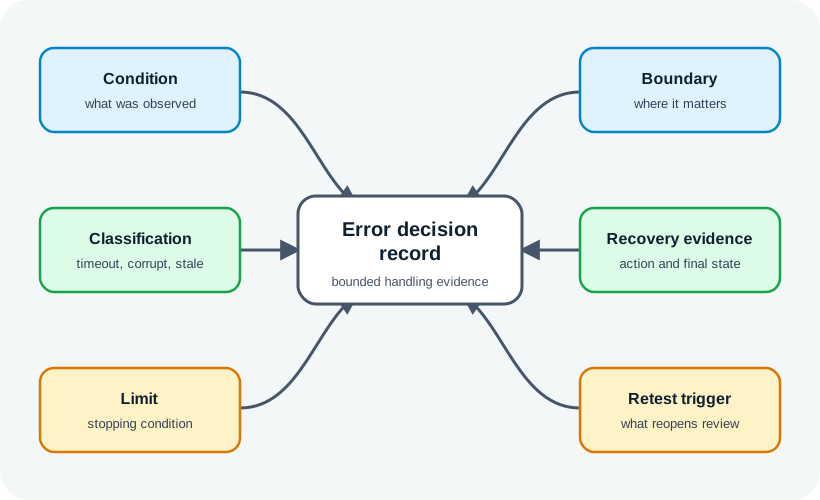
The goal is to show why the system did what it did and what state remains afterward.
- A packet capture, gateway log, queue event, device state sample, and operator alarm may each answer a different part of the same recovery decision.
- The specific event and where it was observed.
- The loop needs a durable record when different logs and state observations contribute to one decision.
Major section
Practitioner: Build a Decision Record for Each Error Path (continued)
Duplicate Message ExampleA gateway receives a message with a sequence value that was already accepted.
- Separates a real condition from a guessed cause.
- Gateway did not receive ACK within the command response window.
- Different classifications need different recovery behavior.
- Transient timeout until retry limit; persistent after limit.
Major section
Practitioner: Build a Decision Record for Each Error Path (continued)
Bounds retry storms and state churn.
- Actuator state remains last-confirmed closed until fresh acknowledgement arrives.
- A weak record only says "duplicate." A stronger record shows the previous accepted state, whether the duplicate changed state, whether an acknowledgement was sent, and what condition would reopen sequence-handling review.
- Keeping those fields together prevents a timeout counter or reset log from masquerading as complete recovery proof and connects the practitioner record to the chapter's state-machine contract.
Major section
Under the Hood: Error Handling Is a State-Machine Contract
Under the hood, transport error handling is a state transition contract.
- A message may move from pending to acknowledged, timed out, retried, rejected, unresolved, or failed safe.
- A connection may move from open to suspect, reconnecting, resumed, or closed.
- The reliability question is whether those transitions are explicit, bounded, and observable.
Major section
Under the Hood: Error Handling Is a State-Machine Contract (continued)
A timeout guard might move a command from pending to retrying only while the retry budget remains.
- TCP may report connection failure or reset.
- UDP may expose no delivery signal unless the application adds one.
- The review record should match the actual signals available at that boundary.
Major section
Under the Hood: Error Handling Is a State-Machine Contract (continued)
The state-machine contract should name guards and side effects, not just states.
- The final timeout might move it to unresolved, emit an alarm, preserve last-confirmed state, and reject late acknowledgements that no longer match the active command.
- Without those guards, a diagram can look tidy while the implementation still accepts stale, duplicated, or out-of-order recovery events.
- Deadline, retry schedule, final state, and alert or hold rule.
Major section
Under the Hood: Error Handling Is a State-Machine Contract (continued)
Session or connection state is rebuilt after suspected failure.
- Input is corrupt, stale, reordered, unauthorized, or missing evidence.
- IdempotencyRepeated delivery must not create repeated physical action unless the command was designed for that behavior.
- OrderingLate or reordered messages need sequence, timestamp, or state evidence before they are accepted.
Major section
Summary
Reliability error handling starts from an observable condition, not a guessed cause.
- Reliable handling means more than noticing an error or attempting a retry.
- The summary below connects timeout, duplicate, corrupt-input, reconnect, and fail-safe behavior through that same state-machine contract.
- A reviewable record names the affected boundary, classification, decision, limit, recovery evidence, final state, owner, and retest trigger.
Major section
Summary (continued)
One observed recovery proves the configured path under the recorded condition; it does not establish a permanent root cause or guarantee every future link.
- That discipline is why limits, final state, operator visibility, and retest ownership belong beside the technical mechanism in the closing record.
- Duplicate, stale, reordered, corrupt, and timed-out inputs must not change state silently.
- Transport protocol choice affects which signals are available, but application state handling still needs proof.
Deck summary
Key takeaways
The control screen retries, but the operator cannot tell whether the first command ran.
- This first exercise does not remove every source of failure.
- Transport reliability is not the absence of errors.
- For example, gateway-west sends close command C-841 to actuator-17 and expects an acknowledgement before the command window closes.
- A bounded outcome might be: two retries with backoff, command marked unresolved, valve state left at last-confirmed open, operator alarm raised, and later duplicate acknowledgements ignored unless they match the active command id.
Retrieval practice
Recall check 1 of 3

Packet Pete says: answer from memory, then check your reasoning.
Q1A command path times out waiting for an acknowledgement. The record shows repeated retries, but no retry limit or final state. What is the strongest review feedback?
Show answer
Answer: A An error-handling record needs the condition, bounded action, final state, and retest trigger.
Retrieval practice
Recall check 2 of 3
Packet Pete says: answer from memory, then check your reasoning.
Q2A gateway receives a duplicate sensor message with an already accepted sequence number. Which record is strongest?
Show answer
Answer: B Duplicate-message review must show classification, state protection, acknowledgement behavior, and retest conditions.
Retrieval practice
Recall check 3 of 3
Packet Pete says: answer from memory, then check your reasoning.
Q3Which evidence best supports accepting a transport error-handling design for production?
Show answer
Answer: C Transport error handling is production-ready when abnormal conditions map to bounded, observable state transitions.
Print reference
Answers
Answer key.
- A · An error-handling record needs the condition, bounded action, final state, and retest trigger.
- B · Duplicate-message review must show classification, state protection, acknowledgement behavior, and retest conditions.
- C · Transport error handling is production-ready when abnormal conditions map to bounded, observable state transitions.