Application Protocols · Study deck
Realtime Protocols: Messaging Foundations
A realtime protocol carries updates soon enough for the task.
Broker Bex is your guide for this deck.

After studying this chapter
Learning objectives
You will be able to:
- Explain what realtime means for application protocols in IoT media and control paths.
- Distinguish media transport, session signaling, stream control, browser transport, and event updates.
- Compare RTP, RTCP, SIP, SRTP, RTSP, WebRTC, and WebSocket by role.
- Decide when messaging protocols should remain separate from media-session protocols.
Major section
In 60 Seconds
Realtime application protocols are used when the timing of a message matters as much as the message itself.
- RTP carries media frames and uses sequence numbers and timestamps so receivers can handle loss, reordering, and jitter.
- RTCP reports stream quality.
- SIP sets up and ends sessions.
- SRTP protects media.
Major section
Key Concepts
A late media frame can be less useful than the next fresh frame.
- Session Control Is Separate.
- Signaling protocols set up who talks, which media is used, and when a session starts or ends.
- Media Transport Is Continuous.
- Media transport carries timed audio, video, or sensor streams with sequence and timestamp context.
Major section
What Realtime Means Here
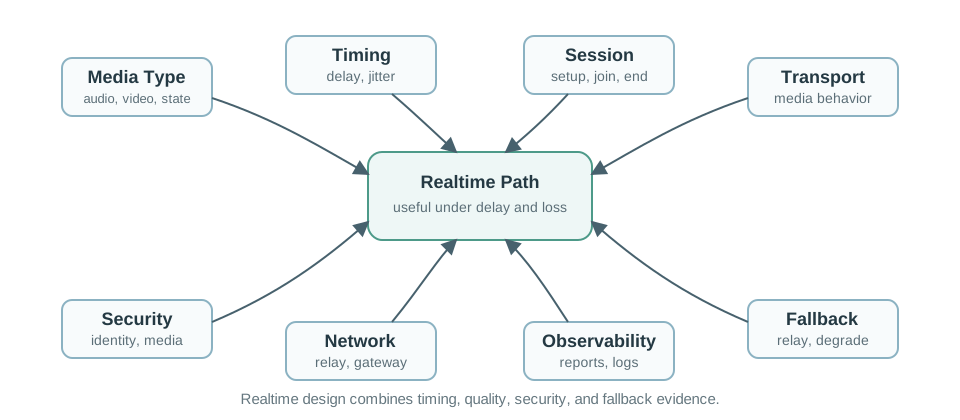
Realtime does not mean every message is instant or guaranteed.
- In application-protocol design, realtime means the system has a timing target and must keep media, interaction, or live state useful while the network changes.
Major section
Realtime Protocol Roles
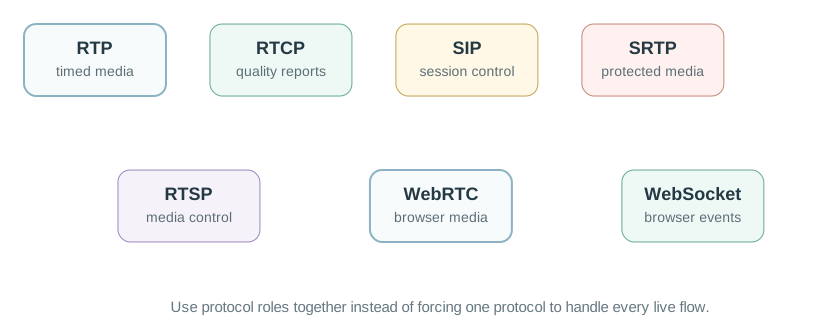
The protocol names are easier to use when their roles are separated.
- One IoT product may use several of them in the same workflow.
- SIP or WebRTC signaling establishes the session; RTP carries timed media; RTCP reports how that delivery is behaving; and SRTP protects the media packets.
- This role split becomes the vocabulary for the hybrid workflow below.
Major section
Messaging and Realtime Together
MQTT, CoAP, HTTP, AMQP, RTP, SIP, and WebRTC should not be forced into one role.
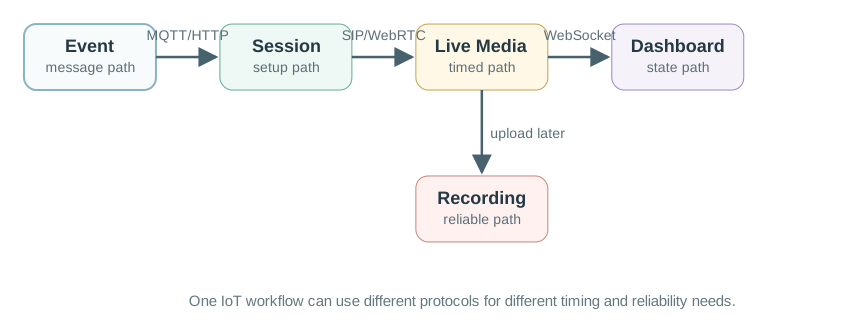
- A door station, operations panel, or camera can use message protocols for events and realtime protocols for live interaction.
- That separation prevents a convenience protocol from silently inheriting responsibilities it was not chosen to meet.
- INVITE starts a media session.
Major section
Messaging and Realtime Together (continued)
MQTT, AMQP, or HTTP can announce the event without carrying the call; SIP or WebRTC coordinates participants and route; SRTP carries the time-sensitive audio or video.
- The PSTN is the traditional circuit-switched phone network.
- Implementation examples make the same split easier to inspect.
- The method names are a useful checklist during troubleshooting.
Major section
Messaging and Realtime Together (continued)
A hands-on softphone exercise should make those responsibilities visible in settings, not only in source code.
- VoIP carries voice over IP networks instead, usually with SIP or another signaling path to set up the session and RTP or SRTP to carry media.
- An analog telephone adapter, or ATA, is the bridge box that lets an analog handset or fax device join that IP workflow.
- CANCEL stops a pending request.
Major section
Messaging and Realtime Together (continued)
Peer-to-peer calling systems can also route media or discovery through other clients, so the design record should say when traffic is direct, relayed, or service-mediated.
- Legacy Android SIP examples use SipProfile.Builder, SipManager, SipAudioCall, and SipSession; Android deprecated these APIs in API level 31 and says they should not be the basis of future VoIP apps.
- SIP can run over UDP, TCP, or SCTP; common deployments use port 5060 for SIP and port 5061 for SIP over TLS.
- The voice or video stream still belongs on RTP or SRTP after the session has been negotiated.
Major section
Messaging and Realtime Together (continued)
A user agent is the endpoint that sends requests and returns responses; in practice it may be an IP phone, a softphone, or a device gateway.
- A proxy server forwards requests on behalf of clients and can enforce routing, policy, and permissions while moving the request closer to the target user.
- A registrar accepts REGISTER requests and updates the location service that maps a user's SIP identity to the current reachable address.
- A session border controller sits at the boundary to control VoIP signaling during setup, teardown, and inter-domain traversal.

Deck summary
Key takeaways
Realtime application protocols are used when the timing of a message matters as much as the message itself.
- A late media frame can be less useful than the next fresh frame.
- Realtime does not mean every message is instant or guaranteed.
- The protocol names are easier to use when their roles are separated.
- MQTT, CoAP, HTTP, AMQP, RTP, SIP, and WebRTC should not be forced into one role.
Retrieval practice
Recall check 1 of 2
Broker Bex says: answer from memory, then check your reasoning.
Q1A door intercom team calls its dashboard realtime because it updates frequently. What should it define before selecting protocols?
Show answer
Answer: B Media, control, and live state tolerate delay and loss differently and need explicit constraints.
Q2A camera team needs reports about media reception quality. Which protocol role fits that task?
Show answer
Answer: D RTCP reports reception quality and stream health.
Retrieval practice
Recall check 2 of 2
Broker Bex says: answer from memory, then check your reasoning.
Q3A camera stream looks smooth during an idle demo. What evidence is still needed for a live service review?
Show answer
Answer: D A live path needs timing and failure evidence beyond an idle demo.
Print reference
Answers
Answer key.
- B · Media, control, and live state tolerate delay and loss differently and need explicit constraints.
- D · RTCP reports reception quality and stream health.
- D · A live path needs timing and failure evidence beyond an idle demo.