Prototyping · Study deck

Maintainable Firmware Practices

Imagine a second engineer taking over a sensor prototype.

Voltage Vera is your guide for this deck.

bestpractices
iotclass.org

After studying this chapter

Learning objectives

You will be able to:

  • Define firmware boundaries that make code easier to test, debug, update, and hand off.
  • Keep configuration, credentials, calibration, and environment-specific values reviewable without embedding site-specific values in source behavior.
  • Use non-blocking timing, bounded memory, explicit timeouts, watchdog-aware recovery, and local fallback states to reduce field failure risk.
  • Add observability that explains faults without changing the behavior under review.
iotclass.org

Major section

In 60 Seconds · Start With the Story

The device works today, but its settings, errors, and test history are hidden in the code.

  • Firmware means the software stored inside the device.
  • Maintainable firmware lets another person understand, test, and change that behavior.
  • Bound waits, memory use, and retries.
  • A clean style is not enough if the failure path stays hidden.

Key terms

Good practice
Good practice is visible in the behavior and record, not only in neat source code.
iotclass.org

Major section

Reviewable Firmware Behavior · Name Mechanism, Limit, Record
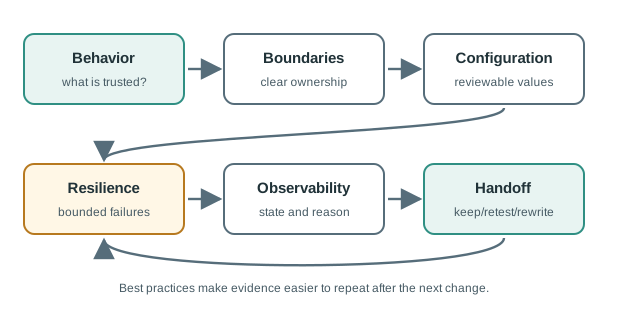
Responsibility boundaries make ownership visible; configuration separates reusable behavior from site-specific values; resilience defines what happens under faults; and observability exposes the state needed to judge the result.

  • The release handoff then records which of those claims were actually tested.
  • The review record should connect each practice to evidence.
  • This route is the chapter's running narrative: each practice matters because it makes one link in the evidence chain inspectable.

Why it matters

This route is the chapter's running narrative: each practice matters because it makes one link in the evidence chain inspectable.

Maintainable firmware practices keep prototype behavior reviewable by linking boundaries, configuration, resilience, observability, and handoff evidence.
iotclass.org

Major section

Silent Success Is Not Maintainable

A prototype that recovers silently can look stable while losing data, masking brownouts, skipping samples, overwriting flash, or hiding failed updates.

  • The goal is not to log everything; it is to expose the state that decides whether the behavior can be trusted.
  • A heap allocation that usually succeeds may fragment over a long run.
  • A retained queue that works during a short outage may wrap or corrupt records after a power loss.
iotclass.org

Major section

Silent Success Is Not Maintainable (continued)

A watchdog reset can restore the loop while erasing the reason it happened.

  • A debug build can meet the demo goal while a production logging level changes timing and current draw.
  • Maintainable firmware preserves the facts needed to separate a real fix from a hidden retry loop.
  • On an ESP32, that may include NVS keys, partition table, FreeRTOS stack high-water marks, and esp_reset_reason output.
iotclass.org

Major section

Silent Success Is Not Maintainable (continued)

On Nordic or STM32 targets, it may include retained RAM flags, watchdog cause, flash-log sequence numbers, and power-profile notes from a shunt or power profiler.

  • The firmware is maintainable enough for the next stage when its records let a reviewer reproduce the build, trigger the fault, inspect the state, and decide what must be checked again.
  • The under-the-hood rule is to preserve meaning when the device is unattended.
  • If a gateway outage, missing probe, queue overflow, update rollback, brownout, or configuration mismatch happens overnight, the next boot should still explain the boundary involved and the action taken.
iotclass.org

Major section

Responsibility Boundaries · Keep the Orchestrator Small
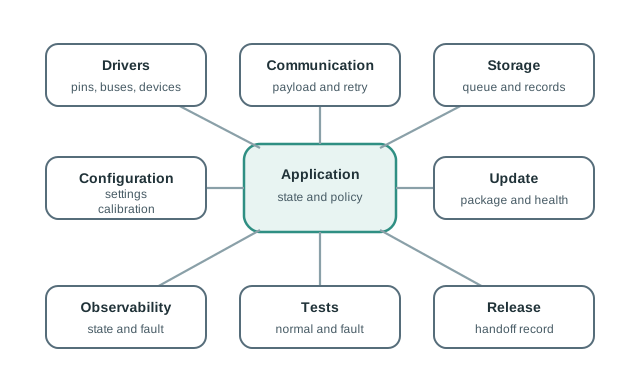
Firmware becomes fragile when every function knows about every device, state, queue, network, and setting.

  • A maintainable prototype gives each boundary a clear owner and a clear evidence path.
  • Configuration and update paths change behavior over time, while observability and tests supply the evidence needed to judge those changes.
  • Keeping the paths distinct lets a reviewer inject a fault or replace one implementation without silently changing unrelated policy.
  • It reports status and raw observations without owning product policy.
Firmware responsibility boundaries
iotclass.org

Major section

Configuration and Credential Boundaries · Resilience and Bounded Behavior
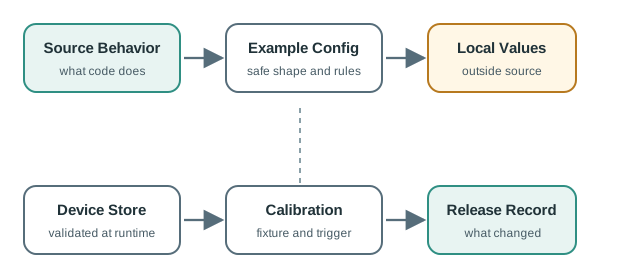
Prototype firmware should separate behavior from environment-specific values.

  • Device storage and calibration then need validation, ownership, and version information, and the release record captures exactly which profile was tested.
  • This boundary preserves the earlier responsibility split: firmware defines how values are used, but deployment evidence proves which values governed the observed behavior.
  • Feature flags are bounded: Flags include owner, default, reason, expiry or review date, and the evidence needed before the flag becomes normal behavior.

Why it matters

Non-blocking timing: Waiting should not prevent critical local sensing, control, update checks, health reporting, or user interaction.

Configuration and credential boundary
iotclass.org

Major section

Do Not Mask Faults With Recovery · Observability and Review Gates
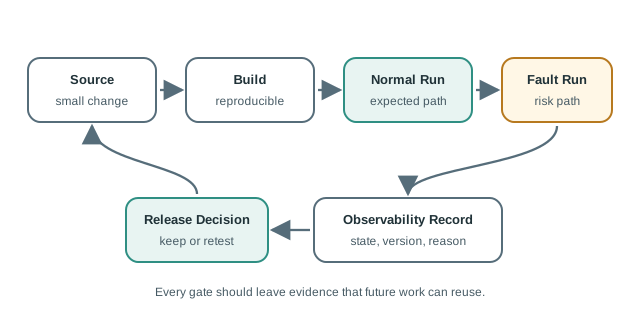
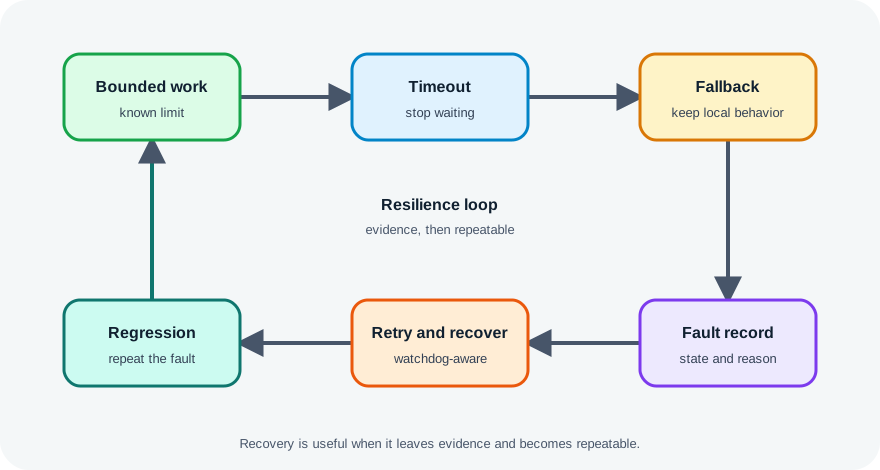
A retry, reset, or fallback is useful only when the device reports why it happened.

  • Silent recovery can make the demo look stable while hiding a pattern that will matter during a pilot.
  • Good observability is intentionally small.
  • It gives reviewers enough evidence to understand the state of the device, the last fault, and the current release without flooding storage, radio, or power budgets.
  • A reproducible build fixes the artifact under review; normal and fault tests then exercise both the intended path and the bounded failures described earlier.
Observability and review gates
iotclass.org

Major section

Power-Aware CI and Review Gate · Cold-Room Release Review
A prototype with a realistic current trace and an honest limitation note is more useful than one precise estimate copied from a datasheet.

  • A cold-room monitor prototype now has clear architecture boundaries, dependency records, test evidence, and OTA evidence.
  • Resilience review: Repeats gateway-unavailable, missing-probe, full-queue, and post-reset fault-record runs from the testing chapter.
  • Handoff review: States which firmware parts are fit for pilot, which are temporary prototype fixtures, and which must be rewritten before production work.
Firmware prototype resilience loop: bounded work, timeout, fallback, fault record, retry and recover, and regression keep recovery evidence repeatable.
iotclass.org

Major section

Release and Handoff Record · Try It: Set a Handoff Change Condition
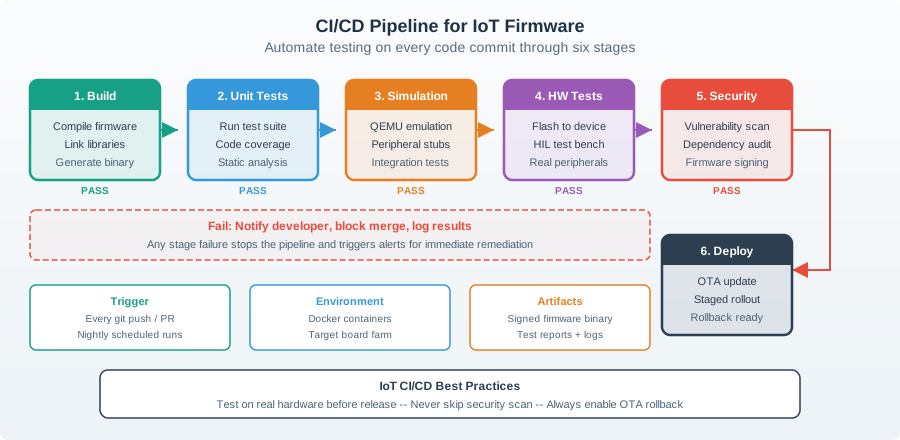
A model then tests the program with fake parts.

  • Packaging keeps those tested bytes and adds a manifest, digest, and signature link.
  • It must not rebuild them.
  • The release gate still checks board revision, setup, fault results, and rollout rules.

Why it matters

Any failed gate stops the build because an early software pass cannot replace proof from a later physical test.

The firmware pipeline accumulates increasingly physical evidence while preserving one identifiable candidate artifact.
iotclass.org

Major section

Common Failure Patterns

Best practices are treated as style only: The code looks neat, but there is no evidence for failure behavior, configuration changes, release decisions, or handoff risks.

  • Configuration is hidden in source behavior: Site-specific values, calibration, feature flags, and lab overrides are mixed into firmware logic where reviewers cannot separate them.
  • The team cannot explain how often the fault happened or whether it is getting worse.
  • One change touches everything: Sensor, network, storage, update, and display changes are mixed together, making testing and review too broad to trust.
iotclass.org

Deck summary

Key takeaways

The device works today, but its settings, errors, and test history are hidden in the code.

  • Responsibility boundaries make ownership visible; configuration separates reusable behavior from site-specific values; resilience defines what happens under faults; and observability exposes the state needed to judge the result.
  • A prototype that recovers silently can look stable while losing data, masking brownouts, skipping samples, overwriting flash, or hiding failed updates.
  • A watchdog reset can restore the loop while erasing the reason it happened.
  • On Nordic or STM32 targets, it may include retained RAM flags, watchdog cause, flash-log sequence numbers, and power-profile notes from a shunt or power profiler.
iotclass.org

Retrieval practice

Recall check 1 of 6

Voltage Vera says: answer from memory, then check your reasoning.

Q1A prototype has a site-specific calibration and a network credential. Which practice makes handoff reviewable?

AUse unlabelled site configuration and shared calibration and credential defaults.
BHard-code live credentials in source so the next builder can repeat the demo.
CKeep configuration outside source, show safe examples and scope secret access for handoff.
DHide calibration in a branch instead of documenting the site-specific scale.
Show answer

Answer: C Reviewers can see configuration boundaries without exposing credentials.

iotclass.org

Retrieval practice

Recall check 2 of 6

Voltage Vera says: answer from memory, then check your reasoning.

Q2Per this chapter's discussion of silent success, why is a watchdog reset that 'restores the loop' not by itself evidence that the firmware is healthy?

AEvery watchdog reset proves an unfixable hardware defect, so the repeated fault needs no firmware record.
BWatchdog reset guarantees queue and flash corruption even if no fault state was retained.
CThe chapter rejects watchdog timers altogether, so a restarted loop cannot be reviewed.
DA reset can erase its cause; loop resumption may hide recurring faults, not prove clean recovery.
Show answer

Answer: D see answers page

iotclass.org

Retrieval practice

Recall check 3 of 6

Voltage Vera says: answer from memory, then check your reasoning.

Q3Per this chapter's responsibility boundaries, which boundary 'reports status and raw observations without owning product policy'?

ADriver boundary for raw hardware status and observations.
BApplication state boundary for product behavior policy.
CObservability boundary for logs and performance reports.
DCommunication boundary for messages to other systems.
Show answer

Answer: A The chapter defines the driver boundary as: 'Owns pin, bus, sensor, actuator, and peripheral details.

iotclass.org

Retrieval practice

Recall check 4 of 6

Voltage Vera says: answer from memory, then check your reasoning.

Q4Per this chapter's 'Feature flags are bounded' configuration check, what should a feature flag's record include?

AOnly the flag's current on or off state, since that is all a reviewer needs.
BThe developer's personal notes about why the flag seemed like a good idea at the time.
COwner, default, reason, expiry or review date and evidence needed before normal use.
DA permanent commitment that the flag will never be removed once added.
Show answer

Answer: C The chapter's configuration checklist states: 'Feature flags are bounded: Flags include owner, default, reason, expiry or review date, and the evidence needed before the flag becomes normal behavior.' This keeps a flag from silently becoming permanent, unreviewed branching logic.

iotclass.org

Retrieval practice

Recall check 5 of 6

Voltage Vera says: answer from memory, then check your reasoning.

Q5A gateway client waits forever for a cloud reply while local control must continue. Which firmware change is strongest?

ABound cloud wait, record timeout and continue in safe local fallback on timeout.
BRetry without a stop rule until the cloud replies, starving local control.
CTurn off watchdog so an endless cloud wait cannot be interrupted.
DHide timeout records after recovery so repeated faults stay invisible.
Show answer

Answer: A Bounded timing and visible fallback protect local work.

iotclass.org

Retrieval practice

Recall check 6 of 6

Voltage Vera says: answer from memory, then check your reasoning.

Q6A prototype demo works, but the firmware has hidden configuration, unclear module boundaries, no fault records, and no repeatable release record. What is the best next review action?

AAccept the demo as pilot proof because successful normal-path behavior establishes the configuration and fault response.
BRewrite everything first, erasing current behavior evidence before review.
CDocument boundaries, config, resilience, observability and release evidence; rerun faults.
DAdd broad logs alone while delaying boundary and release decisions to pilot.
Show answer

Answer: C A maintainable prototype needs reviewable boundaries, configuration records, resilience evidence, observability, and a release handoff record.

iotclass.org

Print reference

Answers 1 of 2

Answer key.

  1. C · Reviewers can see configuration boundaries without exposing credentials.
  2. D · A watchdog reset can restore the loop while erasing the reason it happened.
  3. A · It reports status and raw observations without owning product policy.
iotclass.org

Print reference

Answers 2 of 2

Answer key.

  1. C · The chapter's configuration checklist states: 'Feature flags are bounded: Flags include owner, default, reason, expiry or review date, and the evidence needed before the flag becomes normal behavior.' This keeps a flag from silently becoming permanent, unreviewed branching logic.
  2. A · Bounded timing and visible fallback protect local work.
  3. C · A maintainable prototype needs reviewable boundaries, configuration records, resilience evidence, observability, and a release handoff record.
iotclass.org
