Prototyping · Study deck
Smart Home and Environmental Kits
A protocol is an agreed set of message rules.
Voltage Vera is your guide for this deck.
After studying this chapter
Learning objectives
You will be able to:
- Explain: Smart-home kits are useful when they expose the full control loop: request, accepted command, device action, confirmed state, manual override, delayed response, local fallback, and recovery after hub or network failure.
- Explain: A BME280 temperature reading beside a vent, an SCD41 carbon-dioxide reading during warm-up, or a DS18B20 water reading with a damaged cable can look precise while being operationally misleading.
- Explain: The kit choice is not a shopping comparison; it is a question about which path can produce reviewable evidence with timestamps, firmware versions, configuration files, and repeatable failure cases.
Major section
In 60 Seconds
For the monitor, name the measured fact, place, range, unit, comparison method, saved period, and person who acts.
- A protocol is an agreed set of message rules.
- A kit may bridge those rules, but the bridge still needs a named input, output, owner, and failure test.
- A quick kit proves learning and fit under stated conditions.
Major section
In 60 Seconds (continued)
It does not prove years of battery life, every home layout, outdoor exposure, final privacy practice, or safe control hardware.
- For the window, add travel, force, stop state, local override, blocked-path test, and the safe state after loss of power or contact.
- Any new case, placement, schedule, or user group can reopen the test.
- Under the Hood covers sensing error, control drive, radio choice, power rhythm, data boundaries, and the limits hidden by a polished demo.
Major section
Split State and Context
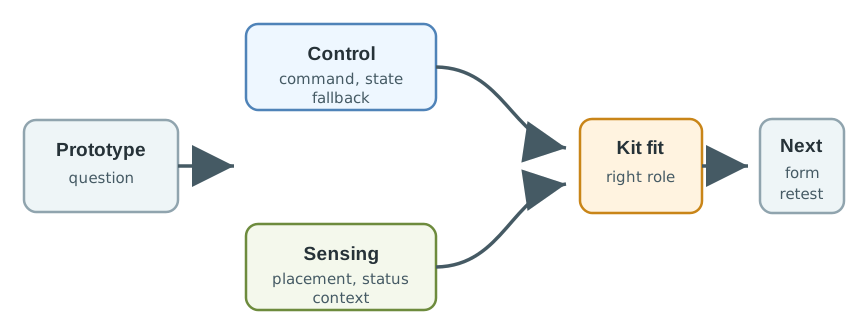
Smart-home kits are useful when they expose the full control loop: request, accepted command, device action, confirmed state, manual override, delayed response, local fallback, and recovery after hub or network failure.
- A button that toggles a demo lamp does not prove the product state contract.
- It proves that one path could send one command in one condition.
Major section
Split State and Context (continued)
A BME280 temperature reading beside a vent, an SCD41 carbon-dioxide reading during warm-up, or a DS18B20 water reading with a damaged cable can look precise while being operationally misleading.
- The kit should make that context visible before the team connects the value to an alert, dashboard color, or automatic action.
- The main review move is to keep control evidence and sensing evidence in separate lanes until both have been challenged.
- A hybrid classroom monitor, greenhouse controller, leak detector, or assisted-living comfort system may eventually combine command, occupancy, air-quality, water, temperature, and maintenance signals.
Major section
Test Protocol and Sensor Path
The kit choice is not a shopping comparison; it is a question about which path can produce reviewable evidence with timestamps, firmware versions, configuration files, and repeatable failure cases.
- A practical test script should exercise one control path and one sensing path under normal and degraded conditions.
- For control, send a command from the rule engine, from the dashboard, and from a physical input.
- The review record should also name the data and privacy boundary.
Major section
Ambiguous State Breaks Automation
The dangerous failure is not only a wrong reading or a missed command.
- The prototype should make uncertainty visible before it controls a device or sends a notification.
- A retained MQTT message can look like current state after a device is offline.
- Environmental readings have a similar hidden-state problem.
- It should also record safe defaults.
Major section
Ambiguous State Breaks Automation (continued)
A device-shadow value can describe the last reported state, the desired cloud state, or a pending delta depending on the platform.
- A sensor pipeline may carry raw counts, compensated readings, rolling averages, calibration coefficients, sample time, publish time, receive time, battery state, and quality flags.
- If the dashboard keeps the last good value without showing age and quality, an automation rule can ventilate, water, heat, alert, or suppress an alert for the wrong reason.
- These details keep the next form from inheriting a demo-only state model.
Major section
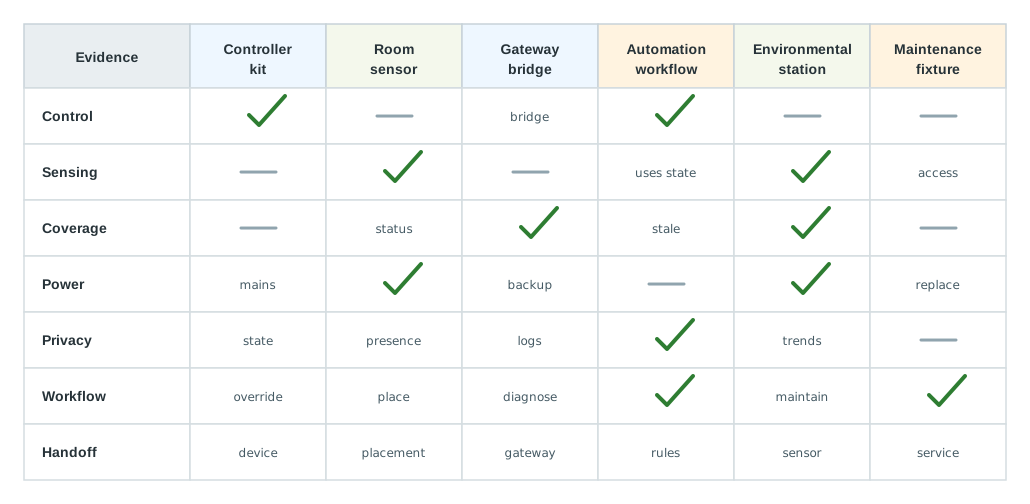
Kit Roles
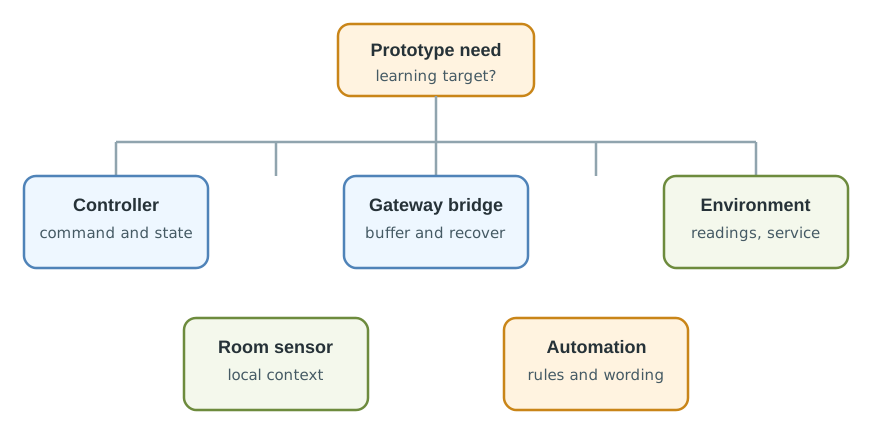
A lighting controller, room sensor node, gateway bridge, and outdoor monitor should not be compared only by feature count.
- They support different review questions.
- The classroom comfort monitor needs a room reading and a clear stale-status signal before it needs broader automation.
- the Roles of smart-home and environmental prototyping kits diagram selects a room-sensor kit for a classroom status question.
- A gateway may add buffering and stale flags, but its result must be tested during a gap or restart.
Major section
Classroom Comfort Monitor
A team is prototyping a classroom comfort monitor.
- The first version should observe room conditions, show stale status, and trigger a local alert when conditions need attention.
- Room sensor nodes are placed in representative positions away from drafts, vents, direct sunlight, and doors.
- A gateway bridge is placed where a real gateway might live.
Major section
Classroom Comfort Monitor (continued)
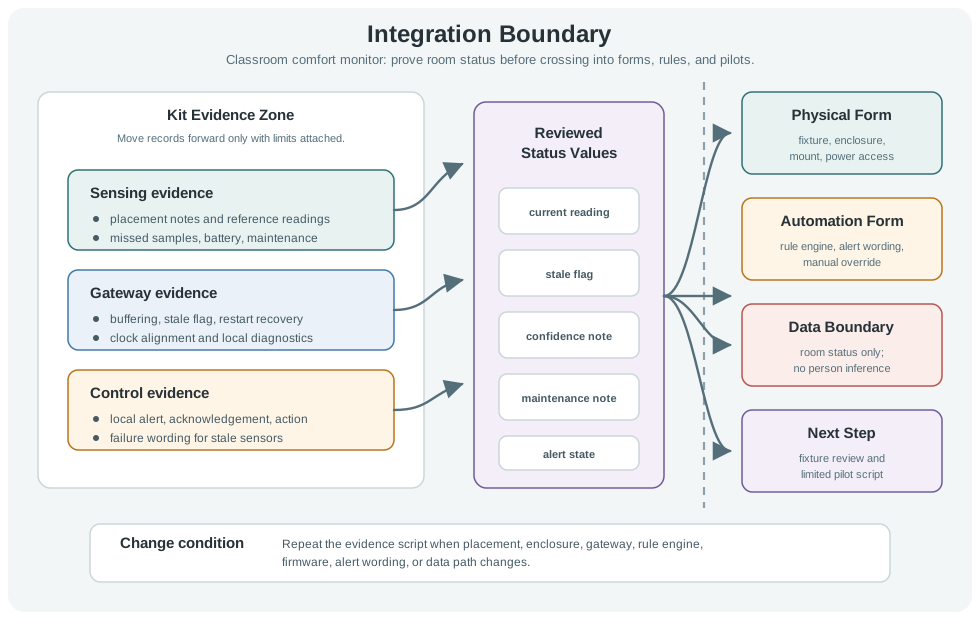
The team records placement notes, reference readings, warm-up behavior, missed samples, battery state, and maintenance access.
- The team records message buffering, stale-reading labels, restart recovery, clock alignment, and local diagnostics.
- The team records trigger thresholds, acknowledgement behavior, occupant wording, override, and recovery when the sensor is stale.
- Any later connection to a controller, dashboard, or building system must repeat the evidence script.
Major section
Integration Boundary
The classroom sensor node first records reading time, battery state, and a stale timestamp in a representative room position.
- Local alert rules need wording, acknowledgement, override, and a path for stale data.
- The integration review carries current reading, stale flag, confidence note, maintenance note, and alert state into automation.
- the Integration boundary for smart-home and environmental kit evidence diagram marks which classroom status evidence can cross into later forms.
- A mounted node, hub, dashboard, or building control still needs its own tests.
Major section
Kit Review Record
Leave a record that another reviewer can challenge.
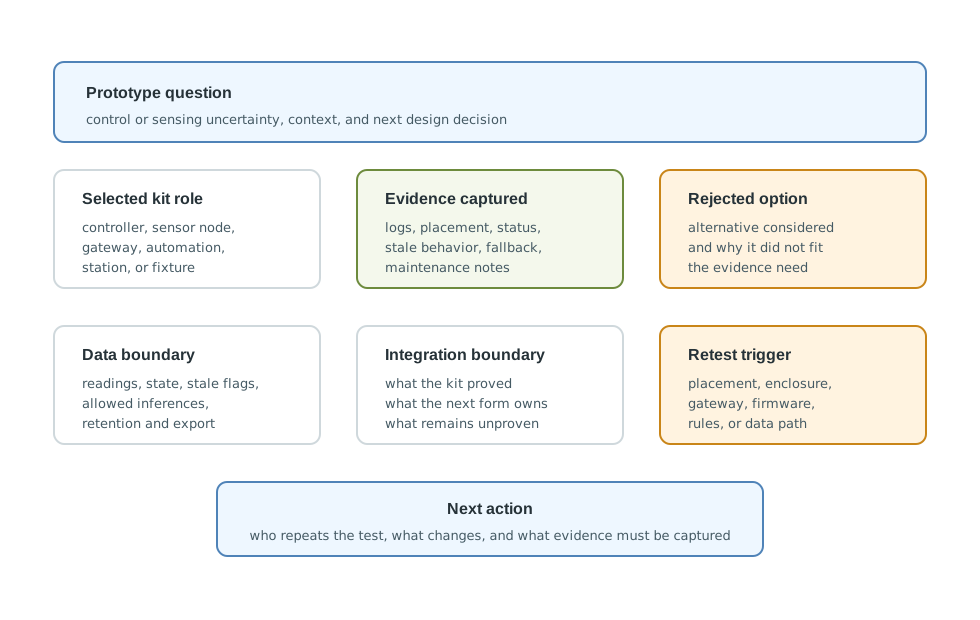
- A good record explains what the kit proved, what was rejected, what remains unproven, and when evidence must be repeated.
- It then keeps the observed logs, placement, stale state, and fallback beside the selected kit role.
- The record also preserves a rejected option and the reason its evidence did not fit.
Major section
Common Failure Patterns
Dashboard-first proof: The display looks complete but raw readings, stale status, control confirmation, and gateway recovery are unreviewed.
- Command-only control: The prototype sends a command but does not confirm state after delay, manual override, restart, or network loss.
- Context-free reading: The sensor value is shown without placement, reference, warm-up, calibration, or maintenance context.
- Hidden occupancy inference: The prototype collects presence or room activity signals without marking what inferences are allowed.
Deck summary
Key takeaways
For the monitor, name the measured fact, place, range, unit, comparison method, saved period, and person who acts.
- The chart may look convincing, but opening a window creates a physical action and a privacy question that the sensing demo did not settle.
- Smart-home kits are useful when they expose the full control loop: request, accepted command, device action, confirmed state, manual override, delayed response, local fallback, and recovery after hub or network failure.
- A BME280 temperature reading beside a vent, an SCD41 carbon-dioxide reading during warm-up, or a DS18B20 water reading with a damaged cable can look precise while being operationally misleading.
Retrieval practice
Recall check 1 of 4

Voltage Vera says: answer from memory, then check your reasoning.
Q1Per this chapter's 'Split State and Context' section, if a hybrid prototype's control stream is currently the weaker, unproven stream, what should the team prove first?
Show answer
Answer: C see answers page
Retrieval practice
Recall check 2 of 4
Voltage Vera says: answer from memory, then check your reasoning.
Q2Per this chapter's test-protocol guidance, after sending a control command from the rule engine, the dashboard, and a physical input, what should the test script do next to properly exercise the control path?
Show answer
Answer: A see answers page
Retrieval practice
Recall check 3 of 4
Voltage Vera says: answer from memory, then check your reasoning.
Q3Per this chapter's 'Ambiguous State Breaks Automation' section, what safe default does the chapter specify for a valve when water evidence is stale?
Show answer
Answer: C see answers page
Retrieval practice
Recall check 4 of 4
Voltage Vera says: answer from memory, then check your reasoning.
Q4A classroom comfort prototype needs room readings, stale-status labels, and a local alert. What is the strongest first review strategy?
Show answer
Answer: B Smart-home and environmental prototypes should stage evidence.
Print reference
Answers 1 of 3
Answer key.
- C · The chapter's review move is to keep control and sensing evidence in separate lanes and prove whichever stream is currently weak first: command acknowledgement, physical state, local override, and fallback for a weak control stream; placement, calibration, stale flags, power rhythm, and maintenance access for a weak sensing stream.
Print reference
Answers 2 of 3
Answer key.
- A · The chapter's practical test script for the control path has two stages: first send a command from the rule engine, dashboard, and a physical input while recording acknowledgement and actual device state; then restart the gateway, remove internet access, and toggle the local switch to confirm the state record still explains what changed.
Print reference
Answers 3 of 3
Answer key.
- C · The chapter's under-the-hood handoff guidance lists specific safe defaults per device type when state is ambiguous: valve fails closed or needs local confirmation when water evidence is stale, a door or lock preserves manual operation, HVAC/fan rules avoid acting on unexplained occupancy inference, and environmental alerts label stale data rather than silently clearing.
- B · Smart-home and environmental prototypes should stage evidence.