Prototyping · Study deck
Choosing a Prototyping Kit
Picture a team comparing three boards for a cold-room monitor.
Voltage Vera is your guide for this deck.
After studying this chapter
Learning objectives
You will be able to:
- Explain: A kit that shows a pretty dashboard but hides retry logs is weaker than a plainer kit that exposes raw readings, firmware version, configuration, and recovery states.
- Explain: It becomes risk when tutorial firmware, breadboard wiring, USB power, default credentials, vendor dashboards, auto-generated cloud topics, or board-specific libraries become hidden architecture decisions.
- Explain: The team rejects any option that cannot log raw readings, show stale-data status, expose retry behavior, support the intended sensor placement, or preserve configuration notes.
- Explain: Shopping-list review: The team compares features and accessories but never states the evidence gap.
Major section
In 60 Seconds
A good kit choice starts with the uncertainty the prototype must reduce.
- The board with the longest feature list may hide restart logs or make the final enclosure impossible.
- The first choice starts with one uncertainty the prototype must remove.
- Disconnect the sensor, interrupt power, delay the link, repeat an event, change the software version, and restart.
Major section
Kit Selection Removes Risk
A kit is the right choice only if it exposes the next uncertainty better than the alternatives.
- The decision should start with a sentence about the behavior, context, and next design form, then reject kits that cannot exercise that question under representative conditions.
- The selection record should be written before the team falls in love with a board.
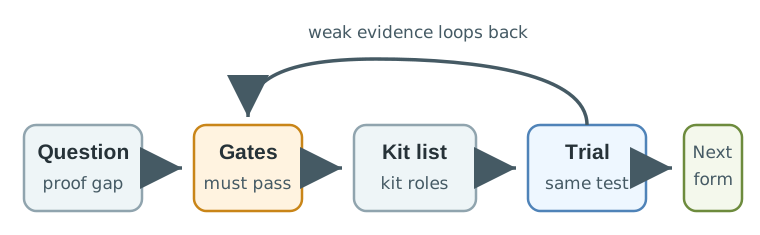
- In the Choose a prototyping kit by moving from the evidence question to hard gates, a shortlist, a shared evidence trial, and a next-form decision with weak evidence looping back diagram, The useful comparison is not Arduino versus Raspberry Pi versus ESP32 versus a vendor kit.
- The useful comparison is whether the candidate can show the measurement, message path, power state, physical fit, update route, and service behavior the next decision needs.
Major section
Kit Selection Removes Risk (continued)
If the question is a cold-room monitor, the evidence script might require DS18B20 or RTD readings, a door-event input, timestamped stale-data status, gateway restart recovery, and a staff-facing warning state.
- A kit that shows a pretty dashboard but hides retry logs is weaker than a plainer kit that exposes raw readings, firmware version, configuration, and recovery states.
- Selection also has a time horizon.
- A kit can be perfect for proving a measurement path and still be wrong for an enclosure, pilot, or product.
Major section
Early Convenience Costs Later
It becomes risk when tutorial firmware, breadboard wiring, USB power, default credentials, vendor dashboards, auto-generated cloud topics, or board-specific libraries become hidden architecture decisions.
- Firmware migration: separate application logic from board support package calls, sample credentials, blocking demo loops, cloud client code, and library-specific message schemas.
- The kit should leave raw samples, timestamps, configuration, calibration notes, status labels, failure events, firmware identifiers, and test conditions in a form another reviewer can inspect.
- The selection record should let a reviewer repeat the comparison, challenge the rejected options, and see exactly which checks must repeat after the kit is replaced.
Major section
Selection Gates
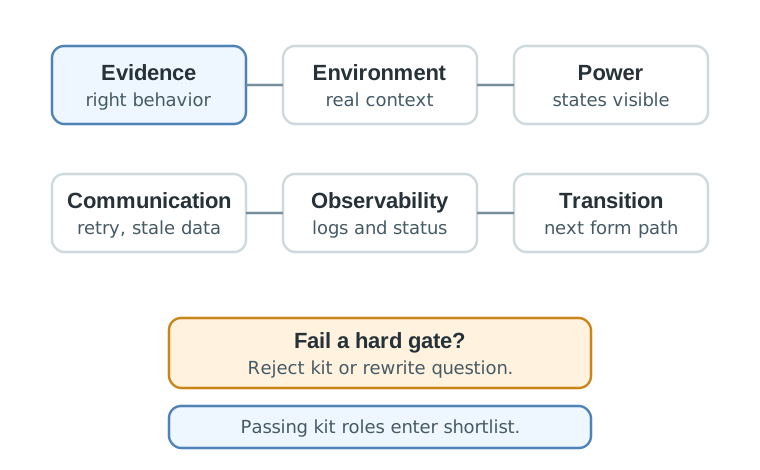
A kit that fails a hard gate should not remain in the shortlist, even if it is inexpensive, familiar, or popular.
- Communication requires loss and recovery traces: Observability requires states and error identity, and: Transition requires owners, known gaps, and a retest plan.
- Evidence fit: The kit can measure or exercise the behavior that matters to the next decision.
- the Six hard gates require evidence fit, environment, power, communication, observability, and transition proof before an IoT kit reaches comparative scoring diagram turns each hard gate into a question, a pass artifact, and a fail action.
- Any failure rejects the option or rewrites the experiment; six passes only earn a place on the shortlist.
Major section
Selection Gates (continued)
Environment fit: The kit can be tested in a realistic bench, room, vehicle, field, factory, body-worn, or outdoor context.
- Communication fit: The kit can expose link quality, retries, gateway behavior, stale data, and recovery rather than only a happy-path dashboard.
- Observability fit: The kit lets reviewers collect logs, status, timestamps, configuration, version, and failure notes without guessing.
- Transition fit: The kit does not hide assumptions that must later move to a board, enclosure, fixture, backend, or service workflow.
Major section
Score the Shortlist
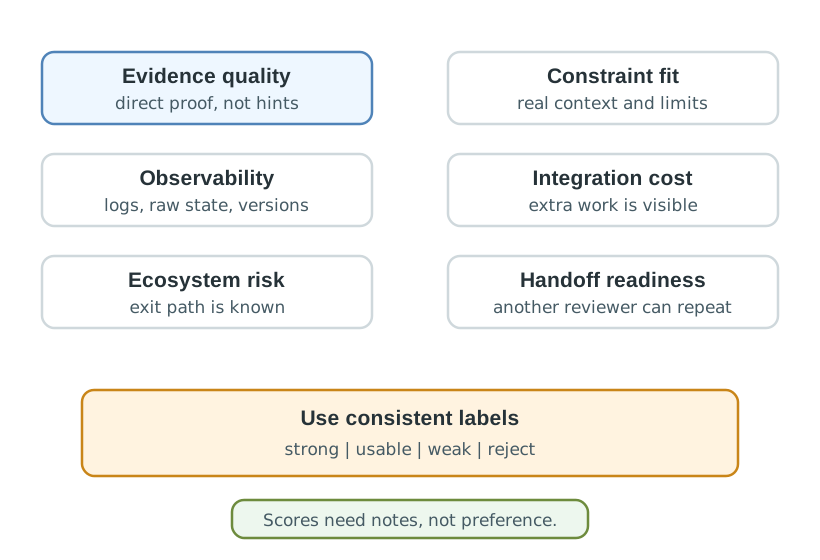
After hard gates, use a scorecard to compare the remaining options.
- Weighted numbers can be useful, but they should not pretend that unknowns are precise.
- the A worked qualitative scorecard compares controller and gateway kit roles while retaining the evidence behind every judgement diagram keeps the reason beside every qualitative judgement.
Major section
Lifecycle and Cost Shape
For selection review, the more useful question is the cost shape: where effort and risk will move as the prototype grows.
- Cheap hardware, expensive debugging: Loose parts may cost less but can create wiring, compatibility, documentation, and repeatability problems.
- Prototype cost, pilot cost, product cost: Do not collapse these into one number.
- A kit can be right for prototype evidence while still being wrong for a pilot or product form.
Major section
Cold-Room Kit Shortlist
A team is building a cold-room monitoring prototype.
- The first decision is not which kit is cheapest.
- The team needs evidence that temperature and door events can be captured, buffered during connectivity gaps, and reviewed by staff without hiding stale data.
- The team records raw readings, status labels, missed events, recovery behavior, wiring assumptions, and setup friction.
Major section
Cold-Room Kit Shortlist (continued)
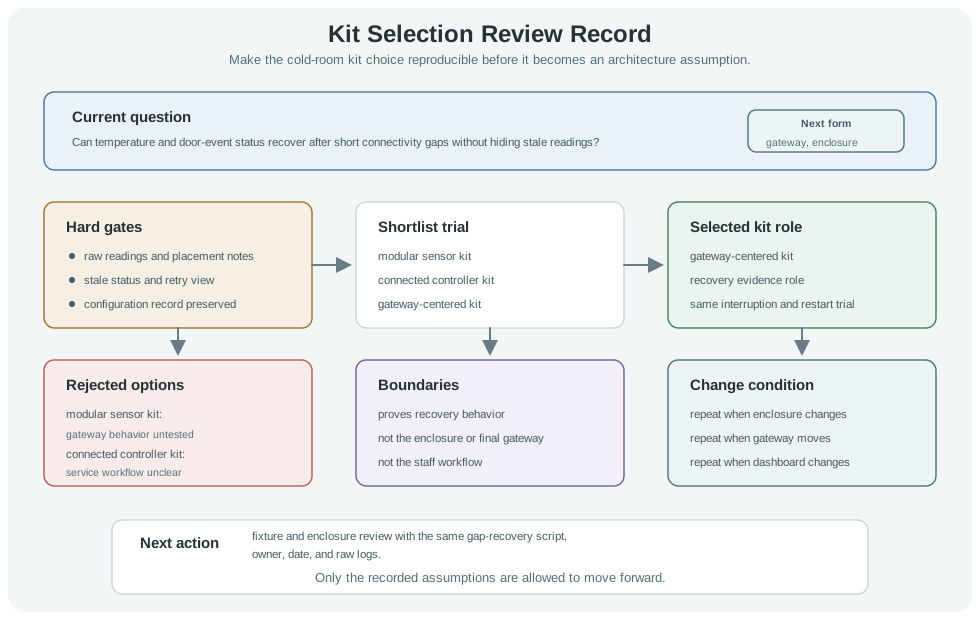
The team rejects any option that cannot log raw readings, show stale-data status, expose retry behavior, support the intended sensor placement, or preserve configuration notes.
- Each shortlisted kit is tested with the same room placement, door-event pattern, connectivity interruption, restart, and staff review task.
- The modular sensor kit gives fast measurement evidence but needs gateway work.
- The connected controller kit gives strong firmware visibility but needs a clearer service workflow.
Major section
Transition Boundary
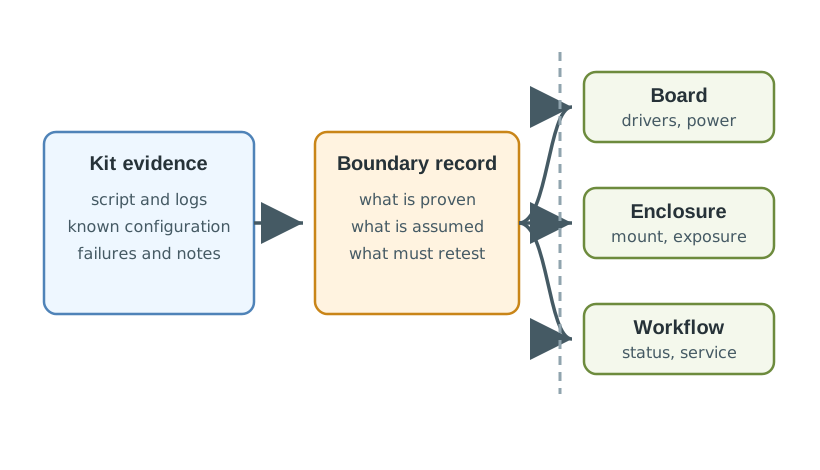
The cold-room script records raw readings, stale status, missed events, and restart recovery in one room setup.
- Those logs and the known-good configuration can move forward.
- Demo wiring, tutorial firmware, sample dashboard, and temporary gateway placement are replaced as the form changes.
- the Transition boundary from kit evidence to next prototype form diagram keeps a cold-room kit result within its tested conditions.
- The transition in the Transition boundary from kit evidence to next prototype form diagram keeps a kit result inside its tested conditions.
Major section
Kit Review Record
A review record makes the selection decision reproducible.
- A gateway-centered kit is selected for the interruption and restart trial.
- The modular sensor option leaves gateway behavior untested, while the connected controller leaves the service workflow unclear.
- Its next action is a fixture and enclosure review using the same gap-recovery script, with raw logs and an owner.
Major section
Common Failure Patterns
Shopping-list review: The team compares features and accessories but never states the evidence gap.
- Hard gates ignored: A familiar kit stays in the shortlist even though it cannot expose the required measurement, power, communication, or recovery behavior.
- Unmarked ecosystem dependency: The prototype quietly depends on a library, account, service, connector, or data path that the next form cannot use.
- No rejected options: The team records what it chose but not why reasonable alternatives were rejected.
Deck summary
Key takeaways
A good kit choice starts with the uncertainty the prototype must reduce.
- A kit is the right choice only if it exposes the next uncertainty better than the alternatives.
- If the question is a cold-room monitor, the evidence script might require DS18B20 or RTD readings, a door-event input, timestamped stale-data status, gateway restart recovery, and a staff-facing warning state.
- It becomes risk when tutorial firmware, breadboard wiring, USB power, default credentials, vendor dashboards, auto-generated cloud topics, or board-specific libraries become hidden architecture decisions.
- After hard gates, use a scorecard to compare the remaining options.
Retrieval practice
Recall check 1 of 4

Voltage Vera says: answer from memory, then check your reasoning.
Q1Per this chapter, why might a sensor that worked reliably on a kit's breakout board fail once the same sensor moves to a custom PCB?
Show answer
Answer: B see answers page
Retrieval practice
Recall check 2 of 4
Voltage Vera says: answer from memory, then check your reasoning.
Q2Using this chapter's own worked cold-room example (PT100 RTD, R0 = 100 ohms, alpha = 0.00385, Rref = 430 ohms, 15-bit ratiometric ADC), what resistance and approximate ADC code does the chapter compute at -20 degrees C?
Show answer
Answer: A see answers page
Retrieval practice
Recall check 3 of 4
Voltage Vera says: answer from memory, then check your reasoning.
Q3A candidate kit shows connectivity only through a curated demo screen, with no visible retries, gateway behavior, or stale-data status. Per this chapter's hard-gate list, which gate does that kit fail?
Show answer
Answer: A see answers page
Retrieval practice
Recall check 4 of 4
Voltage Vera says: answer from memory, then check your reasoning.
Q4A team is choosing a kit for a cold-room monitor. Which selection approach is strongest?
Show answer
Answer: B Use hard gates first, then compare remaining kits with the same evidence script.
Print reference
Answers 1 of 3
Answer key.
- B · a breakout board may rely on pull-ups, level shifting, or regulator margin that disappears on a custom PCB.
Print reference
Answers 2 of 3
Answer key.
- A · s worked example computes R(-20C) = 100 x (1 + 0.00385 x -20) = 92.3 ohms, then the ratiometric code = 92.3/430 x 32,768, about 7,034 counts on a 15-bit ADC.
Print reference
Answers 3 of 3
Answer key.
- A · The kit can expose link quality, retries, gateway behavior, stale data, and recovery rather than only a happy-path dashboard.
- B · Use hard gates first, then compare remaining kits with the same evidence script.