Prototyping · Study deck

Industrial and Wearable Kits

Picture a maintenance team testing two ideas.

Voltage Vera is your guide for this deck.

kitsindustrialwearable
iotclass.org

After studying this chapter

Learning objectives

You will be able to:

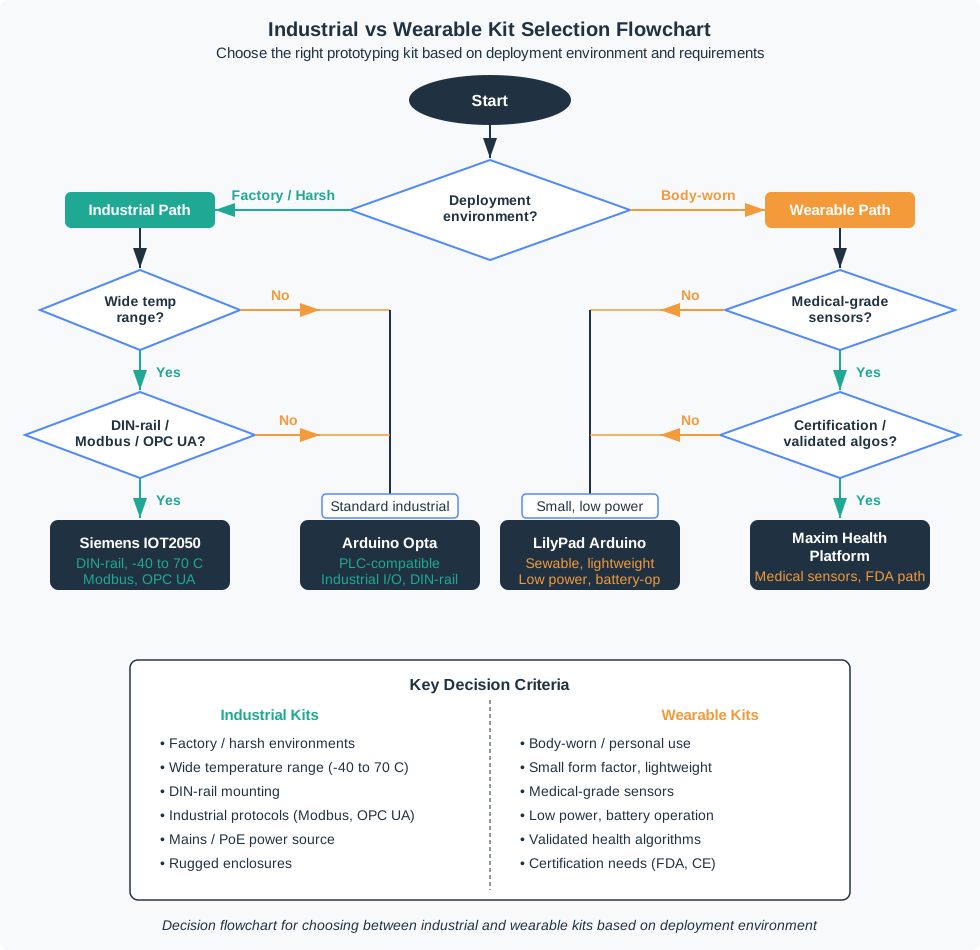
  • Explain why industrial and wearable kits should be selected by evidence need, not brand familiarity.
  • Compare harsh-environment evidence with body-worn evidence.
  • Build a review matrix for interfaces, environment, form factor, energy, data handling, and handoff risk.
  • Plan a combined site-and-worker prototype without hiding subsystem failures.
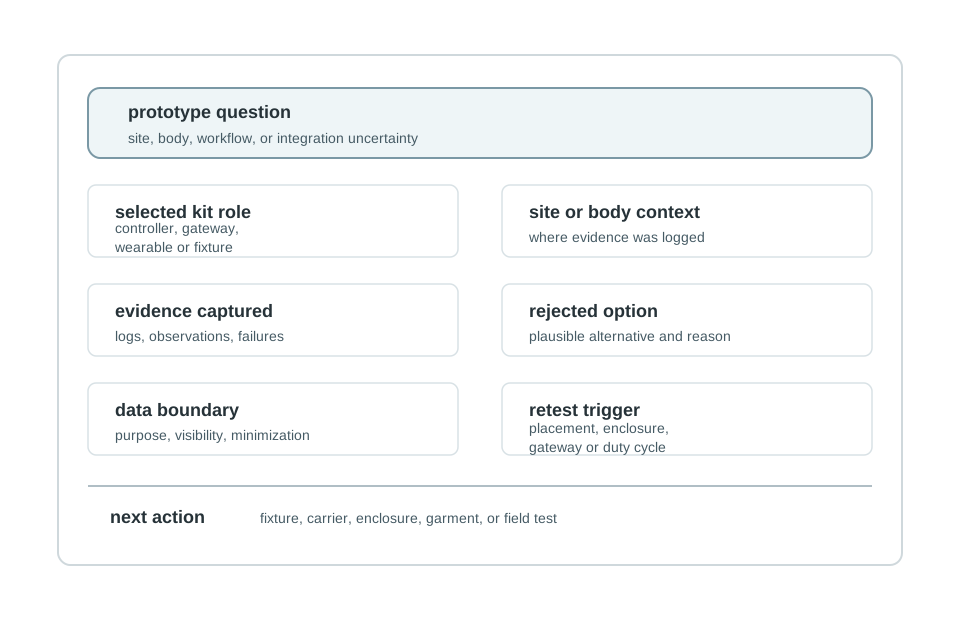
Review record template for industrial and wearable kits
iotclass.org

Major section

In 60 Seconds

A bright display is not proof of safe use.

  • The other sits on a worker's wrist and warns when heat strain rises.
  • For the press, record heat, dust, power, cable strain, access, and who may stop the machine.
  • This opening does not approve a kit for sale or site use.
iotclass.org

Major section

In 60 Seconds (continued)

Shake cables, interrupt power, block a reading, change the body fit, miss a charge, and hand the unit to a new user.

  • Practitioner turns the trial into a fit and risk record.
  • Under the Hood examines electrical limits, body effects, long use, and the stronger tests needed before release.
  • Wearable kits help prove placement, comfort, sensing reliability, energy use, privacy boundaries, and human workflow.
iotclass.org

Major section

Start With the Story · Industrial vs Wearable Kit Risks
Industrial and wearable prototypes meet people, machines, and environments that do not forgive vague evidence.

  • A wearable must respect body placement, comfort, privacy, battery life, and maintenance.
  • An industrial kit must survive noise, safety expectations, physical access limits, and support ownership.
  • This chapter uses kits as controlled trials.

Why it matters

For example, a pump-room monitor might start with an Arduino Opta, Siemens LOGO!, WAGO controller, or Moxa gateway because the risk is not simply reading a sensor.

Industrial and wearable kits are useful when they expose different evidence worlds: site behavior near equipment and body behavior on a person, before either result is carried into the next product form.
iotclass.org

Major section

Match Kit Families to Risk

A practical industrial kit test should include the field interface, not just the controller.

  • If the gateway publishes to MQTT or HTTPS, record topic or endpoint, payload timestamp, retained state or queue behavior, duplicate handling, offline duration, and recovery after power loss.
  • These details make the result reviewable when the board or gateway changes.
  • A practical wearable kit test should include the body fixture and phone or hub path.
iotclass.org

Major section

Physical and Operational Failures

Under the hood, industrial evidence depends on protection and diagnostics as much as sensing.

  • Ground loops, ESD, surge, EMI, cable flex, connector reversal, regulator dropout, brownout recovery, ingress, washdown, glove use, and technician access can defeat a site prototype.
  • Motion artifacts, loose contact, skin-tone effects, strap pressure, sweat, charging contacts, phone background limits, consent, and support handoff can defeat a wearable prototype.
  • The integration boundary also carries data risk.
iotclass.org

Major section

Physical and Operational Failures (continued)

Electrical boundary: separate logic ground, field wiring, surge protection, fuses, TVS placement, opto-isolation, 4-20 mA loops, 0-10 V inputs, RS-485 termination, and CAN termination from the convenient dev-board wiring.

  • The kit has done its job when it exposes which industrial, wearable, data, and service checks must repeat in the next product form.
  • A prototype that ignores TVS diodes, fusing, reverse-polarity protection, opto-isolation, terminal labeling, cable glands, watchdog behavior, and local status codes can pass a lab script and still be impossible to maintain.
  • A body node may collect more personal information than the gateway or supervisor workflow needs.
iotclass.org

Major section

Kit Roles

A kit that is excellent for a cabinet-mounted gateway may be a poor fit for a worn node.

  • A kit that is excellent for body-signal exploration may be a poor fit for dusty installation work.
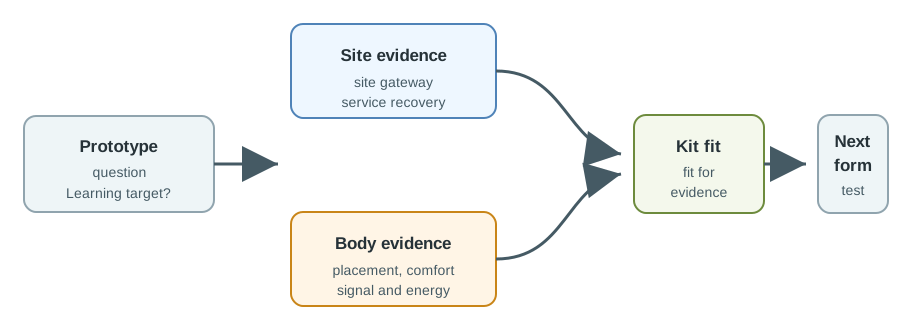
  • On the body-worn side, placement, motion, contact, sweat, and charging affect both signal quality and use.
  • the Industrial and body-worn prototype paths need separate site and wearer evidence before their message paths are combined diagram compares the disturbances that industrial and body-worn kits must expose.

Why it matters

On the industrial side, power, long cables, grounding, vibration, and service access can change a reading or prevent recovery.

Industrial and body-worn prototype paths need separate site and wearer evidence before their message paths are combined.
iotclass.org

Major section

Wearable Kit Evidence · Wearable Evidence Is Human Evidence

Wearable prototypes fail when the electronics work but the body-worn system does not.

  • The kit must help answer whether the sensing path, attachment method, energy rhythm, and data boundary make sense for a real person and a real workflow.
  • A wearable kit is not reviewed only on signal quality.
  • It also needs evidence about donning, removal, comfort, cleaning, consent, failure indication, and what happens when a person uses it incorrectly.
iotclass.org

Major section

Evidence Matrix · Worked Scenario: Worker Safety Prototype
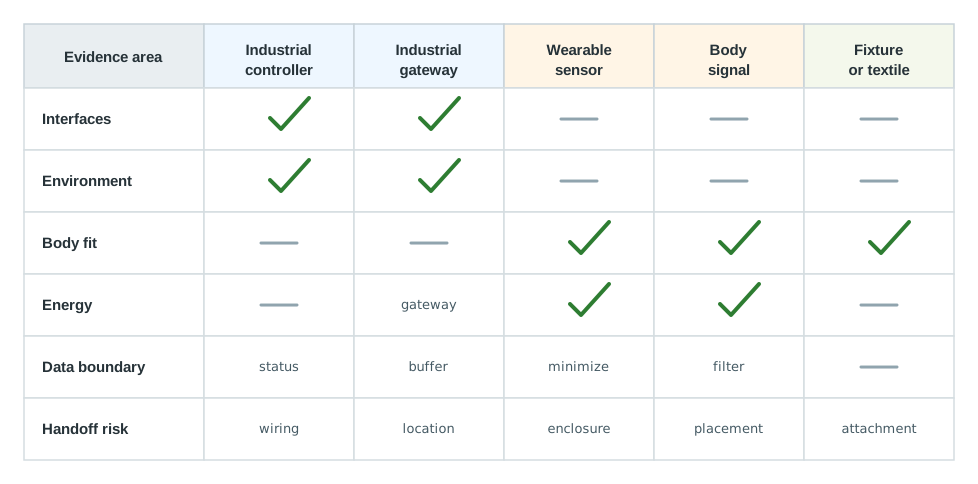
Industrial and wearable kits should be compared by the evidence they can produce.

  • The same project may need both categories, but each should own a different part of the review.
  • An industrial controller or gateway should expose supply, communication, cable, and recovery behavior under the planned installation.
  • the Evidence matrix for industrial and wearable kits diagram asks what site and body tests each kit can retain.
  • A wearable sensor or fixture should expose signal quality during movement, placement changes, comfort, and maintenance.

Why it matters

The team avoids a single all-in-one demo because it would hide both site and body risks.

Evidence matrix for industrial and wearable kits
iotclass.org

Major section

Integration Boundary · Kit Review Record
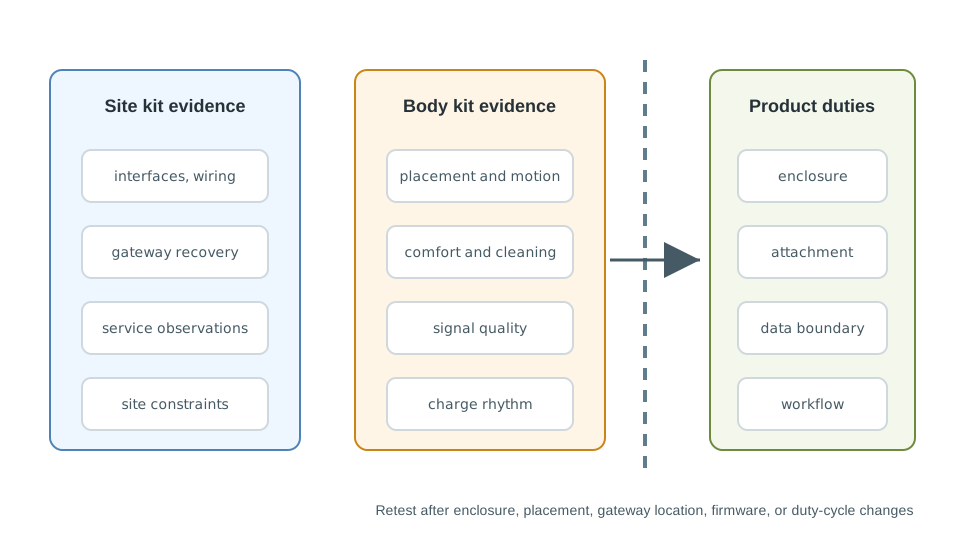
The Industrial bench can bound interface, placement, and recovery behavior; the: Wearable trial can expose attachment, power, and data-boundary evidence.

  • Enclosure, attachment, comfort, cleaning, privacy, gateway operation, and service ownership do not.
  • Retest whenever one of those product conditions changes.
  • Leave a record that another reviewer can challenge.

Why it matters

The record prevents a pass from an isolated kit setup being read as proof that a worker alert will survive the whole path.

Industrial-bench and wearable-trial evidence can cross into the next prototype, but product assurance must be re-established after integration.
iotclass.org

Major section

Common Failure Patterns

Bench-only industrial proof: The kit works on a desk but never sees the site wiring, cabinet, heat, vibration, local recovery, or service process.

  • Electronics-only wearable proof: The sensor reads data but the attachment is uncomfortable, unstable, hard to clean, or incompatible with normal motion.
  • No rejected option: The team records the chosen kit but not the alternative that was considered and rejected.
  • No change condition: The team changes placement, enclosure, duty cycle, gateway location, or data handling without repeating the evidence test.
iotclass.org

Deck summary

Key takeaways

A bright display is not proof of safe use.

  • Shake cables, interrupt power, block a reading, change the body fit, miss a charge, and hand the unit to a new user.
  • Industrial and wearable prototypes meet people, machines, and environments that do not forgive vague evidence.
  • A practical industrial kit test should include the field interface, not just the controller.
  • Under the hood, industrial evidence depends on protection and diagnostics as much as sensing.
iotclass.org

Retrieval practice

Recall check 1 of 4

Voltage Vera says: answer from memory, then check your reasoning.

Q1Per this chapter's worked example, a 4-20 mA loop runs over 1,000 m of 24 AWG wire (168.4 ohm round-trip cable resistance) with a 250 ohm burden resistor, at 20 mA full scale. Roughly what voltage drops across the cable plus burden, and what happens to the current reading compared to the 500 m run while transmitter compliance is maintained?

AAbout 8.37 V, but extra cable resistance lowers loop current even while the transmitter has compliance.
BAbout 8.37 V across cable and burden; current is unchanged while transmitter headroom remains.
CAbout 3.37 V, since the burden drop doubles when the cable is doubled.
DAbout 16.7 V, because doubling cable length also doubles the fixed burden drop.
Show answer

Answer: B see answers page

iotclass.org

Retrieval practice

Recall check 2 of 4

Voltage Vera says: answer from memory, then check your reasoning.

Q2Per this chapter's under-the-hood section, why might a wearable prototype's accelerometer-based motion detection behave differently in real use than it did during a bench test?

AAccelerometers require a wired connection, so a battery wearable cannot measure moving axes.
BAccelerometers stop below freezing because low temperature prevents the sensing element from responding.
CAccelerometers need an industrial gateway to report valid motion as axes rotate.
DBody motion rotates accelerometer axes; fixed bench orientation misses that reorientation.
Show answer

Answer: D see answers page

iotclass.org

Retrieval practice

Recall check 3 of 4

Voltage Vera says: answer from memory, then check your reasoning.

Q3Per this chapter's kit-role checklist, which role is 'best for holding sensors, probes, gateway modules, and antennas in repeatable positions while evidence is collected'?

AIndustrial gateway kit
BBody-signal kit
CTextile or fixture kit
DReview fixture
Show answer

Answer: D see answers page

iotclass.org

Retrieval practice

Recall check 4 of 4

Voltage Vera says: answer from memory, then check your reasoning.

Q4A project needs a body-worn status device and a site gateway for a harsh worksite. What is the strongest prototype strategy?

AReview wearable and gateway evidence separately, then test the message path.
BBuild one all-in-one demo first so a shared pass counts as separate wearable and gateway evidence.
CChoose the kit with most compute headroom and freeze the wearable-to-gateway message path.
DDelay wearable testing until enclosure and strap are final, then infer gateway fit from that test.
Show answer

Answer: A Industrial and wearable kit evidence should be staged.

iotclass.org

Print reference

Answers 1 of 3

Answer key.

  1. B · At 1,000 m, R_cable = 0.0842 x 1000 x 2 = 168.4 ohms, so the cable-plus-burden drop is 0.020 A x (168.4 + 250) ohms = 8.37 V. The total supply must also cover the selected transmitter's operating voltage. A plain voltage signal would be corrupted by 0.020 x 168.4 = 3.37 V across the same cable resistance.
iotclass.org

Print reference

Answers 2 of 3

Answer key.

  1. D · The chapter states: 'Wearable evidence has its own hidden limits: accelerometer axes rotate with the body, optical sensors need stable contact and light control, ECG electrodes need skin preparation and safe front-end design, and small batteries change behavior with charge age and temperature.' A bench test with a fixed sensor orientation does not exercise this axis-rotation effect.
iotclass.org

Print reference

Answers 3 of 3

Answer key.

  1. D · The chapter's kit-role checklist lists 'Review fixture' as: 'Best for holding sensors, probes, gateway modules, and antennas in repeatable positions while evidence is collected.' It is distinct from the 'Textile or fixture kit' role, which is specifically about garment routing, straps, and cleaning for wearables.
  2. A · Industrial and wearable kit evidence should be staged.
iotclass.org