Prototyping · Study deck
AI, Wireless, and Energy Kits
Imagine a team building a remote sound monitor.
Voltage Vera is your guide for this deck.
After studying this chapter
Learning objectives
You will be able to:
- Match AI, wireless, and energy kits to the uncertainty they are best suited to reduce.
- Separate kit evidence from final product decisions.
- Build a review matrix for model behavior, link behavior, energy states, physical fit, and handoff risk.
- Plan staged experiments that combine specialized kits without creating a fragile one-off prototype.
Major section
In 60 Seconds · Start With the Story
For the radio board, name the site, range, message size, and loss limit.
- One board can label a sound.
- A second can send a message.
- A third can collect a little energy from light.
- Joining three good demos does not yet make one dependable product.
Major section
Specialized Kits Shrink Unknowns · Name Kit Class and Measurement
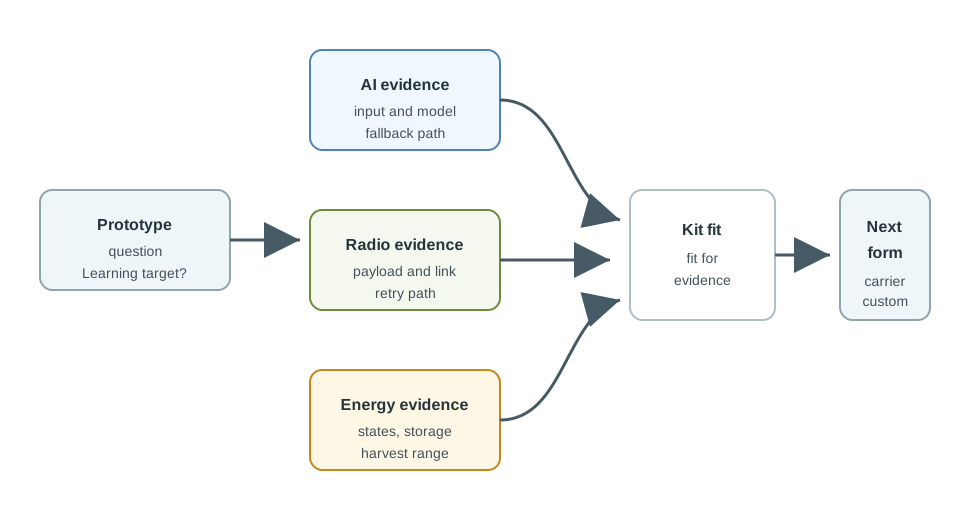
The AI lane checks whether the model can run within its resource limits.
- The radio lane tests data delivery, placement, noise, and recovery.
- The energy lane measures active, idle, sleep, and charge cycles.
- Kit fit then states what the board proved and what it could not show.
Major section
Integration Fails Between Kits
Separate kit experiments can all pass and still fail together.
- Local inference may heat the enclosure before a radio burst.
- A camera angle may require an antenna location that detunes the link.
- A harvest schedule may support sensing but not model update or reconnect behavior.
- Under the hood, the hard part is often shared resources.
Major section
Integration Fails Between Kits (continued)
A Jetson or Coral prototype may prove inference, but the final microcontroller cannot inherit its memory bandwidth or Linux driver stack.
- Timing coupling: align image capture, DSP, inference, transmit, receive window, flash write, and sleep entry so burst overlap is visible.
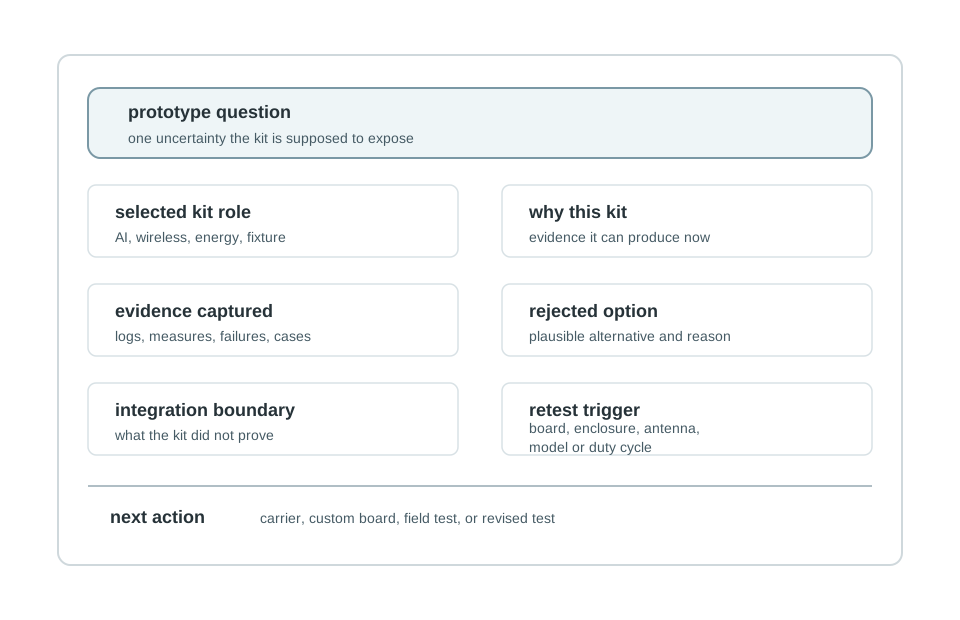
- The integration boundary should say what each kit proved, what it did not prove, and which check must repeat when the product form changes.
- Good integration records therefore include interfaces and invariants, not just screenshots.
Major section
Integration Fails Between Kits (continued)
A camera sensor, neural accelerator, radio module, flash chip, charger, fuel gauge, and microcontroller may compete for I2C or SPI buses, DMA buffers, interrupt lines, regulator headroom, thermal budget, and wake timing.
- A LoRa kit may prove range, but the final enclosure and antenna feed can change link margin.
- An energy board may prove harvesting, but not when inference and transmit bursts overlap.
- When the carrier board, custom PCB, enclosure, or gateway changes, the record tells the team which measurements must be repeated.
Major section
Start With the Evidence Question · Do Not Shop for a Universal Kit
Specialized kits are most useful when the team needs to learn quickly without first designing every board, enclosure, service, and test fixture.
- The mistake is treating the kit as a ready-made product direction.
- A kit should answer a focused question, then hand that answer to the next prototype stage.
- The best kit for one subsystem can be the wrong choice for the whole prototype.
Major section
What Each Kit Category Is Good For
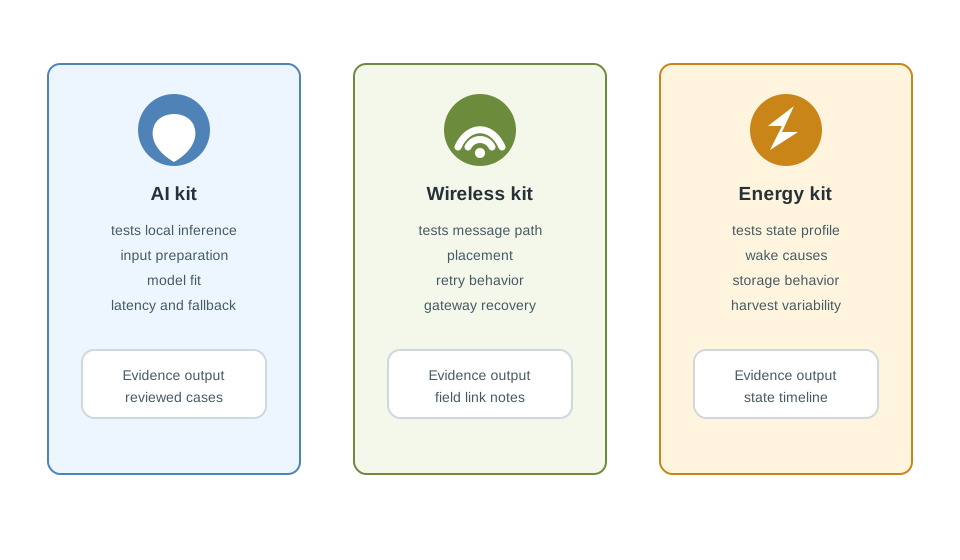
An AI kit checks input preparation, model fit, inference time, confidence, and fallback with reviewed cases.
- An energy kit follows wake causes and duty cycle through a state timeline that includes boot, capture, transmit, receive, and sleep.
- The evidence from one kit does not approve the other subsystem.
- AI, wireless, and energy kits look similar because they arrive as boards, adapters, examples, and documents. the Roles of AI, wireless, and energy prototyping kits diagram separates their useful evidence.
Major section
What Each Kit Category Is Good For (continued)
The AI kit can answer whether local inference is feasible.
- After integration, repeat the relevant tests with the intended enclosure, antenna, heat path, and power supply; those changes can alter the result that a kit showed on the bench.
- Energy measurement kit: Best for separating active, idle, sleep, wake, storage, charging, and load states before the power path is embedded in a custom form.
- Integration should happen after each subsystem has produced reviewable evidence.
Major section
What Each Kit Category Is Good For (continued)
Energy-harvesting kit: Best for proving whether light, motion, heat, or user action can support a realistic duty cycle in the actual installation context.
- Gateway kit: Best for testing local buffering, protocol translation, offline behavior, diagnostics, and recovery before the gateway role is hardened.
- A remote monitor might need local image classification, long-distance event reporting, and a strict energy budget.
- The wireless kit can answer whether the message path survives placement and interference.
Major section
Wireless Link and Topology
A short, structured placement test is more valuable than a broad range claim because it ties the result to the environment the product must survive.
- A wireless kit is useful when the prototype must prove communication behavior in a real environment.
- Bench success is not enough.
- The review should include placement, antenna orientation, gateway location, message size, retries, and recovery after interruption.
Major section
Duty Cycle and Harvesting · Energy Evidence Needs a Timeline
The goal is not just to show that a source can generate energy.
- The goal is to show that the system's rhythm can live within the available energy envelope.
- Average consumption can hide failure.
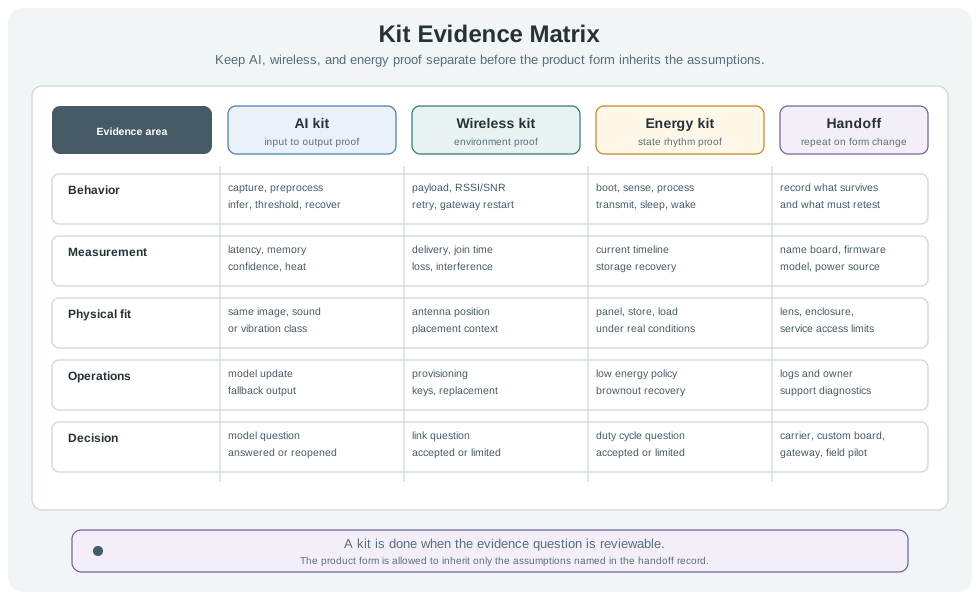
- Energy kits are useful when the prototype must prove that the device can operate through real active, idle, sleep, wake, and recovery states. the Evidence matrix for AI, wireless, and energy kits diagram separates that evidence from the AI and wireless checks.
Major section
Integration Boundary
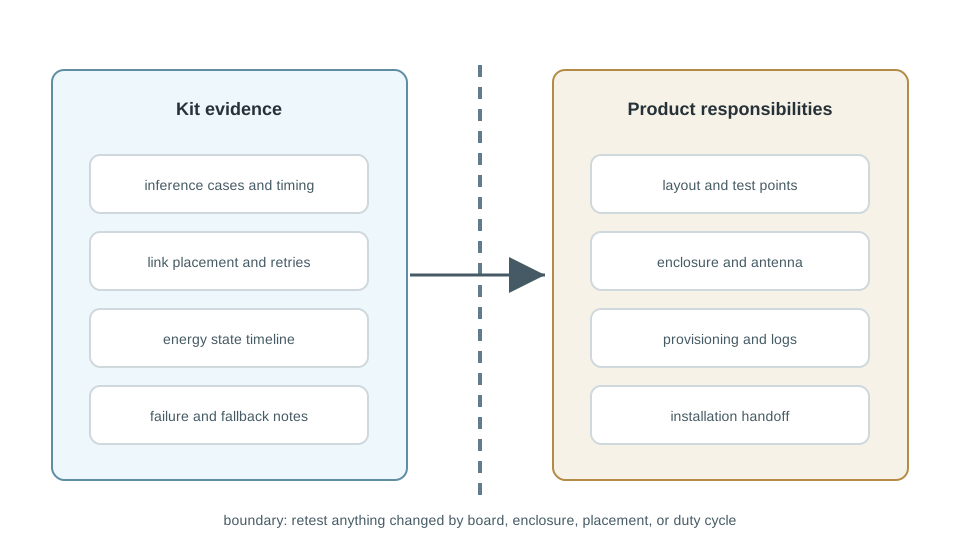
An AI kit can record representative inputs, false positives, false negatives, and inference time.
- A wireless kit can record placement, retries, and link quality, while an energy kit exposes supply and recovery behavior.
- Those results come from separate setups.
- Once sensing, inference, communication, and power share a product path, timing, layout, and test points can change the outcome.
Major section
Remote Equipment Monitor · Kit Review Record
A team is prototyping a remote equipment monitor.
- The device should detect a visual event, send a compact alert through a low-power link, and operate from a limited energy source.
- The AI kit is mounted where the future sensor might sit.
- The result is a review record for the model, preprocessing, and alert threshold.
Deck summary
Key takeaways
For the radio board, name the site, range, message size, and loss limit.
- The AI lane checks whether the model can run within its resource limits.
- Separate kit experiments can all pass and still fail together.
- A Jetson or Coral prototype may prove inference, but the final microcontroller cannot inherit its memory bandwidth or Linux driver stack.
- A camera sensor, neural accelerator, radio module, flash chip, charger, fuel gauge, and microcontroller may compete for I2C or SPI buses, DMA buffers, interrupt lines, regulator headroom, thermal budget, and wake timing.
Retrieval practice
Recall check 1 of 3

Voltage Vera says: answer from memory, then check your reasoning.
Q1Per this chapter's under-the-hood discussion of integration risk, why can't a Jetson- or Coral-based AI kit's inference performance be assumed to carry over directly to the final product's microcontroller?
Show answer
Answer: C see answers page
Retrieval practice
Recall check 2 of 3
Voltage Vera says: answer from memory, then check your reasoning.
Q2A team wants to keep antennas, a camera lens, and a storage element stable and easy to reposition while iterating on a specialized-kit experiment, without committing to final wiring. Per this chapter's kit-category list, which role fits that need?
Show answer
Answer: B see answers page
Retrieval practice
Recall check 3 of 3
Voltage Vera says: answer from memory, then check your reasoning.
Q3A team needs to know whether local image classification, a low-power alert link, and an intermittent energy source can work together. What is the strongest prototyping strategy?
Show answer
Answer: A Specialized kits should reduce one uncertainty at a time.
Print reference
Answers 1 of 2
Answer key.
- C · A Jetson or Coral prototype may prove inference, but the final microcontroller cannot inherit its memory bandwidth or Linux driver stack.
Print reference
Answers 2 of 2
Answer key.
- B · The chapter's kit-category checklist lists 'Fixture or carrier' as: 'Best for stabilizing connections, probes, antennas, cameras, and storage elements while still keeping the experiment easy to revise' -- distinct from the AI, wireless, energy, and gateway kit roles, which each answer a measurement question rather than a mechanical-stability need.
- A · Specialized kits should reduce one uncertainty at a time.