Prototyping · Study deck
Choosing a Hardware Platform
Picture a bench prototype whose loose wiring resets whenever its radio sends.
Voltage Vera is your guide for this deck.
After studying this chapter
Learning objectives
You will be able to:
- Explain the difference between a platform role and a specific board.
- Match platform forms to prototype evidence needs.
- Compare starter boards, connected controller boards, module carriers, gateway boards, and custom boards by the questions they answer.
- Decide when to move from a flexible platform to a more constrained hardware form.
Major section
In 60 Seconds
Buying a more powerful board may hide the fault without proving power, wiring, or deployment behavior.
- Firmware means the software stored on the device.
- A gateway means the boundary system that connects local devices to another network or service.
- This runway does not prove that the prototype is ready to manufacture.
Major section
Platform Is a Role · A Raspberry Pi GPIO and Camera Proof Slice
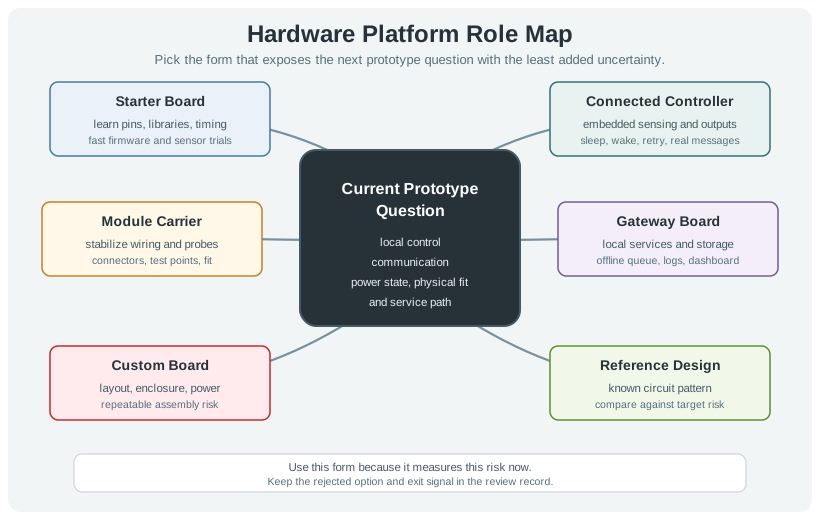
The same board can be a learning tool, a throwaway demo platform, a production-intent module host, or the wrong abstraction depending on the stage.
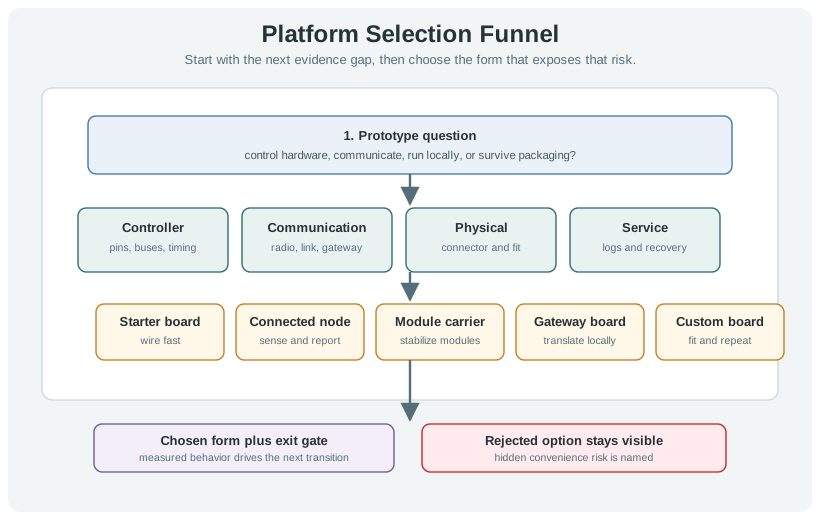
- For IoT work, the platform decision usually turns on five questions: local control, communication, power state, physical fit, and service path.
- A board that is excellent for firmware iteration may still hide enclosure, sleep-current, connector, antenna, or update risks.
- the The useful platform is the form that exposes the current prototype question: learning pins and firmware on a starter board, proving embedded node behavior on a connected controller, stabilizing modules on a carrier, testing gateway services, preparing a custom-board transition, or checking a reference design against the target risk diagram assigns platform forms to the question the prototype must answer.
- A Pico W may be a fast way to learn MicroPython GPIO and Wi-Fi behavior.
Major section
Practitioner: Shortlist by Risk Removed
Board names hide the silicon family underneath them, and the family is often the more durable piece of shortlist evidence.
- A useful shortlist names what each platform form can prove.
- Arduino Uno, Arduino Nano 33 IoT, Raspberry Pi Pico W, ESP32 DevKit, STM32 Nucleo, Nordic nRF52 DK, and Adafruit Feather boards make different tradeoffs in pin access, radios, power, toolchains, shields, and ecosystem support.
- Gateway-class boards make a similar substitution at a coarser grain.
Major section
Practitioner: Shortlist by Risk Removed (continued)
Raspberry Pi, Compute Module, BeagleBone, Jetson Nano, and small x86 gateways make different tradeoffs in Linux services, storage, camera/display support, and power draw.
- For a gateway, compare a Raspberry Pi-class single-board computer, an industrial gateway, and the lowest-power Linux-capable option that can still run the needed services.
- For each option, record the measurement that would disqualify it: active current, deep-sleep current, wake time, radio attach time, sensor noise, storage corruption after power loss, enclosure interference, or inability to recover firmware.
- The winning platform is the one that removes the current uncertainty without making the next transition unreasonably expensive.
Major section
Convenience Hides Product Risk
Development convenience is real value, but it should be separated from deployment risk.
- Communication risk: lab Wi-Fi can hide LoRaWAN, LTE-M, NB-IoT, BLE, Ethernet, RS-485, Thread, or Matter commissioning behavior.
- Mechanical risk: jumper wires and shields can hide connector keying, cable strain, antenna placement, exposed sensors, gasket pressure, and service access.
- Operations risk: dev images can hide secure boot, signed OTA updates, credential storage, remote logs, recovery mode, and fleet provisioning.
Major section
Convenience Hides Product Risk (continued)
Many board-level differences are hidden in support circuits rather than the main processor.
- Those parts can change idle current, reset timing, ADC noise, radio behavior, and first-power symptoms.
- The platform review should name which support circuits are part of the evidence and which are merely conveniences.
- The platform has done its job when it exposes the next risk clearly enough to choose the next form.
Major section
Platform Forms and What They Prove
The first question may concern controller pins and timing, a radio link, a local service, physical fit, or later recovery.
- The chosen platform should make the uncertain behavior observable and testable.
- Starter board: Best for learning pin behavior, sensor libraries, simple firmware loops, and fast wiring changes.
- Comparing platforms by a single feature is usually misleading.
Major section
Platform Forms and What They Prove (continued)
If a starter board masks sleep current or loose wires mask connector strain, move to a form that can measure that risk before making a final design claim.
- Connected controller board: Best for embedded nodes that need local sensing, low-energy states, and direct communication testing.
- Custom board: Best for layout, power distribution, connector placement, enclosure fit, repeatability, and assembly handoff.
- A board with more processing headroom may be weaker for battery sleep.
Major section
Platform Fit Matrix · Shortlist Rule
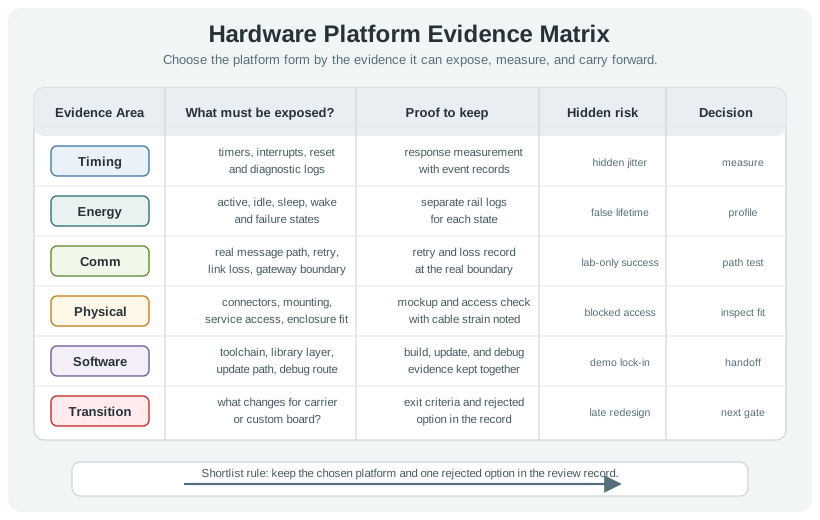
A platform shortlist should be reviewed against constraints that can be measured or inspected.
- Timing needs event records for timers, interrupts, and reset; energy needs separate rail logs for active, idle, sleep, wake, and fault states.
- Physical fit adds connector access, cable strain, and enclosure checks, while software fit keeps build, update, and debug records together.
- the Hardware platform evidence matrix linking platform constraints to proof and hidden risk diagram compares platform choices by the proof they can retain.
- The communication row asks for retry and loss evidence at the real gateway boundary, since a lab-only path can hide failure.
Major section
Transition Timing · Keep the Old Platform Alive
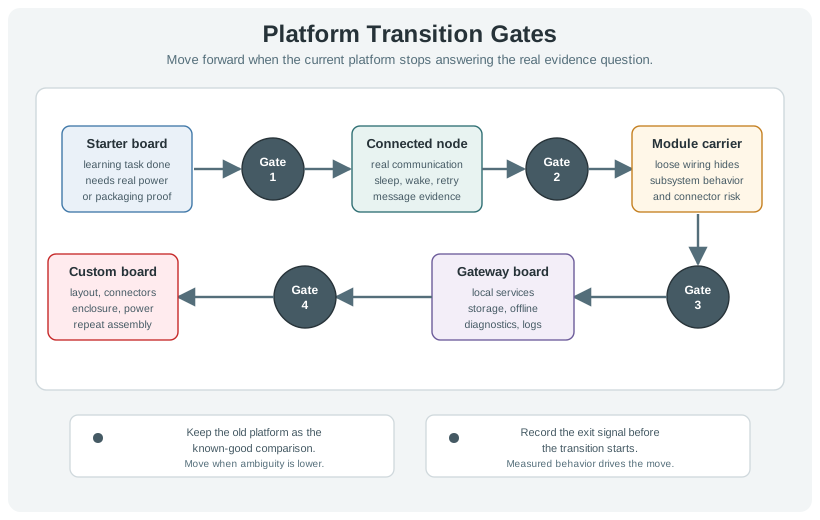
The starter board is useful until the learning task is done and power or packaging becomes the issue.
- A connected node can expose real communication, sleep, wake, retry, and message evidence.
- Each gate asks what evidence is still missing, not how polished the current demonstration looks.
- Early platforms are flexible because they are easy to change.
- the Hardware platform transition gates from starter board to custom board diagram shows when a platform stops answering the next design question.
Major section
Worked Scenario: Cold Storage Monitor · Platform Handoff Record
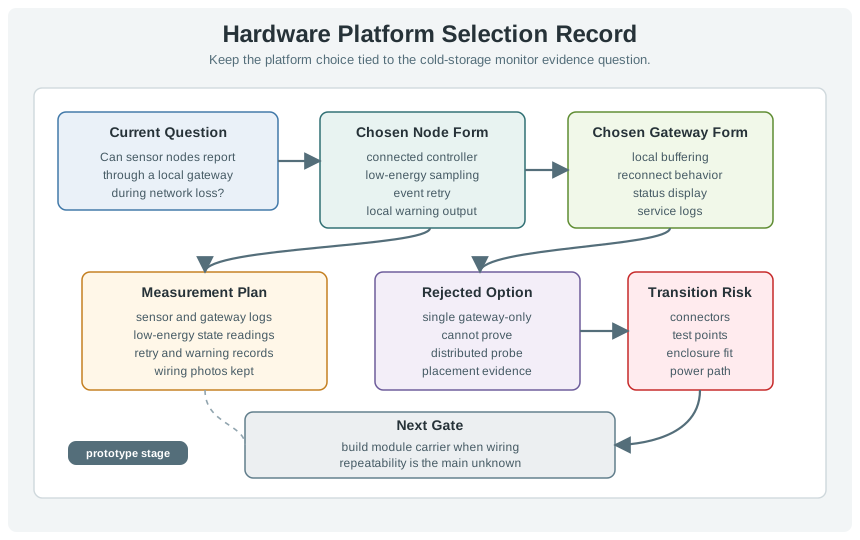
A team is building a cold storage monitor for small facilities.
- The device must read several sensors, report events to a nearby gateway, keep working during short network outages, and fit inside a small enclosure with external probes.
- Connected controller: The team tests low-energy sampling, event messages, retry behavior, and local warning output.
- When a platform is selected, leave a record that future reviewers can challenge.
- the Hardware platform selection record for a cold-storage monitor diagram keeps the cold-storage platform choice tied to network-loss evidence.
Major section
Hardware Accelerators: Select by Workload Evidence · Accelerator Decision Record
Currency treatment: technology classes and evidence questions are retained; no source-era device is presented as a current recommendation. -->.
- A microcontroller or application processor does not have to execute every workload alone.
- The useful comparison is workload, programmability, energy per completed task, latency/jitter, non-recurring engineering (NRE), unit volume, toolchain risk, and the evidence available when the design must be maintained.
- Peak operations per second alone is not selection evidence.
Deck summary
Key takeaways
Buying a more powerful board may hide the fault without proving power, wiring, or deployment behavior.
- The same board can be a learning tool, a throwaway demo platform, a production-intent module host, or the wrong abstraction depending on the stage.
- Board names hide the silicon family underneath them, and the family is often the more durable piece of shortlist evidence.
- Raspberry Pi, Compute Module, BeagleBone, Jetson Nano, and small x86 gateways make different tradeoffs in Linux services, storage, camera/display support, and power draw.
- Development convenience is real value, but it should be separated from deployment risk.
Retrieval practice
Recall check 1 of 4

Voltage Vera says: answer from memory, then check your reasoning.
Q1Per this chapter's worked antenna example, going from a 2 dBi onboard chip antenna to a 9 dBi external panel antenna (same 0 dBm transmit power) roughly changes range and coverage how?
Show answer
Answer: D see answers page
Retrieval practice
Recall check 2 of 4

Voltage Vera says: answer from memory, then check your reasoning.
Q2Per this chapter's 'Convenience Hides Product Risk' section, what is the point about support circuits like a USB-to-UART bridge, linear regulator, or auto-reset circuit on a development board?
Show answer
Answer: A see answers page
Retrieval practice
Recall check 3 of 4

Voltage Vera says: answer from memory, then check your reasoning.
Q3In this chapter's cold-storage monitor scenario, why was a single gateway-only design rejected in favor of a connected-controller node plus gateway board?
Show answer
Answer: C see answers page
Retrieval practice
Recall check 4 of 4

Voltage Vera says: answer from memory, then check your reasoning.
Q4A prototype has proven basic sensor readings on a starter board. The next risk is loose wiring, connector orientation, and whether another builder can assemble the same setup. Which platform form is the best next step?
Show answer
Answer: B A module carrier removes loose-wiring ambiguity while still allowing modules and subsystems to be changed.
Print reference
Answers 1 of 3
Answer key.
- D · The chapter's worked example computes EIRP = Pt + G in dB for both antennas (2.00 dBm onboard vs 9.00 dBm panel), then shows range scaling as the square root of the linear EIRP ratio (2.24x) while covered solid angle shrinks from 63.1% to 12.6% of the sphere -- which is why a panel-antenna gateway needs a placement and aiming record that a chip-antenna starter board does not.
Print reference
Answers 2 of 3
Answer key.
- A · The chapter's under-the-hood point is that board-level differences often live in support circuits (USB-UART bridge, regulator, charger, level shifter, auto-reset, boot-mode strapping) rather than the main processor, and those parts can change idle current, reset timing, ADC noise, and radio behavior without changing the source code under review.
Print reference
Answers 3 of 3
Answer key.
- C · The chapter's platform review record for the cold-storage scenario names the specific rejection reason: 'rejected_option=single gateway-only design because it cannot prove distributed probe placement' -- distinguishing this from what a gateway board is otherwise good at (buffering, reconnect, status display, service logs).
- B · A module carrier removes loose-wiring ambiguity while still allowing modules and subsystems to be changed.